Tag Archives: ancestors

RHL, ‘On Disrespecting Ancestors’

I disrespect my ancestors fighting in wars,
Europeans fighting Europeans, blame without cause;
my English grandfather killed fighting the Germans,
my Danish uncle executed for killing with Germans,
my earlier German ancestors fighting the French,
my French ancestors fighting (and marrying) the English…
and the cause of the wars always indefensibly wrong.
Why should anyone glorify them in song?
Pride, greed and stupidity – these are the drivers of war.
I turn my back on all of them, stand on the sea shore,
marvel at wind and wave, at sun, moon and stars,
despising, ignoring, forgetting their idiot wars.

*****

I’m so sick of Putin, Netanyahu… and Bush Jr, Dick Cheney, Tony Blair… war criminals, the lot of them. But they’re the products of our genetic makeup as social animals, dividing everything into “us” and “them”, and then through crafty hysteria and massively organised mob violence, grabbing everything they can for themselves.

Anyway, this semi-incoherent rant of a poem was published in the current Amsterdam Quarterly, and editor Bryan R. Monte wanted one change in my submission: to change the last line’s “ape-idiot wars” to “their idiot wars”. As usual, I acquiesced. Also as usual, I’m not sure whether it is a good suggestion or not. Apes figure in a lot of my verse, as being an underlying reality of humans, essential to acknowledge, equally essential to try to control. In the context of my other work, I think I prefer “ape-idiot”.

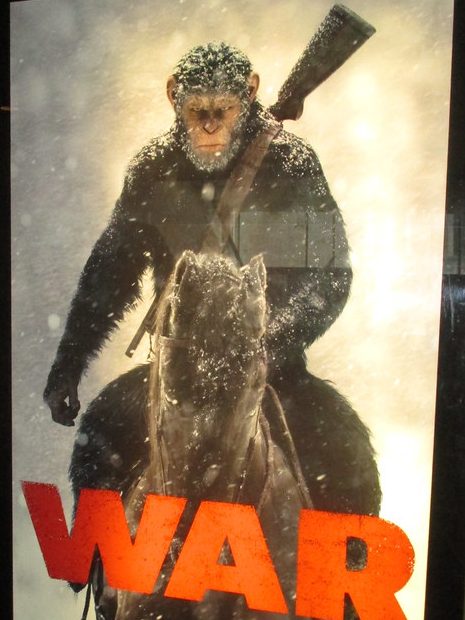
Photo: “War of the Planet of the Apes Poster 2671” by Brechtbug is licensed under CC BY-NC-ND 2.0.
Sonnet: ‘Ultimate Control’ (from the series ‘Voices from the Future’)

If you’ve the aptitude and love the role,
the Army’s always been the place to be.
Rise in the ranks, absorbing strategy:
coordinate, consolidate, control.
And what a blessing when those new implants
gave mind-to-mind awareness… and command.
Like the unthinking fingers on your hand
you can maneuver thousands with a glance.
The battle then’s to see what you can wrest
from other leaders, fighting mind-to-mind;
you have to grow, or you get left behind:
can you control ten million, like the best?
Of would-be kings there’s never been a dearth…
will it be only one who rules all Earth?

*****

This sonnet has just been published in Pulsebeat Poetry Journal’s 3rd issue (thanks, David Stephenson!) It is one of a series written in response to a comment from Maryann Corbett (a brilliant formalist poet) about the bleakness of my vision of the future. Well, she’s a Christian, so she has a totally different take on humanity’s future from my irreligious SF-infused speculations. Another sonnet in the series, ‘Exiled Leader‘, was published by Star*Line.

I don’t find it bleak to think that there will be unprecedented individual and planetary disruptions. I’m not distressed at the thought of humans being supplanted some posthuman higher intelligence. Should the earliest rat-like mammals of 145 million years ago be upset to learn that their human descendants build cities and kill any rats they find in them? Should they identify only with the familiar rats and wish that evolution had stopped there, or instead be proud that they have also developed into humans (and dogs, and whales, etc)?

For myself, life is a wild ride, and I long to see where it will take humans in a hundred or in a thousand years. Because of the current revolutions in genomics, robotics, AI and nanotechnology, I doubt we can reasonably forecast even a hundred years into the future. We can speculate all we like but once we merge a human with AI, create a cyborg, all bets are off.

20120401 – Hand – IMG_2898” by Nicola since 1972 is licensed under CC BY-NC-ND 2.0.

Potcake Poet’s Choice: Susan McLean, ‘A Woman of a Certain Age’

I read more slowly now, because I read
between the lines.  The heroes of my youth,
who gave their lives for justice, art, or truth
(consumed with purpose, driven to succeed),
now seem like puppets pulled by strings of need,
while those who died unknown (except by those
they fed, taught, nursed through illness, mended clothes
and cared for) doled out grace unmixed with greed.

A quilt, a tablecloth she hand-crocheted,
some tips for making piecrust, kneading dough,
the memory of a gumdrop tree she made—
small things of use, of beauty, of delight
are what they leave when they have left our sight.
Don’t tell me what such gifts are worth.   I know.

Susan McLean writes: “This poem was inspired by reading that people read more slowly as they get older, because everything they read reminds them of something else. As I thought about that, I also thought about the people I would have called the ones I admired the most, and about the people I actually loved most and why I loved them. The former were mainly men, which made me realize that the lives of women (until recently) have often been invisible in the world and have left no written record. What they leave instead is the impact they have had on those around them, and little things they have said and done and made. My maternal grandmother and my mother are both unseen presences in this poem. My life has been very different from theirs, with opportunities they never had. But that does not mean that I value less what they did.”

Susan McLean grew up in Oxon Hill, Maryland, attended Harvard University and Rutgers University, and taught English for thirty years at Southwest Minnesota State University. She has published two books of poetry, The Best Disguise and The Whetstone Misses the Knife, and one book of translations of the Latin poet Martial, Selected Epigrams. She lives in Iowa City, Iowa.

https://www.pw.org/directory/writers/susan_mclean