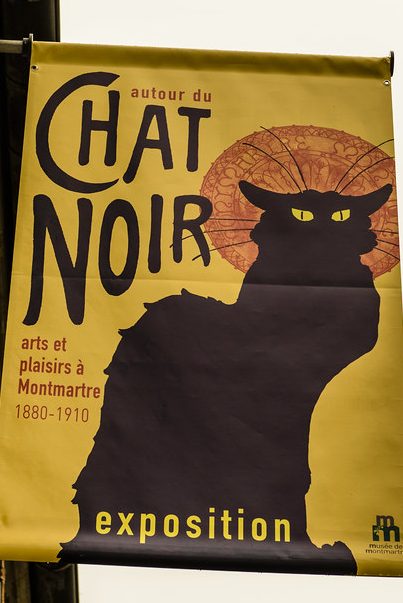
For it was Auriol who concocted the Chat Noir-Guide toward the end of the nineteenth century. The Guide provides, for every objet d’art and knick-knack purportedly on display in the bar, fantastical tales of provenance.
– From Cabaret to Concert Hall, Steven Moore Whiting
Come in, come in! Here, have a glass of beer—
The best in Paris! Whence derives such praise?
The Comte du Saint-Clement, when he drinks here,
And several other lumières Françaises
All say so. (Rimbaud swore “the best in France!”)
Perhaps you have been eyeing some of our
Objets and esoterica? Perchance
You’d like to hear their provenance? Le Soir
Has called the Chat’s decor the greatest work
Of art collection since the Louvre. These darts
Were thrown by Pippi Pavlo of Le Cirque.
This mirror-frame once held a Queen of Hearts
Played by the Duke of Sandwich in the game
At which he famously invented soup.
That specimen was lost before it came
To us—pinched by a croupier with the croup.
The mirror, too, is memorable—this crack
Imparted by a blow from cannon fire.
The cannoneer collapsed. Upon his back
They found the selfsame mark. Since then, each buyer
Has met a grisly fate—until bought by
A suicidal poet named Pierre.
It didn’t work. He gave it to Le Chat
In payment for a shot. We hung it there.
The timepiece on the mantle was a gift
From Pope Immaculate to me. Of course,
At that time, I had left the church. A rift
Arose when I ordained a bishop’s horse.
Ignore the wireless just beside—the news
Is so depressing, no? So . . . uninspired.
The mud, the blood, the bombs, the flu, the coups,
Enough to make Scheherazade tired.
But here! This silhouette is me—back then
I had a beard. I lost it in a duel
With three mad Turkish painters in Ardennes.
The third defaulted. Still I shot. It’s cruel
To leave a loser living. I was called
“The Caesar of Sargasso”—naturally
There wasn’t a resemblance. He was bald
While, under wraps as “Cleopatra Lee”
I worked with Pasteur researching a cure
To hair loss. Though the lab sank in a storm,
I drank the last drop as I swam to shore,
And thus my coiffure’s never lost its form.
This bronze, by Claus of Innsbruck, is a hoot—
So said the critic who is sealed inside
Its twin, the Triton by the stairs. Poor brute!
He knocked for half a week before he died.
It’s best not to insult these artist types.
I have the Gift myself, but can’t unearth it.
To catch the Muse is much like hunting snipes:
They bite, and taste too gamey to be worth it.
Each crystal on that chandelier’s a shard
From Louie Something’s windows at Versailles.
They say there came a witch, old, hunched, and scarred,
One night at midnight. With her one bright eye
She sneered once through the pane, and then departed.
Within a week, the king went mad and smashed
The lot of them, while mumbling “It has started!”
It’s cursed, of course. Too pretty to be trashed.
The candles are of beeswax. And what bees!
They live like princes. Endless fields of flowers
Are tended by the gardeners at Nice
And watered by a set of special showers
Constructed for the grounds by Lord Brunel.
We light them only rarely. For a guest
Such as yourself, I’ll gladly burn one. Well,
Just half. Come back someday, we’ll burn the rest.
These coasters? Quite mundane. They’re bits of planks
I salvaged from the Hesperus. Oh yes,
I once was quite the soldier. Only blanks
I ever loaded in my gun. The rest
Must have a chance, you know. It isn’t fair
To pit them up against whom Nelson dubbed
“The finest shot in Europe.” On a dare,
I handed him my pistol once. He clubbed
Me with his wooden leg. What’s that? His arm?
Oh no, that’s merely what the papers said.
In fact, it was his leg. It does no harm
To stretch the truth a little. Nelson plead
For them (the press) to print it right, but they
Insisted that an arm read better. He,
Of course, cried “What a silly thing to say!
An arm can’t read! Perhaps an eye?” You see,
They listened—Nelson loved Le Chat. You’ll find,
If you direct attention here, I’ll show
You where he signed the bar. Just why he signed
As “Ferdinando Smitty,” I don’t know.
That stool you’re sitting on I carved myself
With a pocketknife from one great slab of teak
When, hounded through a forest by some elf
I climbed a tree and hid there for a week.
That tree was this: The chair. The table, too,
Unless that one’s the Pharaoh’s table—no,
But come along, I’ll show that one to you,
Just past these poker-playing dogs (Van Gogh).
Don’t touch, the paint is fresh! I knew the model,
Lovely gal. Alsatian, I recall.
Her only vice, a weakness for the bottle;
Poor dear! Not drink—the bottle, that was all.
Our barman is a secret Count, a bastard
Practicing the rapier to reclaim
His stolen birthright. So far, he has mastered
Fourteen styles of swordplay. Soon his name
Will grace kings’ lips. For now, he’s just our skinker.
The chambermaid, as well, has quite a story.
A moron, yes? Wrong! Why, that genius thinker
Solved the famous Kjotz Conjecture. Glory
Is nought to her. She labors for mankind,
And for her god (the Devil). The Sorbonne
Has offered her a chair. But she declined.
(They say her mother was Napoleon’s son.)
That busboy? Oh, don’t heed him. He is lame
Not from trench foot, as some (and he) insist,
But—let me see—oh, yes!—a goon whose name
Was “Olaf” chopped his toes off at the wrist,
And now he’s quite—But pray, don’t touch that curtain!
The outside light must never be allowed
To touch these treasures. They’ll tarnish, I am certain.
(Besides, those drapes were Victor Hugo’s shroud.)
Our rum’s supplied by pirates. These fine cups
Looted from the Louvre. These splendid spoons
Are those with which the Mongol chieftain sups.
The silver forks are forged from gold doubloons.
Our beer, which I can see you quite enjoy,
Is brewed by tight-lipped monks who take a vow
Never to speak a lie—I, as a boy
Was in the order. (I have left it now.)
*****
Daniel Galef writes: “A few years ago when I was learning the Gymnopedies and Gnossiennes on piano I also tried reading up on Erik Satie, whose circle was full of interesting eccentrics, especially those frequenting Rodolphe Salis’s famous fin-de-siecle cabaret in Montmartre the Chat Noir: George Auriol, Vital Hocquet, Alphonse Allais, &c. As a fiction writer, I am fascinated by lies and liars and what drives them, and was particularly taken by the fact, mentioned in passing, that Auriol had written and published a fake guidebook for the Chat Noir. I’ve since read more about Auriol, and even tracked down and read (with the help of Google Translate) a scan of the Guide itself (and highly recommend it, if it’s still to be found online), but when it was the only thing I knew about him that line alone in Whiting’s book was enough to serve as springboard for this weird, sort of Browning-y monologue poem, which is one of my favorite things I’ve ever written. The long version was written first even though it was published second; it appeared in 2022 in Bad Lilies, and later I snipped a sonnet out of it, which was published in 2020 in Light (and then in a slightly different form in my first book Imaginary Sonnets).
Daniel Galef’s poetry, half-serious and half-non-, has been published in a variety of venues themselves both serious and non-. His first book, Imaginary Sonnets, collects 70 persona poems from the point of view of various historical figures and literary characters, including Lucrezia Borgia, Christopher Smart’s cat, and a taco. “A Nightingale to a Sad Poet” first appeared in the Spring/Summer 2025 issue of Sein und Werden. Other recent writing can be found in the Indiana Review, the Best Small Fictions anthology, and Scientific American.
Photo: “Le Chat Noir” by Son of Groucho is licensed under CC BY 2.0.

 Form in Formless Times