Tag Archives: evil

Political poem: Michael R. Burch, ‘Not Elves, Exactly’

after Robert Frost’s “Mending Wall”

Something there is that likes a wall,
that likes it spiked and likes it tall,

that likes its pikes’ sharp rows of teeth
and doesn’t mind its victims’ grief

(wherever they come from, far or wide)
as long as they fall on the other side.

*****

Michael R. Burch writes: “Many people misunderstand the most famous phrase in Robert Frost’s poem ‘Mending Wall.’ In the poem Frost’s neighbor quotes his father’s adage that “Good fences make good neighbors” as they work together to repair an unnecessary wall on the border of their properties. Talk about a misunderstanding: this phrase has even been used by politicians to justify apartheid walls and similar barriers! But Frost did not share his neighbor’s belief and compared him to a stone-armed savage who moved in primitive darkness and could not go beyond his father’s saying. Frost’s own belief about such walls was expressed in the poem: “Before I built a wall I’d ask to know / What I was walling in or walling out / And to whom I was like to give offense.” At the end of the poem, Frost considers teasing his neighbor with the idea that mischievous elves are responsible for the wall falling down, but decides to hold his peace. My title questions who builds such walls: ‘Not Elves, Exactly’ but something much darker and more ominous.”

Michael R. Burch’s poems have been published by hundreds of literary journals, taught in high schools and colleges, translated into 22 languages, incorporated into three plays and four operas, and set to music, from swamp blues to classical, 61 times by 32 composers. He is also the founder and editor-in-chief of The HyperTexts.

The Wall Has Spikes” by Kevan is licensed under CC BY 2.0.
Marcus Bales: ‘Villains, Too’

Villains, too, believe they’re righting wrongs,
Their traumas just as blunt as yours or mine.
They write their manifestoes, sing their songs,
And hope their cancer screens turn out benign;
It’s where they differ that the trouble lies.
Their personal concerns are all they see.
For them there are no others’ laughs or cries —
We’re furniture to them, not you, not me.
They see us not as people, but as means
For them to harm a world that helped their foes,
Or if we give them pleasure, as machines
To give whatever pleasure that they chose.
They see themselves as victims who must seize
Their rights to do whatever they may please.

*****

Marcus Bales writes: “Villains, Too is one more in a series of attempts to write this poem. If I knew exactly what I was trying to say I hope I’d have actually said it by now. The forlorn fragments of phrases strung through my notes for poems show that this business recurs and wants something from me. I hope to get this done, eventually. In the meantime, without spending too much time trolling through my own failings, here’s the last time I tried:

Grinning Henchmen

They do not wake up sharing bwahahas
With grinning henchmen as they shave, and think
“Today I shall be evil!” No, the laws
Are on their side. They never even blink
At all the tears and suffering they cause.
They’ve got their lives to live, and they don’t shrink
From living them, like you and me, with flaws
And virtues, growing families, food and drink,
And love and death. They look at life and view it
Just like us. And in our common murk
They did each evil deed and never knew it
To be evil. No one, king to clerk,
Has thought they’re doing evil as they do it;
They always think they’re doing some god’s work.”

Not much is known about Marcus Bales except that he lives and works in Cleveland, Ohio, and that his work has not been published in Poetry or The New Yorker. However his ’51 Poems’ is available from Amazon.

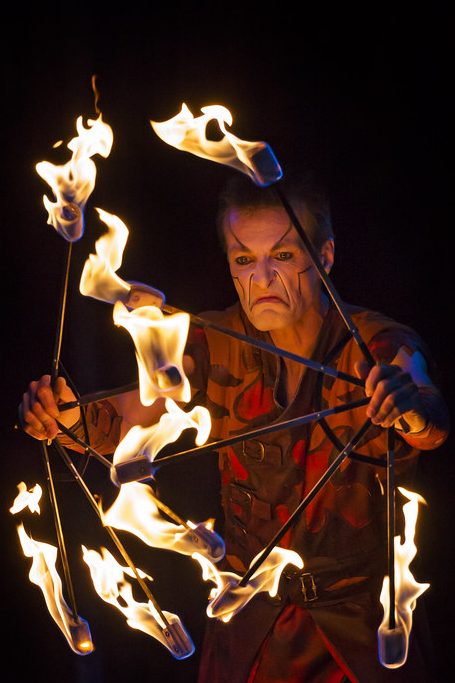
Photo: “Villain with fire” by Tambako the Jaguar is licensed under CC BY-ND 2.0.