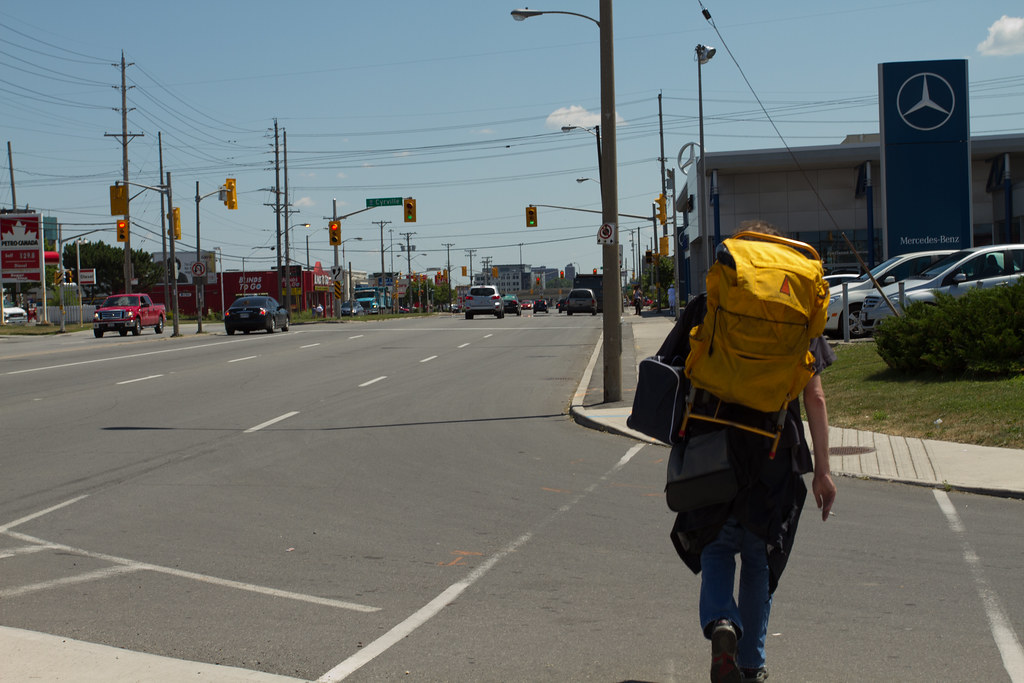
Well, he was near played out when I went on and took him in.
His mind and body like his clothes were worn.
His self-control and wallet like his boots were mighty thin.
I patched him up wherever he was torn.
He needed somewhere safe and warm so maybe he’d begin
To grow a callus back someone had shorn.
There wasn’t much he’d ask that I’d refuse
Until he got those got-to-leave-you blues.
He said “I’ve got those got-to-leave-you blues,
You understand the way it is, I’m sure.
But I’ve got ramblin’ fever in my shoes
That only walkin’ lonesome roads can cure.”
I smiled and nodded and I thought there always comes a day
When being treated well will get to you
When hurt so bad you lash out in that narcissistic way
And all the good I’ve done or might yet do
Is twisted with dependence, and it’s something you can’t say.
So you are acting out now right on cue.
I said “I kept your outfit, every rag,
So here’s your boots and there’s your travelin’ bag.”
When they’ve got ramblin’ fever in their shoes
I give them back the worn-out stuff they brought,
Since if they think they’re giving me the blues
They won’t be gettin’ anything I bought.
He doesn’t know and I don’t say he’s not the only one
I’ve helped who’s helped me make it through a night
Or several whether in the short or in the medium run,
Nor will he be the last to find the sight
Of those white center-lines out on that road there in the sun
Will make him feel he’s never been not right,
And he’ll regret he’s giving me bad news
That he has got the got-to-leave-you blues.
He doesn’t see it’s me who gets to choose.
There’s half a dozen others just like him
Who’ll washed up here whose ramblin’ fever shoes
Are looking for a road a bit less grim.
He takes his stuff and tries to not look back
To see if I will notice that he does.
I give him one sad smile, then eye the pack
To pick the next one care-worn as he was.
And he’ll be near played out when I go on and take him in.
His mind and body like his clothes are worn.
His self-control and wallet like his boots are mighty thin
I’ll start to patch him up where he’s been torn.
He’s needing somewhere safe and warm so maybe he’ll begin
To grow a callus back someone had shorn.
There isn’t much he’ll ask that I’ll refuse
Until he gets those got-to-leave-you blues.
*****
Marcus Bales writes: “One of the song tropes my brother John and I used to enjoy mocking the most as we listened to records or the radio in our shared bedroom in the late 60s in Columbus, Ohio in our early teens was an odd one for a pair of Air Force brats whose whole life experience had been saying goodbye to new friends whose parents were being irrevocably transferred somewhere else, never to be seen again, or we were being similarly transferred away, and that trope was the country or blues song addressed to the woman by the ramblin’ man whose litany of reasons to leave seemed, to us, whose leavings and arriving were dictated by unequivocal orders, thin-to-non-existent. The singer was constantly moaning about how, despite how good he had it, he was movin’ on . John and I thought it was hilarious that civilians would voluntarily abandon situations in which, by their own accounts, they simply had no good reason to leave. We’d left, or been left, by that time, by a decade and a half of friends. The very notion that some cowboy or bluesman felt like there must be greener grass down the road that never ends seemed ludicrous. We’d seen those pastures. We’d ridden down those roads. We’d flown that wild blue yonder to other states and countries. We thought that plea of desperate yarning was a load of crap.
What’s the woman’s side of the story? It occurred to me that she probably thought that ramblin’ fever was a load of crap, too. And, maybe, that it made for a nice change from time to time, since in all those songs and stories he wanders off, but she gets the house. Maybe she got the better deal. And, so, voila.”
Not much is known about Marcus Bales, except he lives and works in Cleveland, Ohio, USA, and his work has not appeared in Poetry or The New Yorker. His latest book is 51 Poems; reviews and information at http://tinyurl.com/jo8ek3r
Photo: “Pat, July 15, 2011 – Rambling Man” by pat00139 is licensed under CC BY 2.0.

 Form in Formless Times