Tag Archives: long read

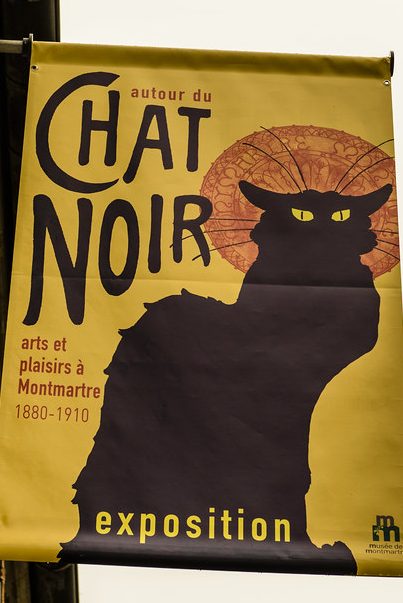
Weekend read: Daniel Galef, ‘Auriol to a Patron at Le Chat Noir’

For it was Auriol who concocted the Chat Noir-Guide toward the end of the nineteenth century. The Guide provides, for every objet d’art and knick-knack purportedly on display in the bar, fantastical tales of provenance.
From Cabaret to Concert Hall, Steven Moore Whiting


Come in, come in! Here, have a glass of beer—
The best in Paris! Whence derives such praise?
The Comte du Saint-Clement, when he drinks here,
And several other lumières Françaises
All say so. (Rimbaud swore “the best in France!”)
Perhaps you have been eyeing some of our
Objets and esoterica? Perchance
You’d like to hear their provenance? Le Soir
Has called the Chat’s decor the greatest work
Of art collection since the Louvre. These darts
Were thrown by Pippi Pavlo of Le Cirque.
This mirror-frame once held a Queen of Hearts
Played by the Duke of Sandwich in the game
At which he famously invented soup.
That specimen was lost before it came
To us—pinched by a croupier with the croup.
The mirror, too, is memorable—this crack
Imparted by a blow from cannon fire.
The cannoneer collapsed. Upon his back
They found the selfsame mark. Since then, each buyer
Has met a grisly fate—until bought by
A suicidal poet named Pierre.
It didn’t work. He gave it to Le Chat
In payment for a shot. We hung it there.
The timepiece on the mantle was a gift
From Pope Immaculate to me. Of course,
At that time, I had left the church. A rift
Arose when I ordained a bishop’s horse.
Ignore the wireless just beside—the news
Is so depressing, no? So . . . uninspired.
The mud, the blood, the bombs, the flu, the coups,
Enough to make Scheherazade tired.
But here! This silhouette is me—back then
I had a beard. I lost it in a duel
With three mad Turkish painters in Ardennes.
The third defaulted. Still I shot. It’s cruel
To leave a loser living. I was called
“The Caesar of Sargasso”—naturally
There wasn’t a resemblance. He was bald
While, under wraps as “Cleopatra Lee”
I worked with Pasteur researching a cure
To hair loss. Though the lab sank in a storm,
I drank the last drop as I swam to shore,
And thus my coiffure’s never lost its form.
This bronze, by Claus of Innsbruck, is a hoot—
So said the critic who is sealed inside
Its twin, the Triton by the stairs. Poor brute!
He knocked for half a week before he died.
It’s best not to insult these artist types.
I have the Gift myself, but can’t unearth it.
To catch the Muse is much like hunting snipes:
They bite, and taste too gamey to be worth it.
Each crystal on that chandelier’s a shard
From Louie Something’s windows at Versailles.
They say there came a witch, old, hunched, and scarred,
One night at midnight. With her one bright eye
She sneered once through the pane, and then departed.
Within a week, the king went mad and smashed
The lot of them, while mumbling “It has started!”
It’s cursed, of course. Too pretty to be trashed.
The candles are of beeswax. And what bees!
They live like princes. Endless fields of flowers
Are tended by the gardeners at Nice
And watered by a set of special showers
Constructed for the grounds by Lord Brunel.
We light them only rarely. For a guest
Such as yourself, I’ll gladly burn one. Well,
Just half. Come back someday, we’ll burn the rest.
These coasters? Quite mundane. They’re bits of planks
I salvaged from the Hesperus. Oh yes,
I once was quite the soldier. Only blanks
I ever loaded in my gun. The rest
Must have a chance, you know. It isn’t fair
To pit them up against whom Nelson dubbed
“The finest shot in Europe.” On a dare,
I handed him my pistol once. He clubbed
Me with his wooden leg. What’s that? His arm?
Oh no, that’s merely what the papers said.
In fact, it was his leg. It does no harm
To stretch the truth a little. Nelson plead
For them (the press) to print it right, but they
Insisted that an arm read better. He,
Of course, cried “What a silly thing to say!
An arm can’t read! Perhaps an eye?” You see,
They listened—Nelson loved Le Chat. You’ll find,
If you direct attention here, I’ll show
You where he signed the bar. Just why he signed
As “Ferdinando Smitty,” I don’t know.
That stool you’re sitting on I carved myself
With a pocketknife from one great slab of teak
When, hounded through a forest by some elf
I climbed a tree and hid there for a week.
That tree was this: The chair. The table, too,
Unless that one’s the Pharaoh’s table—no,
But come along, I’ll show that one to you,
Just past these poker-playing dogs (Van Gogh).
Don’t touch, the paint is fresh! I knew the model,
Lovely gal. Alsatian, I recall.
Her only vice, a weakness for the bottle;
Poor dear! Not drink—the bottle, that was all.
Our barman is a secret Count, a bastard
Practicing the rapier to reclaim
His stolen birthright. So far, he has mastered
Fourteen styles of swordplay. Soon his name
Will grace kings’ lips. For now, he’s just our skinker.
The chambermaid, as well, has quite a story.
A moron, yes? Wrong! Why, that genius thinker
Solved the famous Kjotz Conjecture. Glory
Is nought to her. She labors for mankind,
And for her god (the Devil). The Sorbonne
Has offered her a chair. But she declined.
(They say her mother was Napoleon’s son.)
That busboy? Oh, don’t heed him. He is lame
Not from trench foot, as some (and he) insist,
But—let me see—oh, yes!—a goon whose name
Was “Olaf” chopped his toes off at the wrist,
And now he’s quite—But pray, don’t touch that curtain!
The outside light must never be allowed
To touch these treasures. They’ll tarnish, I am certain.
(Besides, those drapes were Victor Hugo’s shroud.)
Our rum’s supplied by pirates. These fine cups
Looted from the Louvre. These splendid spoons
Are those with which the Mongol chieftain sups.
The silver forks are forged from gold doubloons.
Our beer, which I can see you quite enjoy,
Is brewed by tight-lipped monks who take a vow
Never to speak a lie—I, as a boy
Was in the order. (I have left it now.)

*****

Daniel Galef writes: “A few years ago when I was learning the Gymnopedies and Gnossiennes on piano I also tried reading up on Erik Satie, whose circle was full of interesting eccentrics, especially those frequenting Rodolphe Salis’s famous fin-de-siecle cabaret in Montmartre the Chat Noir: George Auriol, Vital Hocquet, Alphonse Allais, &c. As a fiction writer, I am fascinated by lies and liars and what drives them, and was particularly taken by the fact, mentioned in passing, that Auriol had written and published a fake guidebook for the Chat Noir. I’ve since read more about Auriol, and even tracked down and read (with the help of Google Translate) a scan of the Guide itself (and highly recommend it, if it’s still to be found online), but when it was the only thing I knew about him that line alone in Whiting’s book was enough to serve as springboard for this weird, sort of Browning-y monologue poem, which is one of my favorite things I’ve ever written. The long version was written first even though it was published second; it appeared in 2022 in Bad Lilies, and later I snipped a sonnet out of it, which was published in 2020 in Light (and then in a slightly different form in my first book Imaginary Sonnets).

Daniel Galef’s poetry, half-serious and half-non-, has been published in a variety of venues themselves both serious and non-. His first book, Imaginary Sonnets, collects 70 persona poems from the point of view of various historical figures and literary characters, including Lucrezia Borgia, Christopher Smart’s cat, and a taco. “A Nightingale to a Sad Poet” first appeared in the Spring/Summer 2025 issue of Sein und Werden. Other recent writing can be found in the Indiana Review, the Best Small Fictions anthology, and Scientific American.

Photo: “Le Chat Noir” by Son of Groucho is licensed under CC BY 2.0.
Weekend read: Duncan Gillies MacLaurin, ‘The Real Pity’

No, Wilfred, I never
believed your endeavour
was more than a clever display.
Did you think you could rescue
the boys in the mess queue,
or – no less grotesque – you’d betray
your comrades by opting to stay
in shock in Craiglockhart’s sick bay?
Naive pretence
is no defence
for senseless sacrifice.
Admit it, you
were stupid to
ignore Sassoon’s advice
and blithely return to the fray,
quite deaf to the price you would pay.

You based your decision
on lack of a vision
and fear of derision combined.
You went back to that battle
where kids died “as cattle”
to leave tittle-tattle behind,
regardless of what you might find.
No doubt you were out of your mind!
Or, more exact,
you lacked all tact.
Death was not your “chum”.
One week passed,
and then, at last,
the Armistice had come.
You thought you were helping mankind.
Your nerves were so numb you were blind.

The telegram telling
the news reached your dwelling
as people were yelling “Hooray!”
You were inconsequential
despite your potential.
What did you essentially say?
“Was it for this the clay…?”
Whose drum did you dumbly obey?
You grew obsessed
with your new quest;
it made you big and bold.
Was it fulfilled
when you were killed,
just twenty-five years old?
I have to report with dismay
there’s no lack of soldiers today.

*****

The following is an explanatory essay by Duncan Gillies MacLaurin, entitled ‘Owen, Sassoon, Barker and Me’:

If anything might rouse him now
The kind old sun will know.

– from Wilfred Owen’s sonnet, “Futility

It would have been late 1976 or early 1977 when my English teacher, Peter MacDonald, introduced me, a 14-year-old Scottish public schoolboy, to Wilfred Owen. Pixie, as he was called by the boys, had hardly given us the gist of Owen’s life, death, and poetry, when I found myself pole-axed. I hadn’t got my head around the fact that Owen chose to return to fight in the war that he was denouncing in his poetry even though serious shellshock exempted him from service, when I was told that he was killed just one week before the Armistice. It was too much for me.

Reciting Wilfred Owen’s sonnet “Futility” in chapel a few weeks later, I sensed in poetry an alternative to the spiritual life I had known hitherto. Not that I reacted immediately. I didn’t begin writing poetry until I was 20. And it was not until late 1989 that I returned to the poet whose fate had hit me so hard.

It started the way it sometimes does, with a couple of lines scribbled down just before bedtime. The lines were: “If your heart is your legend,/ if your pen is your weapon…” The next day I sat down with my guitar and put the lines to a tune. Although I hadn’t had Wilfred Owen in my thoughts, I found that the piece was to be about him. A year later, “Letter to a Dead Poet” was published in The Dolphin Newsletter, an internal journal of the English Department at Aarhus University, Denmark.

Letter to a Dead Poet

Hey Wilfred Owen,
where were you going
when you got blown away?
Had your heart been your legend,
had your pen been your weapon,
had your conscience elected to stay
watching the sparrows play,
you might have been here today.
I don’t believe your sacrifice
was generous or free;
the fact you paid the highest price
betrayed “Futility”:
“Was it for this the clay…?”
What were you trying to say?

What use are the laurels?
What use are the morals
in all of your quarrels combined?
You went back to that battle
where kids died “as cattle”
to leave tittle-tattle behind
and claimed you were just being kind.
You must have been out of your mind!
And when at last your blood was spilled
Death was not your friend;
one week after you were killed,
the War was at an end.
How could you be so blind?
What were you hoping to find?

My English literature professor, Donald Hannah, who specialised in WWI poetry, was full of praise.

In 2008 (by chance the year Donald Hannah died) I started revising the piece, enlisting the help of other poets on a couple of online workshops. In the process I became even more critical of Wilfred Owen, and people were saying things like: “If he wasn’t already dead there’s a fair chance this would finish him off.” Even my wife, a novelist and investigative journalist, disliked my revisions. One poet, Janet Kenny, was sympathetic though. She commented:

You must have known that this would upset everybody. Owen is so beautiful and
touches us in the deepest way. But I admire the courage this must have taken. It reminds me of Edward Bond’s “First World War Poets”:

You went to the front like sheep
And bleated at the pity of it
In academies that smell of abattoirs
Your poems are still being studied
You turned the earth to mud
Yet complain you drowned in it
Your generals were dug in at the rear
Degenerates drunk on brandy and prayer
You saw the front—and only bleated
The pity!
You survived
Did you burn your general’s houses?
Loot the new millionaires?
No, you found new excuses
You’d lost an arm or your legs
You sat by the empty fire
And hummed music hall songs
Why did your generals send you away to die?
They saw a Great War coming
Between masters and workers
In their own land
So they herded you over the cliffs to be rid of you
How they hated you while you lived!
How they wept over you once you were dead!
What did you fight for?
A new world?
No — an old world already in ruins!
Your children?
Millions of children died
Because you fought for your enemies
And not against them!
We will not forget!
We will not forgive!


I just wanted to show that there was at least one other naughty boy. I love the poems of Wilfred Owen. I seriously like your poem. It would be impossible to imitate his voice (and
unacceptable) but the irreverence IMO hits the correct note. Your poem is deliberately
“vulgar” and unpretentious and is all the more telling for that reason.


(From the online workshop, Eratosphere, 2008, quoted with Janet Kenny’s permission)

Thus encouraged, I persevered, and in 2012 my new version was published in the newly-founded poetry e-zine, Angle. One of the editors was Janet Kenny.

The Real Pity

No, Wilfred, I never
believed your endeavour
was more than a clever display.
Did you think you could rescue
the boys in the mess queue,
or – no less grotesque – you’d betray
your comrades by opting to stay
in shock in Craiglockhart’s sick bay?
Naive pretence
is no defence
for senseless sacrifice.
Admit it, you
were stupid to
ignore Sassoon’s advice
and blithely return to the fray,
quite deaf to the price you would pay.

You based your decision
on lack of a vision
and fear of derision combined.
You went back to that battle
where kids died “as cattle”
to leave tittle-tattle behind,
regardless of what you might find.
No doubt you were out of your mind!
Or, more exact,
you lacked all tact.
Death was not your “chum”.
One week passed,
and then, at last,
the Armistice had come.
You thought you were helping mankind.
Your nerves were so numb you were blind.

The telegram telling
the news reached your dwelling
as people were yelling “Hooray!”
You were inconsequential
despite your potential.
What did you essentially say?
“Was it for this the clay…?”
Whose drum did you dumbly obey?
You grew obsessed
with your new quest;
it made you big and bold.
Was it fulfilled
when you were killed,
just twenty-five years old?
I have to report with dismay
there’s no lack of soldiers today.

The two lines that inspired the piece are gone, yet the sentiment they express is still its backbone. My new title is a reference to something Owen wrote in a preface to a posthumous collection of his poetry: “My subject is War and the pity of War. The Poetry is in the pity.”

A significant new element in the latest version is the fact that Owen’s mother received the dreaded telegram just as the church bells in Shrewsbury were ringing out in celebration of the Armistice.

The alleged advice from Siegfried Sassoon in the first stanza is undocumented. It was an idea that came from reading about their relationship in Pat Barker’s historical novel, Regeneration (Viking Press, 1991), which is centred around the humane treatment that Owen, Sassoon and others received from the man in charge at Craiglockhart, Dr Rivers. Sassoon was at Craiglockhart (in Edinburgh) because his declaration proclaiming the futility of the war had been read aloud in Parliament. Sassoon wasn’t ill, but the government didn’t know what else to do with this war hero turned pacifist. Owen and Sassoon became good friends, and they had a lot in common. They were both homosexual and both strongly ambivalent about the war. Sassoon, the seasoned poet, recognised Owen’s budding poetical talent and helped him with it. There is no doubt that it was a case of hero worship on Owen’s part. Even though they would not allow themselves to refuse to go back to the front, because they saw it as their duty, on a personal level they would not have wanted each other to have to return. While Sassoon’s return to the front was merely the result of a mature adult’s battle with his own conscience, Owen was a damaged young man who should never have been allowed to return. I have imagined that Sassoon told Owen that he (Owen) didn’t need to return to the front, but that Owen chose to follow his hero’s example rather than his advice. Sassoon grieved bitterly over Owen’s death and claimed he would never be “able to accept that disappearance philosophically”. (Siegfried’s Journey, Faber and
Faber, 1945, p. 72)

In an interview with critic Rob Nixon in 1992 Barker talks about issues that were central for the two poets:
Barker: Yes, it is about various forms of courage. What’s impressive about Sassoon’s courage actually is not just the obvious thing that it takes a lot of courage to get decorated, and that it takes a lot of courage to protest against the war, so he’s being brave in two distinct ways. In fact, it’s a much deeper form of courage than that because—partly because of his sexual makeup—he had a very deep need, I think, to be visibly tough and heroic and hypermasculine and prove he could do it. The bravest thing he does, it seems to me, is to deny that psychological need in order to protest against the war.
Nixon: I think one of the great strengths of the novel is the way it deals with the complexity of the condition of the pacifist-warrior rather than simply taking head-on the question “Is war good or bad?” It’s not an ethical book in that narrow, straightforward sense, but ethical by staging the dilemmas of that condition.
Barker: It’s not an antiwar book in the very simple sense that I was afraid it might seem at the beginning. Not that it isn’t an antiwar book: it is. But you can’t set up things like the Somme or Passchendaele and use them as an Aunt Sally, because nobody thinks the Somme and Passchendaele were a good idea. So in a sense what we appear to be arguing about is never ever going to be what they [the characters] are actually arguing about, which is a much deeper question of honor, I think. “Honor” is another old-fashioned word like “heroism”, but it’s very much a key word in the book.
p.7 of “An Interview with Pat Barker” in Contemporary Literature 45.1 (2004)

The ethos of the committed pacifist scorns mere personal safety. Both Owen and Sassoon returned to the War despite their opposition to it. Yet Barker also points to the ambivalence of the positions the two poets held:
Barker: …part of the paradox of Sassoon’s position and, indeed, of Wilfred Owen’s, is that they are simultaneously condemning the war wholeheartedly and claiming for the combatant a very special, superior, and unique form of knowledge, which they are quite implicitly saying is valuable. That you cannot know what we know, and what unites us is something you cannot enter.
(Ibid., p.8)

Barker later states the ambivalence the two men felt even more baldly. She is also astute in her assessment of the class privileges they enjoyed despite their pacifism:
Barker: On the one hand, you’ve got the war poets telling everybody the horrors as vividly as they can. But at the same time, in both Owen’s and Sassoon’s cases, refusing to say the other truth, which is that a lot of it those two particular men enjoyed. So you get an alternative area of silence developing, and that interests me.
The other thing that interests me is how in the second year of the war you had the increased persecution of the pacifists and the increased persecution of homosexuals. There were two very, very nasty campaigns going on. A lot of state spying of a very nasty kind. There was one poor woman, Alice Wheeldon, who was sent to prison with ten years’ hard labor because a police spy alleged that she had plotted to kill Lloyd George by sticking a curare-tipped blowdart up through his shoe. This was a woman who kept a second-hand clothes shop in Leicester. And she got ten years’ hard labor. Unlike Sassoon, you see, who didn’t get sent to prison. You need to be working class and a woman to actually get yourself sent there.
(Ibid., p.19)

What spurred me to write this piece? As is often the case, it was the combination of two factors. On the one hand, my own public-school background meant that I was able to identify with and feel sympathy for Wilfred Owen. On the other hand, I wanted to condemn the elitist culture and stiff-upper-lip ethos that sent an excellent poet to an early grave.

Duncan Gillies MacLaurin, 4th November 2018

*****

Duncan Gillies MacLaurin is a Scottish poet who was born in Glasgow in 1962. He studied Classics at Oxford, left without a degree, and spent two years busking in the streets of Europe. He met a Danish writer, Ann Bilde, in Italy in 1986 and went to live in Denmark, where he teaches English and Latin. His collection of 51 sonnets, I Sing the Sonnet (2017), is online at Snakeskin. He blogs here.

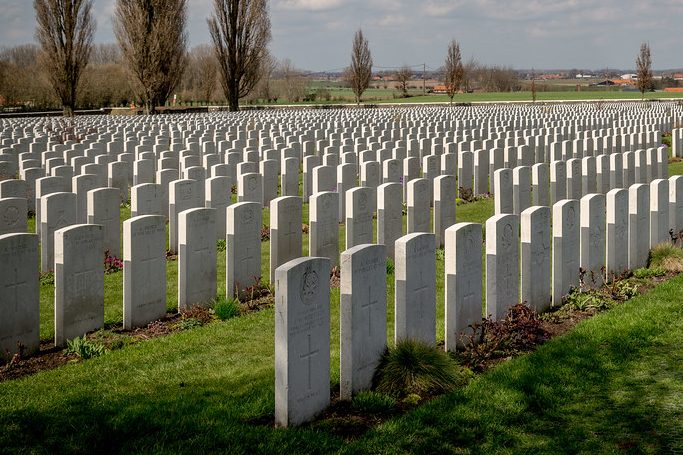
Photo: “Tyne Cot WW1 Cemetery” by PapaPiper is licensed under CC BY-ND 2.0.