Tag Archives: Philpott

Helena (“Nell”) Nelson, ‘Separation’

i

Mrs Philpott goes to bed alone.
The clock in the hall ticks on.
Philpott turns to cut glass, then stone.

All the things we do to be loved,
all of them pointless.
The clock ticks on.

Nothing but moonlight dawns.
The distance from downstairs
to upstairs yawns.

Philpott sags and snoozes alone
in the wishing chair,
in the wishing air.

All the things we do to be loved –
in the night they slip far away.
It will never be day.

The clock ticks on
as well it may.

ii

She wakes first. He has not slept
in the chair all night.

At first light
he has crept

into the bed on the other side.
He will not (cannot) say it, but

everything about him is sorry –
only half of him is under the duvet

and his eyes aren’t really shut.
She pulls the covers over them both and he falls

into a sleep as deep and sound
as a lost child who has wandered far out of sight

(while his mother calls and calls and calls)
and is finally found.

*****

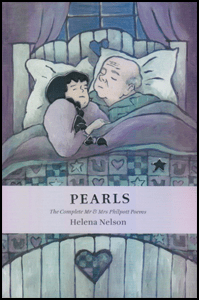
This poem is one of over 80 in Helena Nelson’s ‘Pearls – the Complete Mr & Mrs Philpott Poems’. Starting with poems of the end of their first marriages, it tracks their decades-long second marriage through (as the blurb says) “dreams, anxieties and needs – even sudden spurts of happiness – despite the rainy holidays, arguments and illness. The ordinariness of their love is magical and miraculous. Because ordinary love is a kind of miracle.”

People talk about “novels in verse” but those often don’t capture the poetry of verse. This is definitely a novel in poetry, and the most rereadable novel I’ve come across in a long time.

Helena Nelson writes: “happy that you like Pearls. I made it as well as I could, but it largely came unasked for. I don’t think I have anything to say about it.”

Helena Nelson runs HappenStance Press (now winding down) and also writes poems. Her most recent collection is Pearls (The Complete Mr and Mrs Philpott Poems). She reviews widely and is Consulting Editor for The Friday Poem.
Using form: unconventional couplets: Helena Nelson, ‘The Hill’

His heart is okay (it has been checked)
but not far from the top his pace is checked

and he stops. ‘Enough. Let’s go back.’
Mrs Philpott doesn’t want to go back.

If they get to the summit, they’ll see the view.
He doesn’t give tuppence about the view.

‘It’s not far,’ she says. ‘Too far,’ he says.
She doesn’t care a bit what he says,

she wants to get to the top of the hill. ‘Come on,’
she says. ‘Best foot forward.’ ‘You go on,’

he says. ‘I’ll wait here.’ So she walks on her own
and quickly sets up a pace of her own

not pausing and not once looking back
until for some reason she stops and looks back

and he’s quite out of sight, could be anywhere
and a sort of fear catches her where

head and heart meet. This stupid emotion is love
and because of that, because of her love,

if he won’t get to the top of the hill,
then she won’t get to the top of the hill

either. Anyway, a few drops of rain
fall on her hair and she knows he hates rain.

He might even have turned
and gone home without her. She turns

and half-runs down the path. He’s waiting for her,
sitting on his coat and waiting for her.

‘About time,’ he says. ‘Where have you been?’
She says, ‘Where do you think I’ve been?’

He doesn’t ask about the view from the top.
She doesn’t tell him she didn’t get to the top.

She might think, ‘This is the story of my life,’
but although this is the story of her life

that is not what she thinks.
She thinks something else.

*****

This poem comes from midway through Helena Nelson’s 2022 book ‘Pearls – The Complete Mr & Mrs Philpott Poems‘, some 100 poems (I haven’t counted) detailing their years of marriage, starting with a couple of references to their first marriages, through to their own noticeable ageing.

The book’s blurb asks: ‘Where did Mr and Mrs Philpott come from? The author has no idea. They popped into her head over twenty years ago and have refused to go away. Their story is one of ordinary, difficult, everyday love. And yet they themselves aren’t ordinary. Their dreams, anxieties and needs, their separate and difficult pasts, have somehow coalesced into mutual understanding–even sudden spurts of happiness–despite the rainy holidays, arguments and illness. The ordinariness of their love is magical and miraculous. Because ordinary love is a kind of miracle.’

Helena Nelson writes: “I didn’t choose this absorption with the Philpotts. It just happened, and it seems I really have stopped writing them now. But I’m terribly fond of them and often think about them. Probably one of my top favourite Philpott poems is ’The Hill’. Nearly all the poems have some kind of formal pattern underpinning them. Even when they appear to be free, the rhythms are deliberate. I don’t know if I could say any more about them. I feel as though they’ve gone off on their own now, for better or worse, and I’m happy about that.”

Helena Nelson runs HappenStance Press (now winding down) and also writes poems. Her most recent collection is Pearls (The Complete Mr and Mrs Philpott Poems). She reviews widely and is Consulting Editor for The Friday Poem.

Photo: “Day 40: Grey Skies” by amanky is licensed under CC BY-NC-ND 2.0.

Potcake Poet’s Choice: Helena Nelson, ‘On Gloom and Proper Respect’

He doesn’t exactly blame her for it. No,
it’s not her fault. She is the way she is—
incorrigibly optimistic. But
the strain of her unbridled cheerfulness

must tell. His gloom requires due diligence.
It’s there to serve a need, and needs a slow
and proper processing. That’s it—a proper pro-
cessing. To this he must commit, and hence

his necessary isolation. No,
he is not depressed. He’s just process-
ing. Some ‘thing’ is passing through. It will go
eventually, but it must run its course.

The weight of doom would be a minor stress
if she would just dispense with cheerfulness.

Helena Nelson writes: “This poem is part of a book-length sequence telling the story of an ordinary, conventional marriage (albeit a second marriage for each partner). It’s about love that struggles to survive the difficulties of aging, loss and illness. The husband, Mr Philpott, has always suffered from anxiety but he has bouts of depression too, when he withdraws into himself. In fact, he might fairly be described as a ‘difficult’ man, though he can’t help it. Here the sonnet form reflects his need for tight control, repressing his anxiety about depression, which gets squeezed uncomfortably across the line breaks. There’s humour here, too. Because how absurd it is, surely, to wish your wife were less cheerful? And yet he does. He certainly does.” 

Helena Nelson runs HappenStance Press and sometimes writes poems, one of which appears in the soon-to-be-released latest Potcake Chapbook, ‘Lost Love’. She has been writing the story of Mr and Mrs Philpott for over twenty years, and it can finally be found in its complete form as Pearls (The Complete Mr and Mrs Philpott Poems)