Tag Archives: power

Tom Vaughan, ‘The Great and the Good’

Why sing of the lives
of the fortunate few
whose gong-heavy entries
weigh down Who’s Who ?

They’re smug on their summits
and on Footsie Boards,
Permanent Secretaries
or rotund Law Lords;

generals, merchant bankers,
Top Brass at the Beeb,
dons, doctors, bishops. . .
You can spot the breed

by their ability
blind obedience to claim
from drudges and drivers
and shy, single, tame

PAs who sacrifice
lonely weekends
to type bland speeches
for skimpy stipends.

O don’t be deceived
by the Great and the Good –
you’re a rung on their ladder
on their fire, wood,

grain for their harvest,
a wheel on their car,
corpse on their D-Day,
night for their star.

*****

Tom Vaughan writes: I’ve long been fascinated by the phrase ‘the Great and the Good’, having reached the conclusion during long years of government service that the great cannot generally also be good, given the demands of the exercise of power. But I am also intrigued by the loyalty such people can inspire, and the longing for leaders that reflects, despite the advice given by my favourite political commentator, Bob Dylan, in Subterranean Homesick Blues – ‘Don’t follow leaders/Watch the parkin’ meters’.”

‘The Great and the Good’ was first published in Snakeskin 265, October 2019.

Tom Vaughan is not the real name of a poet whose previous publications include a novel and two poetry pamphlets (A Sampler, 2010, and Envoy, 2013, both published by HappenStance). His poems have been published in a range of poetry magazines, including several of the Potcake Chapbooks:
Careers and Other Catastrophes
Familes and Other Fiascoes
Strip Down
Houses and Homes Forever
Travels and Travails.
He currently lives in Brittany.
https://tomvaughan.website

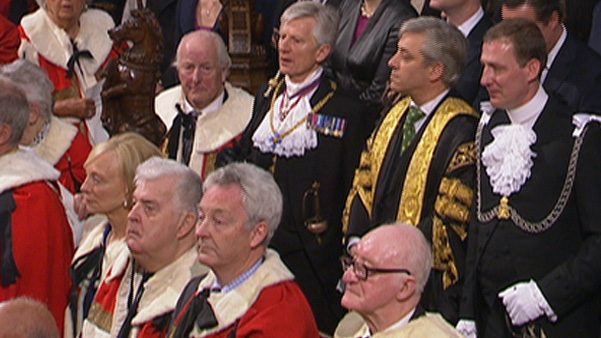
Photo: “MPs and House of Commons officials stand in the House of Lords chamber at the opposite end to the throne, the bar, to listen to the Queen’s Speech” by UK Parliament is licensed under CC BY-NC 2.0.

Using form: nonce form; John Beaton, ‘Wolves’

I’m wakened, drawn towards the ice-thin window,
to witness scenes as faint and still as death.
How bleak the moon; how bare the trees and meadows;
sky’s pale maw overhangs
Earth bleached beneath star fangs.
Night’s curled lip sneers on shadows
of mountains set like teeth.

Two bow waves shear the median of the valley,
iced hayfield yields as feral muscles glide–
hoarfrost disturbed by wakes of live torpedoes.
Grey shoulders breach and lope,
implode and telescope,
impelled by ruthless credos
of chilled and vicious pride.

The wolves tear savage furrows down the nightscape;
their eyes are shined with blood, their mission clear.
Grass springs back shocked to green behind their passage–
twin tracks traverse the vales,
cold comets trailing tails
leave scarred in frost their message:
the wolves, the wolves passed here.

*****

John Beaton writes: “This describes a real incident on our acreage when I woke in the middle of a frosty night for no apparent reason and looked out the window. I was struck by the grace, power, and sense of danger the wolves evoked.
“The first three lines are pentameter and the endings alternate—feminine, masculine, feminine. The next four lines contract to trimeter to give a sense of speed and acceleration. Lines two and seven have a masculine rhyme that closes the stanza and ties its parts together. The overall rhyme-scheme is xabccba. My intent was to convey the power and motion of the wolves running and I built in alliteration and internal rhyme to help with this.”

John Beaton’s metrical poetry has been widely published and has won numerous awards. He recites from memory as a spoken word performer and is author of Leaving Camustianavaig published by Word Galaxy Press. Raised in the Scottish Highlands, John lives in Qualicum Beach on Vancouver Island.
https://www.john-beaton.com/

Photo: “Wolves With Northern Lights (Color Corrected)” by edenpictures is licensed under CC BY 2.0.