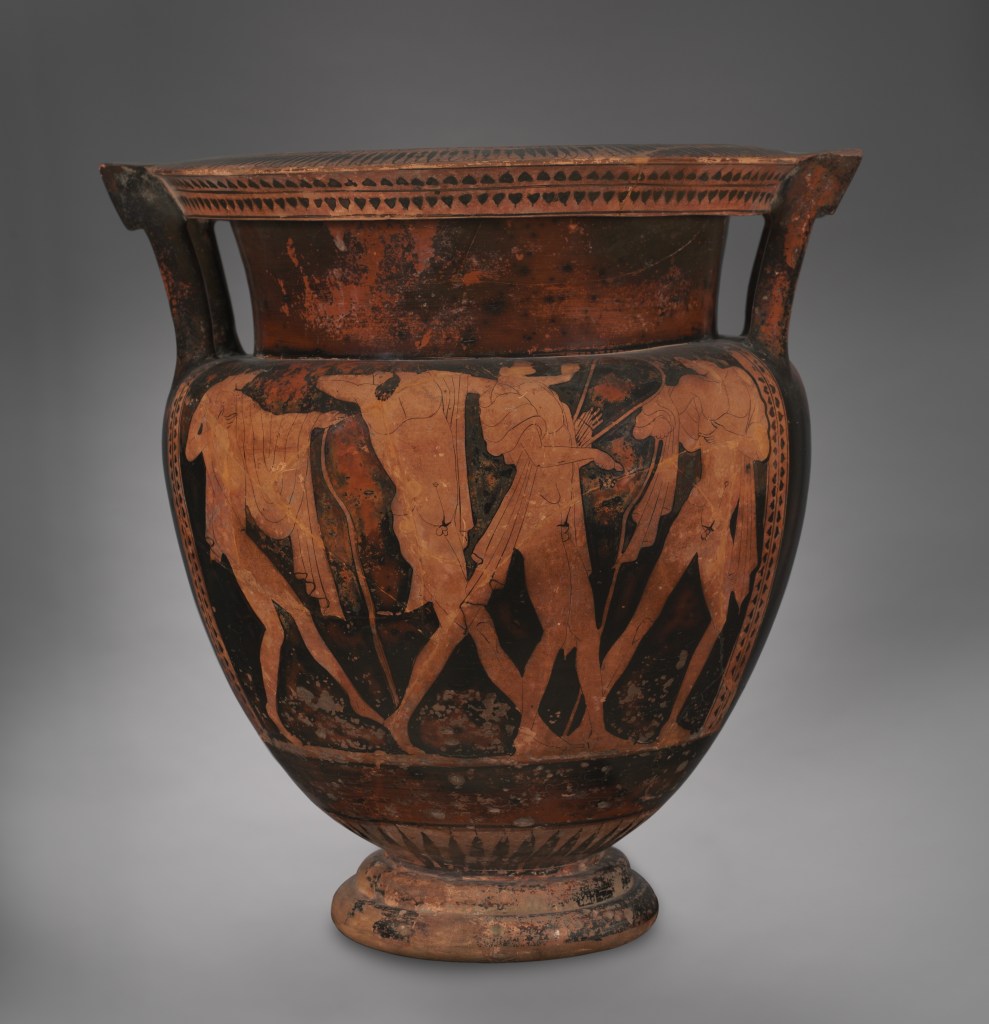
This column krater once held watered wine,
Its figures, red on black, an illustration
Of how it served the daily and divine.
On one side Hera offers a libation
With Artemis, Apollo, and their mother,
While three nude athletes and a bearded man
Are drunk with more than liquor on the other.
I stare through all four panes of glass that ban
All but my eyes from learning every curve,
And I can only dream that luck and nerve
And my own art may earn a chance to feel,
As one of few who cares to understand
That ancient try to make one ideal real,
To feel it push through time with my own hand.
*****
Marcus Bales writes: “A poem is language in meter that evokes emotion in the reader. Those who write to express themselves are doing something other than writing poetry. No reader accomplished enough to be engaged in reading poems is in it for the writer’s blurt. It may be that the writer is trying to evoke the same emotion in the reader that the writer felt in the poem’s circumstances, but the goal remains to evoke that emotion in the reader, not merely recount the writer’s emotion.
Poems that fail to evoke emotion in the reader are failed poems and, alas, every poet has several. They wait patiently like the mythic swordsman in fairytales to keep the protagonist from going through the door behind them. Our hero or heroine arrives in the room, the swordsman puts down Kant’s ‘Critique of Pure Reason’ – in the original German – and smiles, drawing a sword. The writer, however already wounded or tired from the effort of getting there, engages and soon enough, after an elaborate exploration of the waiting swordsman’s skills, is disarmed. The swordsman bows, kicks the writer’s sword back to him, sheathes his own, picks up his book, and sits down again, angles it to the light from the only window, nods goodbye, and resumes his perusal. The writer picks up the disgraced weapon, and trudges back out the way they came in. That poem still does not do what the writer intended to do: evoke emotion in the reader; all it remains as is an account of his or her own emotion.
It is the strength of that felt emotion that keeps the writer coming back to the failed poem, ever hopeful that it is an exception to the unyielding rule that the poem is for the reader, not the poet. Some poets make careers out of performing such things, their agents guaranteeing that the poet will cry during the performance, sure that the promoters are only interested in the performance, not in its effects on the audience. And there are audiences for whom watching the performer fail in their presentation is the point. No one involved in that scenario is there for poetry.
Unfortunately, this poem, ‘Cleveland Krater’ is one of those failed poems. Absent the actual krater, I have finally come to realize, the reader is not going to experience the emotion I did. I have come back and back to this piece, always after having visited the krater again, examining it closely through its Plexiglas box, looking for the clues that moved me and still move me, to try to shove them into words that will bring that impact I felt to the reader. Maybe if I just admit my failure I will get free of the draw of its blade when I arrive at it, again, hoping that this time I’ll do better than the dismissive kick of my sword clattering across the stone floor.”
Not much is known about Marcus Bales except that he lives and works in Cleveland, Ohio, and that his work has not been published in Poetry or The New Yorker. However his ’51 Poems’ is available from Amazon. He has been published in several of the Potcake Chapbooks (‘form in formless times’).
An extensive review of the Cleveland Krater and its creator can be found at https://www.academia.edu/12708103/The_Cleveland_Painter. You don’t need to log in or register, you can simply scroll down to read the entire pdf.
Photo: provided by the Cleveland Museum of Art https://www.clevelandart.org/art/1930.104#

 Form in Formless Times