I.
Many a sun
and many a moon
I walked the earth
and whistled a tune.
I did not whistle
as I worked:
the whistle was my work.
I shirked
nothing I saw
and made a rhyme
to children at play
and hard time.
II.
Among the prisoners
I saw
the leaden manacles
of Law,
the heavy ball and chain,
the quirt.
And yet I whistled
at my work.
III.
Among the children’s
daisy faces
and in the women’s
frowsy laces,
I saw redemption,
and I smiled.
Satanic millers,
unbeguiled,
were swayed by neither girl,
nor child,
nor any God of Love.
Yet mild
I whistled at my work,
and Song
broke out,
ere long.
******
Michael R. Burch writes: “W. H. Auden famously (or infamously) said “poetry makes nothing happen.” I sympathize with his sentiment but beg to differ. William Blake has been a profound influence on modern culture and societies, not only through his own poetry, art and engravings, but also through his influence on singer-songwriters like Bob Dylan, John Lennon and Jim Morrison. When Dylan met the Beatles the first time, things were a bit cool at first, until Allen Ginsberg broke the ice by bringing up Blake. It turned out that everyone in the room was a fan. Morrison named his group the Doors after Blake’s ‘Doors of Perception’.
“William Blake has been a primary influence on my work, not only as a poet, but also as a translator, editor and publisher of poems about the Holocaust, the Palestinian Nakba, the Trail of Tears, and other similar instances of Blake’s three-headed hydra of church, state and industry doing its worst to make life on earth hell.
‘A Passing Observation about Thinking Outside the Box’ by Michael R. Burch
William Blake had no public, and yet he’s still read.
His critics are dead.
“William Blake was not an “art for the sake of art” adherent. Quite the contrary. Blake was an ardent reformer. For instance, he and Charles Dickens, who from what I understand lived on the same London street or nearby, wrote movingly about the plight of child chimneysweeps and other minors forced to work long, gruelling, sometimes dangerous, hours by unscrupulous businessmen, and before long England and other nations like the United States were passing child labor laws. Some poets do make things happen with their poetry…”
*****
Michael R. Burch is an American poet who lives in Nashville, Tennessee with his wife Beth, their son Jeremy, two outrageously spoiled puppies, and a talkative parakeet. Burch’s poems, translations, essays, articles, reviews, short stories, epigrams, quotes, puns, jokes and letters have appeared in hundreds of literary journals, newspapers and magazines. He is also the founder and editor-in-chief of The HyperTexts, a former columnist for the Nashville City Paper, and, according to Google’s rankings, a relevant online publisher of poems about the Holocaust, Hiroshima, the Trail of Tears and the Palestinian Nakba. Burch’s poetry has been taught in high schools and universities, translated into 19 languages, incorporated into three plays and two operas, set to music 61 times by 32 composers, from swamp blues to classical, and recited or otherwise employed in more than a hundred YouTube videos. To read the best poems of Mike Burch in his own opinion, with his comments, please click here: Michael R. Burch Best Poems.
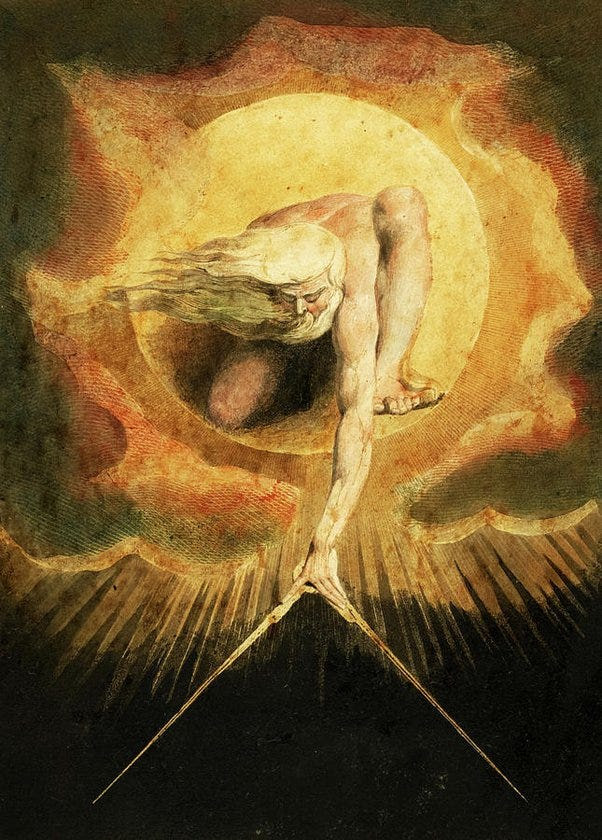
Illustration: ‘Ancient of Days’ by William Blake
 Form in Formless Times
In the poem where Auden all too famously says “poetry makes nothing happen” (‘Elegy for W B Yeats’) he also says (less famously, for some reason) poetry “survives, / A way of happening, a mouth.” Just a thought.
LikeLiked by 2 people
Nell, first thanks for taking the time to read and comment.
I’m usually an Auden fan. I particularly love his “Lullaby” which I consider an utter masterpiece. But I think poetry has done more than survive. And I think it does make things happen, in certain hands, like those of Blake, Burns, Sam Cooke (esp. “A Change is Gonna Come,”), e.e. cummings (“Olaf”), Enheduanna, Bob Dylan, Langston Hughes, Wilfred Owen, Miklos Radnoti (the great Holocaust poet whom I have translated), Sappho, Shelley, et al.
So I will have to disagree with Auden, while admiring his talent and craftsmanship. I have never belonged to the “art for the sake of art” school, being a writer and translator of poems about the Holocaust, Palestinian Nakba, Trail of Tears, and other such examples of man’s humanity to man.
LikeLiked by 3 people
Robin,
I enjoyed Michael R. Burch’s riff on Blake and certainly understand his annoyance with Auden’s dictum “poetry makes nothing happen,” but in fact, as Edward Mendelson, an English professor at Columbia and Auden’s executor, has commented, the emphasis in that phrase should be on “make”; i.e., poetry doesn’t force the issue (the way of propaganda) but can lead to things: it can console, inspire, and live on long after the poet is dead: “The words of a dead man / Are modified in the guts of the living,” as Auden writes elsewhere in the same poem.
In fact, here’s a poem about that:
A Question of Emphasis
Wanna Make Something of It?
poetry makes nothing happen . . . .
—W. H. Auden, “In Memory of W. B. Yeats”
Poetry makes nothing happen.
Song lyrics, on the other hand,
Wedge into people’s hearts
When sung by a heartthrob band.
Poetry makes nothing happen.
It doesn’t enforce a cause.
That’s the way of propaganda,
With all its fixed applause.
Poetry makes nothing happen.
But I’ve seen something sublime
In the eyes of a student reading
Eliot’s Prufrock the first time.
Poetry makes nothing happen.
But must events take place
For poems to be eventful—
To make a normal pulse race?
Best, David
LikeLiked by 3 people
That’s very nice, David… but it does bring to mind this discussion… https://vk.com/video17165_456239062 (6 minutes… please enjoy!)
LikeLiked by 2 people
David, I will have to respectfully disagree. I think some poets have forced the issue.
For instance, the first poet we know by name, Enheduanna, used poetry to make her favored goddess, Inanna, the chief of the Sumerian gods! Now that is poetic POWER!
The poetry of the Bible has impacted many lives. Not always for good, but those ancient poets did force things to change, whether for better or worse.
Ditto for the Koran.
I think William Blake did force the issue with his chimney-sweep poems, which undoubtedly touched readers and helped lead to child labor laws.
Shelley was the first writer to propose nonviolent resistance. Gandhi would quote Shelley in his speeches.
Whitman influenced many readers with his calls for tolerance and outspokenness about previously taboo issues.
Most poets don’t make things happen, don’t force the issue, but some do.
Mike
LikeLiked by 2 people
With all due respect, I think we’re disagreeing about the force of a verb here. In all the instances you mention, the poetry led to something great and powerful, but it didn’t exactly make its audience an offer they couldn’t refuse (to quote Professor Puzo). It inspired; it emboldened; perhaps it shamed. Sorry to quote Auden again, but regarding Shelley’s famous comment “Poets are the unacknowledged legislators of the world,” he remarked, “‘The unacknowledged legislators of the world’ describes the secret police, not the poets.”
LikeLiked by 2 people