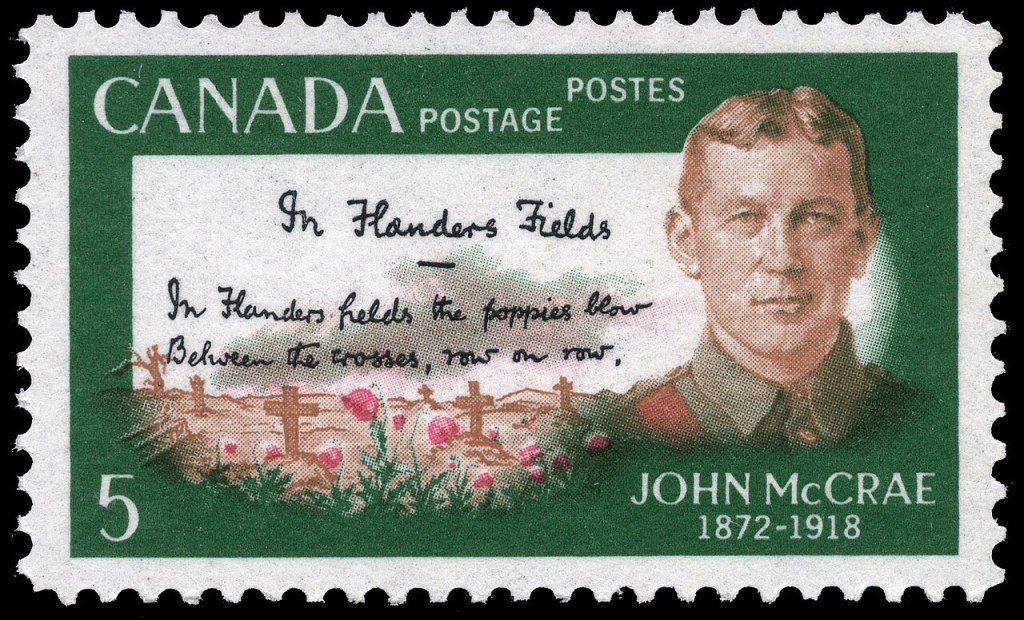
In Flanders fields the poppies blow
Between the crosses, row on row,
That mark our place; and in the sky
The larks, still bravely singing, fly
Scarce heard amid the guns below.
We are the Dead. Short days ago
We lived, felt dawn, saw sunset glow,
Loved and were loved, and now we lie,
In Flanders fields.
Take up our quarrel with the foe:
To you from failing hands we throw
The torch; be yours to hold it high.
If ye break faith with us who die
We shall not sleep, though poppies grow
In Flanders fields.
*****
The trouble for me with this Canadian war poem is that it (correctly) has no suggestion of its First World War conflict being in any way just or having a moral underpinning. That war was merely cousins who ruled empires jockeying for power. And the poem has no more uplifting exhortation than “Take up our quarrel with the foe”. Whoop-di-doo. My foolish Australian grandfather was killed in it in September 1914.
Wikipedia says: “Despite its fame, “In Flanders Fields” is often ignored by academics teaching and discussing Canadian literature. The poem is sometimes viewed as an anachronism; it spoke of glory and honour in a war that has since become synonymous with the futility of trench warfare and the slaughter produced by 20th-century weaponry.”
Happy Remembrance Day? Enjoy the good weather and love life – you only live once, possibly!


When you come to Kansas City, Missouri, you must visit the National World War I Memorial and Museum. First dedicated as a memorial
LikeLike
I confess, I didn’t even know McCrae was Canadian, although I see from Wikipedia that he was the grandson of emigrés from Kircudbrighshire in the Scottish Borders. But it strikes me as a pretty neat rondeau, a form that’s trickier than it looks. And I take your point that it addresses none of the underlying issues of war, but the sentiment that the soldier wants his comrades to keep on fighting — in the battle for which he’s given his life — that seems to me to be reasonable under the circumstances. And he did write it out of loyalty to a dead friend, shortly after the death, so he was genuinely affected, not performing from a distance. My granddaughter (13 at school in Fife in Scotland) is tasked with learning this poem for homework this week. She is not inspired by it.
But at least it explains the reason for the poppies, the focus on them as a symbol of loss of life, and a reminder that the farm fields in France really were awash with poppies, as well as dead men, which is what I said to her. Also interesting that the commemorated comrade, died in the second battle of Ypres, which was the first mass use of poison gas. Horrendous. My great-uncle fought in that war, though I have no idea whether he was at Ypres. But he did tell me that his baldness (not one hair on his shiny head) was caused by the gas, and that helps to remind me that his poem was written during a real and horrible horrible horrible war. Simply appalling. They must have been so glad to have that Canadian doctor/poet on hand. Yet the appetite for such things is not dead.
LikeLike