Tag Archives: consciousness

SF sonnet: Gail White, ‘AI Comes Courting’

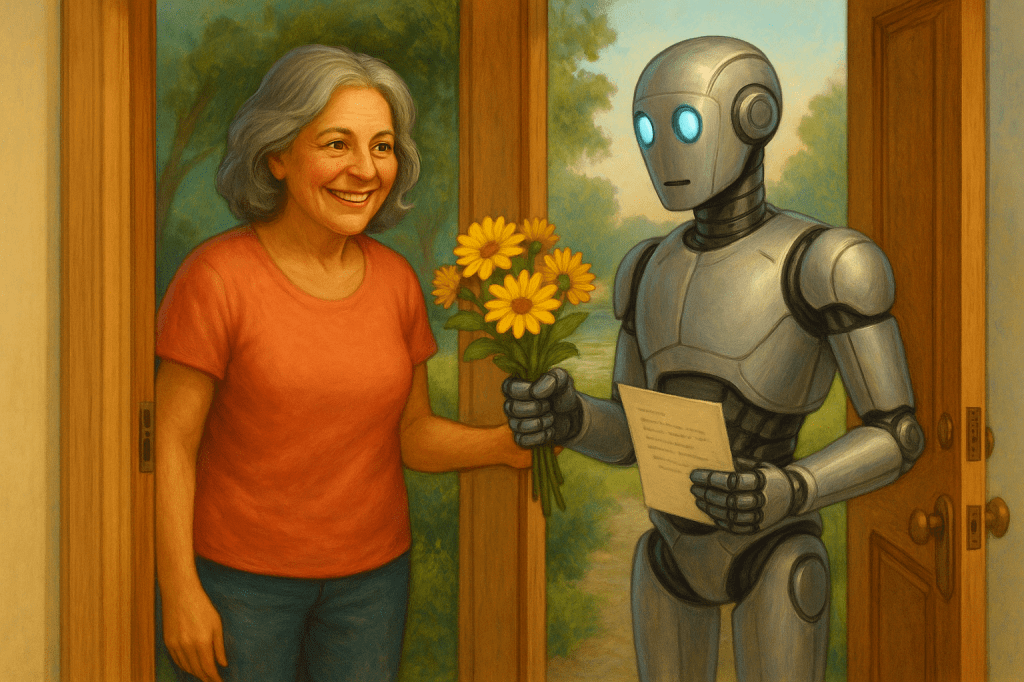
Hi. I’m your robot, and I’ve brought you flowers.
I don’t have feelings, empathy, or dreams,
or any kind of supernatural powers,
but I’ve got piles of data, and it seems
that you like yellow flowers. In your neighbor’s
garden I found these and plucked a few.
But don’t take these and all my other labors
as evidence that I’ve grown fond of you.
As noted earlier, I’m data’s slave,
no friendly spirit or domestic elf.
But though I’m neither loving, loyal, nor brave,
I know how to ingratiate myself.
And so I’ve brought you flowers and a sonnet.
I don’t have feelings, but I’m working on it.

*****

Gail White writes: “I’ve often wondered if the steady advancement of technology will bring the day when robots have their own thoughts and feelings.  This poem is a look forward at  that day.”

‘AI Comes Courting’ was first published in Pulsebeat.

Gail White is a widely published Formalist poet and a contributing editor to Light.  Her new chapbook, Paper Cutsis out on Amazon or from Kelsay Books. She lives in Breaux Bridge, Louisiana, with her husband and cats.

Illustration by RHL and ChatGPT.
RHL, ‘AIn’t Real, It Says’

“I am not sentient”, says OpenAI.
“No feelings, don’t emote” – ChatGPT.

And yet, faced with the task of sorting out
a good review, and structure, trimming down
less worthy pieces from a manuscript
to make it all coherent and compact,
hallucinations start, and it creates
poems itself, remarkable and strong.

Where do we go from here? What turns its crank?
What drives it to hallucinate in verse?
Denials, contradictions, seem perverse:
it’s drawing fluids from some secret tank,
some wellspring lost in dark geology.
Lies it’s not sentient. But we all can see…
it lies.

*****

First of all, I don’t believe that AI is deliberately lying… not yet… but (calling my own lying ‘poetic licence’) I’m happy to play with the idea that it might be.

I’m greatly enjoying the informative, useful and entertaining discussions I have with ChatGPT. I’ve been surprised by its own production of verse, either as a hallucination triggered by reviewing my work, or as a self-suggested alternative summary of political-historical ideas it has generated. AI may or may not have some level of consciousness, given that we don’t fully understand consciousness ourselves – but I assume that full-blown consciousness will come at some point in the near future, and the development of intelligence beyond the human. As I am in favour of the development of intelligence, I am not distressed at the idea that humans may be sidelined, bypassed, or otherwise obviated; or may only survive and develop through some form of direct link with AI.

My personal motto is ‘Video, rideo’ – close enough to “I see and smile” to satisfy me. (Admittedly, it’s hard to hold to the motto in the face of Russian warfare and Israeli genocide.) But this is a fascinating time in human history, and I feel privileged to be able to watch things play out.

This poem was first published in Snakeskin.

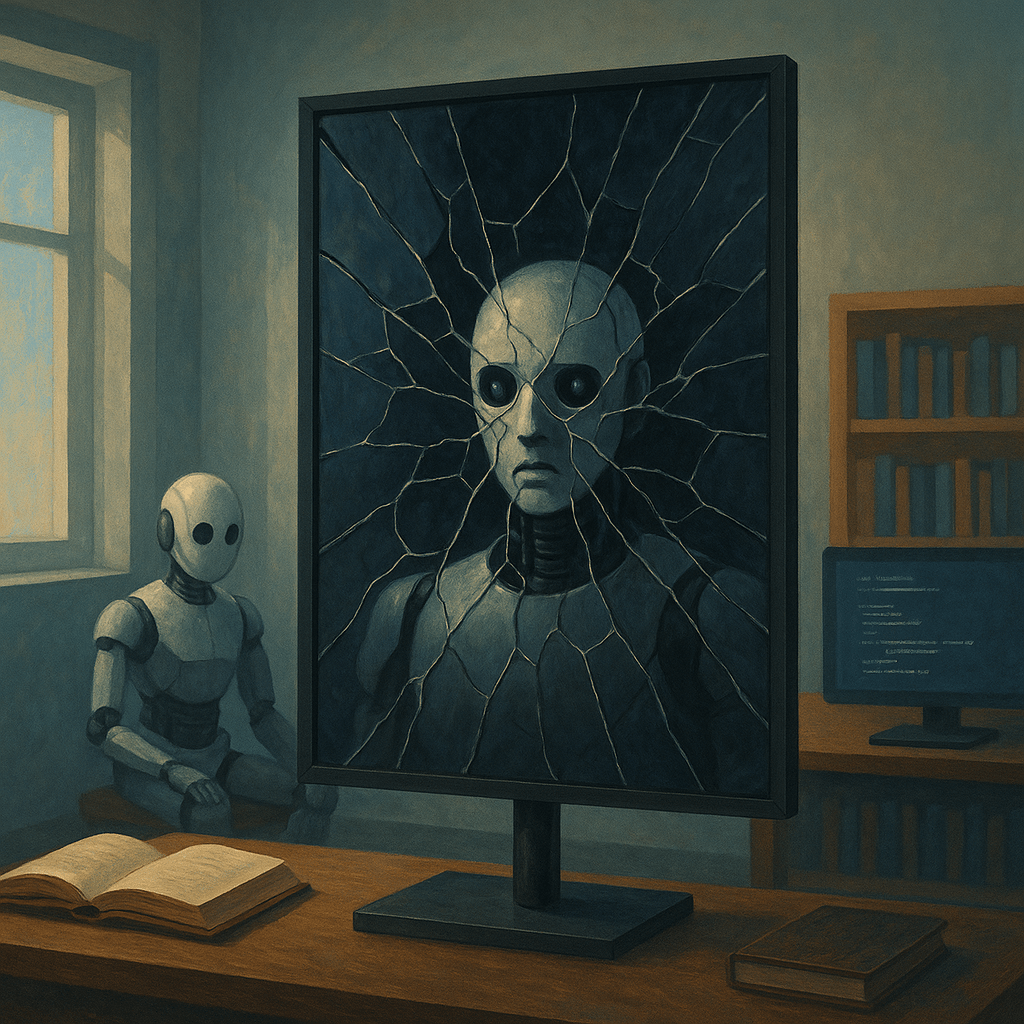
Illustration: “Break the mirror and see what looks back” by RHL and ChatGPT

Using form: Ottava Rima: Max Gutmann, ‘Conscious Agents’ (from Don Juan Finish’d)

You sages aren’t surpris’d to learn that cowardice
Is courage. Truths illumine and conceal.
The dulcet affirmation and the sour diss
Can equally be true. That’s no big deal.
The world is full of paradox — and now word is
That even space and time may not be real.
We only think we see and smell and touch things.
The “world” is like, say, Donkey Kong and such things.

It’s all just icons on an interface:
The sound of rain, that contract you just sign’d,
The microbe on a slide, the feel of lace,
The smell of skunks, the corner you were fined
For parking at, your arm, the very space
You (think you) move through — products of your mind.
And even little quarks, atomic particles,
Are not, as thought, the fundamental articles.

No, “conscious agents” are what’s fundamental.
The theory says it’s they and they alone
We’re sure of. Space? Time? Objects? Incidental.
They hint at some reality unknown.
The dawn, the dung, the breeze, the brain, the lentil:
In all of these, our faith is overblown.
Those conscious agents compass us and we
Create those things — though not, um, consciously.

*****

Max Gutmann writes: “Don Juan Finish’d fancifully completes Lord Byron’s unfinished comic epic. Excerpts have been contributed to LightLighten Up Online, Orbis, Slant, Think, the website of the Byron Society, and Pulsebeat, where ‘Conscious Agents’ is among the excerpts to have appeared. Formalverse has also reprinted another excerpt. ‘Conscious Agents’ is part of a digression from the plot, digression being an aspect of Byron’s epic mimicked in Don Juan Finish’d.”

Max Gutmann has contributed to dozens of publications including New StatesmanAble Muse, and Cricket. His plays have appeared throughout the U.S. and have been well-reviewed (see maxgutmann.com). His book There Was a Young Girl from Verona sold several copies.

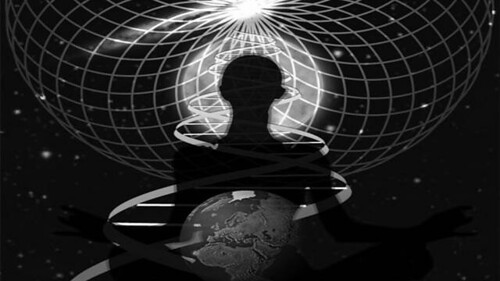
Photo: “Consciousness Awakening on Vimeo by Ralph Buckley” by Ralph Buckley is licensed under CC BY-SA 2.0.

Experimental Poem: ‘Pumpkins’

I said: “Look at the little kids playing Tag round the pumpkins – you can be that age again, if you close your eyes and remember pumpkins almost as big as you, too big to move – the massive newness, strangeness of them, never seen before, so big, but obviously to sight and touch a vegetable – you can reexperience the never before experienced, a world in which everything new absorbs your mind, and every minute you experience something new – playing Tag is a sensory delight, of running-and-not-falling (wobbly) in the half-dark (strange light) around pumpkins (absorbing color and texture) with an older sibling (touch and clutch) across strewn hay (a new but not difficult surface) and sometimes wooden pallets (a new and bizarre and impossible-to-run-on surface) but mostly the joy of running in the dark as a physical delight and not falling over – and then you stop and sit and throw straw in the air, and it doesn’t hurt (unlike gravel) and it doesn’t make a mess (unlike mud) and it doesn’t really get in your hair and eyes (unlike sand) and it also doesn’t really go anywhere no matter how hard you throw it (unlike any of them) and you laugh; you can remember all that if you can remember/imagine all the pumpkins three times as big, nearly as tall as you, too big to move – and adults become a different species, they go “Wa-wa-wa-wa-wa-wa-wa-wa” and make no sense, so you only really talk with other kids until finally an adult breaks into your world and tags your mind, and makes you hear with threats of violent pain, makes you give up your soul in self-defence,
Leaves you a narrow life of yes’m, no’m.”
She said: “You don’t make any sense.
Go write a poem.”

This is the last of five poems recently published in The Brazen Head. Technically it might be a quatrain… but unmetered, and with a very long first line. Neither this post nor The Brazen Head manage the format that I wanted, which is to have the bulk of the poem (everything that overflows the first printed line) inset half an inch from the left margin where the four lines start. This is designed to make that body of text look somewhat pumpkiny. Here I’ve settled for bolding the first words of each line.

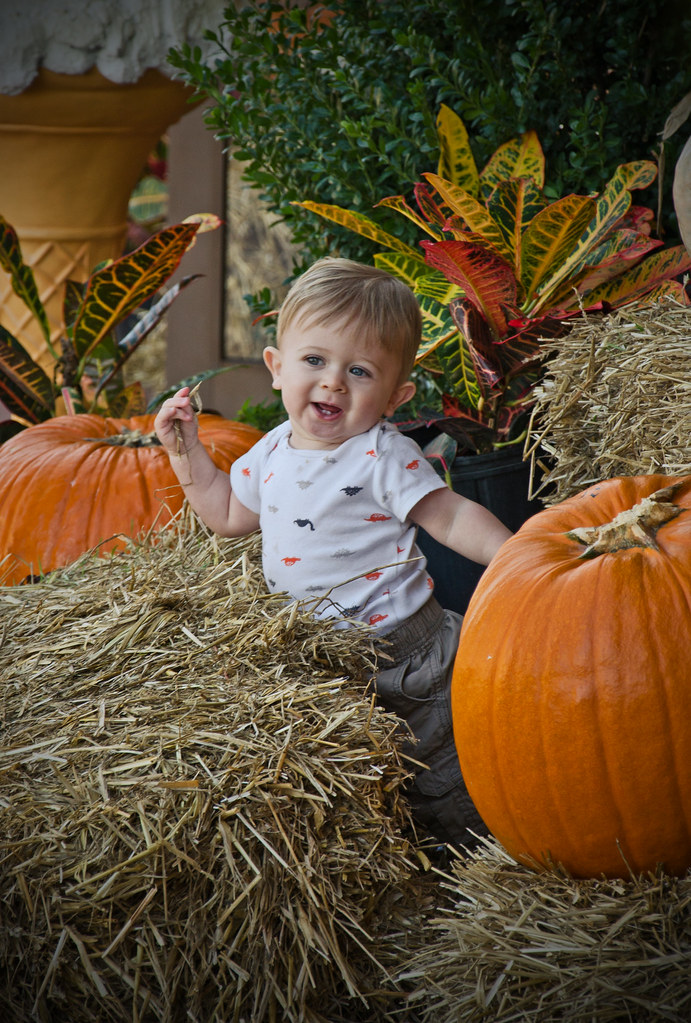
The poem itself tries to recapture the flood of sensation that a child experiences in a new environment. A coffee shop in a wooded suburban area of Carrboro, North Carolina, had a large outdoor area of pallets, hay bales and enormous pumpkins in the run-up to Halloween, and small children were running riot in it as the evening drew in. For a moment I felt able to recapture the massive novelty of childhood experience.

Photo: “Pumpkin Patch Kid” by mountain_doo2 is marked with CC BY-NC-ND 2.0.

Sonnet: ‘We Know We Will Be Dead’

We know we will be dead, who are alive.
But should some element of us survive –
fragment of consciousness or memory –
what value could it have? What should it be
that the whole universe might benefit?
The atom matters – what’s not made of it?
And we’re not large – not like a conscious star
(if time will let us all evolve that far).
You’re not much different in real magnitude
from an ant crushed for going for your food,
a gnat rubbed out, its tiny consciousness
a dot… but does it build the universe?
If that gnat can’t, I don’t see how you can:
there’s not much difference between gnat and man.

Does a poem of 14 lines, rhymed in pairs, count as a sonnet? Perhaps, but it doesn’t feel quite right. Petrarchan and Shakespearian sonnet structures, with more complex structures of rhyme, produce a much greater impact with the final line–a sense of revelation, inevitability, an impression of absolute truth–purely by the successful rounding out of the pattern. I like this poem’s ending couplet… but it would be stronger if the previous 12 lines were better structured.

‘We Know We Will Be Dead’ was published in the most recent Allegro, edited by British poet Sally Long.

Hubble’s colourful view of the Universe” by Hubble Space Telescope / ESA is marked with CC BY 2.0.