I grip its tail, hammock its back,
and swing its head down with a crack
on rock, then feel its spasms judder
through my hands as, with a shudder,
it stills,
a grand finale that fulfills
some ancient impulse in my mind.
Poking my finger through a gill,
I cause the raker fronds to spill
blood that drip drips as I carry
the silver deadweight of my quarry,
my kill,
toward a tidal pool
the sunset has incarnadined.
My knife begins behind its throat
and blood-clouds billow out and bloat
then seep into an outflow, seaward,
where baitfish burrow in the seaboard
in schools,
their heads in sand, small fools
kidding themselves they’re hard to find.
I slit its stomach. From that sac
their half-digested eyes peer back,
sandlance dumbstruck at being hunted
in shallow flats this prowler haunted,
this fish
whose every feeding flash
signalled flesh to seals behind.
Somewhere nearby a black bear roars;
wolves salivate; an antler gores
a starving cougar; orcas cripple
humpbacks, bite their fins, then grapple
great bulks
till bleeding, savaged hulks
sink; and then there’s humankind.
No kindness here. This salmon swam
full speed to seize my lure then, wham,
became a madcap, hell-for-leather,
death-row inmate on a tether
and fed
the caveman in my head.
This coast is one big hunting blind.
*****
John Beaton writes: “I’m a lifelong fly-fisher but I’ve always had twinges of conscience about hurting and killing fish. Catch-and-release makes me question whether I’m being cruel. But there’s also a part of me that still connects with the beautiful brutality of the eat-or-be-eaten ecosystems in which we live. This poem tries to express that perspective in the context of an actual experience—the catching and killing of a coho salmon off a rocky shoreline near Tofino.
I chose a form to tell the story with some element of shock and violence. Each stanza has seven lines: one and two are tetrameter with masculine rhymes; three and four are also tetrameter but with feminine rhymes to cushion what comes next; five and six are monometer and trimeter respectively with masculine rhymes and these cropped lines set up a sense of surprise and violence; and line seven is tetrameter with a masculine ending that ties the poem together by rhyming with all the other seventh lines.
There’s some justification for killing the coho—the victim is itself a killer. And the turn at the end of the penultimate stanza connects humans with the savagery of the wildlife.
Sometimes you find a ‘eureka’ word—one that fits rhyme, meter, and sense so well you think ‘wow.’ This poem has one I think of that way: incarnadined.”
John Beaton’s metrical poetry has been widely published and has won numerous awards. He recites from memory as a spoken word performer and is author of Leaving Camustianavaig published by Word Galaxy Press, which includes this poem. Raised in the Scottish Highlands, John lives in Qualicum Beach on Vancouver Island.
https://www.john-beaton.com/
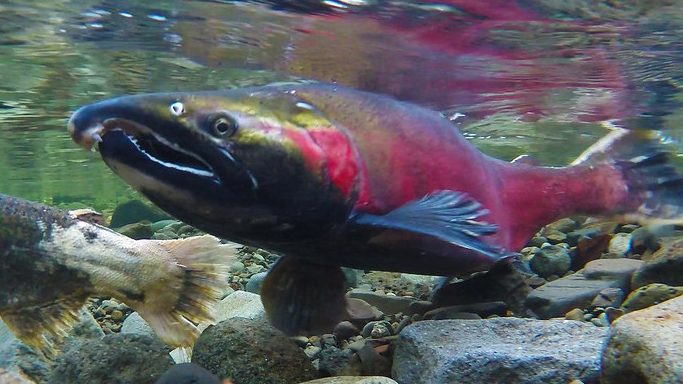
Photo: “Coho Spawning on the Salmon River” by BLM Oregon & Washington is licensed under CC BY 2.0.
 Form in Formless Times