Tag Archives: James B. Nicola

Villanelle variation: James B. Nicola, ‘My MFA’

I thought I’d go and get my MFA
since college never taught me how to write.
It’s not that I had anything to say;
 
I needed somehow, though, to spend the day
and, existentially I guess, the night
as well. So I went for an MFA
 
in Creative Writing. I did OK,
creatively. My grammar was a fright,
and there was nothing that I had to say,
 
but you got extra points for this. The way
you said squat was what mattered. Outasite, 
I thought, which, when I got my MFA,
 
I didn’t know was not a word. But stay,
they’d said, you can’t create if you’re uptight.
There is no wrong or right. And who’s to say
 
that parts of speech, or lie in lieu of lay,
or topic sentences, are not a blight
on Creativity? What could I say?
I’d paid a lot to get my MFA.

*****

James B. Nicola writes: “Purists take note. ‘My MFA‘ is not quite a villanelle, since the repeated lines vary so much. I suppose Elizabeth Bishop started the ball rolling with ‘(Write it!)’ in the last line of her now-famous villanelle (or is it?) ‘One Art.’ Like her, I am originally from Worcester, Massachusetts; perhaps that explains our consaguinity.”

James B. Nicola’s poetry has appeared internationally in Acumen, erbacce, Cannon’s  Mouth, RecusantSnakeskinThe South, Orbis, and Poetry Wales (UK);  Innisfree and  Interpreter’s House (Ireland); Poetry Salzburg (Austria), mgversion2>datura (France);  Gradiva (Italy); EgoPHobia (Romania); the Istanbul Review (Turkey); Sand and The Transnational (Germany), in the latter of which his work appears in German translation;  Harvests of the New Millennium (India); Kathmandu Tribune (Nepal); and Samjoko (Korea). His eight full-length collections (2014-2023) include most recently Fires of Heaven: Poems of Faith and Sense, Turns & Twists, and Natural Tendencies. His nonfiction book Playing the Audience won a Choice magazine award.

‘My MFA’ was originally published in the current Lighten Up Online

Photo: “creative-writing-ideas Atlanta GA” by agilemktg1 is licensed under CC BY 2.0.
Weekend read: James B. Nicola, ‘Pair of Kings’

All Clark Gable had to do
was sit where Hattie sat
the night she won her Oscar®. He
might not’ve thought of that:
but how the angels would have chimed
and cheered the noble cause
of basic decency, and broken
out in wild applause.
 
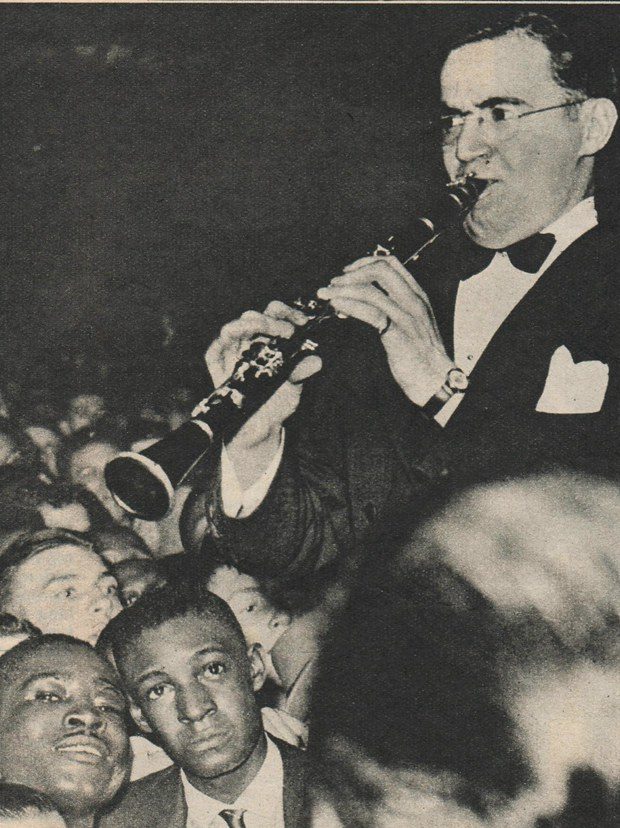
Benny Goodman would not sleep
where his Brothers could not stay.
He paved the American way before
it was the American Way.
For the color of music’s the color of God:
the color of his quartet!
So I hold no truck with movie stars,
but I play the clarinet.

*****

James B. Nicola writes: “Hattie McDaniel was the first American woman of African ancestry to win an acting Oscar. It was for Gone with the Wind, Best Picture of 1939, which starred Clark Gable, the #1 movie star at the time, known as the ‘King of Hollywood’. McDaniel was not allowed to sit with her fellow nominees. Her acceptance speech, nonetheless, overflowed with grace and gratitude.

Benny Goodman, clarinet player and band leader, was so popular he was known as the ‘King of Swing’. His quartet included two players of African ancestry. When on tour, Goodman, true to his name, only booked overnight accommodations that accommodated all four of his players. The film The Green Book gave us a good look at these hotel policies in America. It won the Oscar for Best Picture of 2018.”

James B. Nicola’s poetry has appeared internationally in Acumen, erbacce, Cannon’s  Mouth, RecusantSnakeskinThe South, Orbis, and Poetry Wales (UK);  Innisfree and  Interpreter’s House (Ireland); Poetry Salzburg (Austria), mgversion2>datura (France);  Gradiva (Italy); EgoPHobia (Romania); the Istanbul Review (Turkey); Sand and The Transnational (Germany), in the latter of which his work appears in German translation;  Harvests of the New Millennium (India); Kathmandu Tribune (Nepal); and Samjoko (Korea). His eight full-length collections (2014-2023) include most recently Fires of Heaven: Poems of Faith and Sense, Turns & Twists, and Natural Tendencies. His nonfiction book Playing the Audience won a Choice magazine award.

‘Pair of Kings’ has just been published in Rat’s Ass Review.

Photo: “jazz ill Benny Goodman 1955” by janwillemsen is licensed under CC BY-NC-SA 2.0.
 

Potcake Poet’s Choice: James B. Nicola, ‘Everybody’s Friendly, Just About…’

On my floor there lives a very nice old
man. Foreign. He’s going blind.
I don’t think he was necessarily an act-
or but a vestigial life percolates up from beneath
the lines in his face and accent. Lately, reaching
out to him has become exhausting. He’s too friendly

now and thrusts his face too close. . . . I was friendly
when I moved in the building. I thought old
meant interesting. Besides, singles are always reaching
out somehow, even when we appear blind
to the personalities and plights that lie beneath
the surface of a stranger’s smile, that casual act

on the elevator where everyone’s an act-
or in some way. Alas, I lack the stamina to feel friendly
always. . . . One time I was standing beneath
the shower in the health club, and another old
man poked his head in. The steam must have blind-
ed him to the soapy mess in my hair. He was just reaching

for whomever he could find for help. What’s wrong with reaching
out when you need help? He had been a famous act-
or, probably used to bothering others. I almost blurted, “Are you blind
or what?! I’m showering!” I felt unfriendly—
then hypocritical, for I knew the showers were old.
After I got his to work, I heard him singing beneath

the nozzle and the steam. Tone deaf. Of course beneath
it all, I was just cranky about his not reaching
out to some paid employee instead of me. Was I getting old
all of a sudden? Old and irritable. O, why resent act-
ing friendly simply because you don’t feel particularly friendly? . . .
Sometimes in the elevator, I’ll read. The book or magazine’s a blind,

but is it hypocrisy? I wonder. Then, when a certifiably blind
person gets on—with a walking stick—the person lying beneath
my literary subterfuge looks up, and, actually feeling friendly,
says hello, implying I could provide some assistance in reaching
a floor if so desired. No, this is not an act:
When they don’t ask for help, I don’t feel cranky or old.

When they do, rudely, I fear I’m going blind, reaching
out to souls beneath loud showers, trying too hard to act
friendly always, and turning prematurely old.

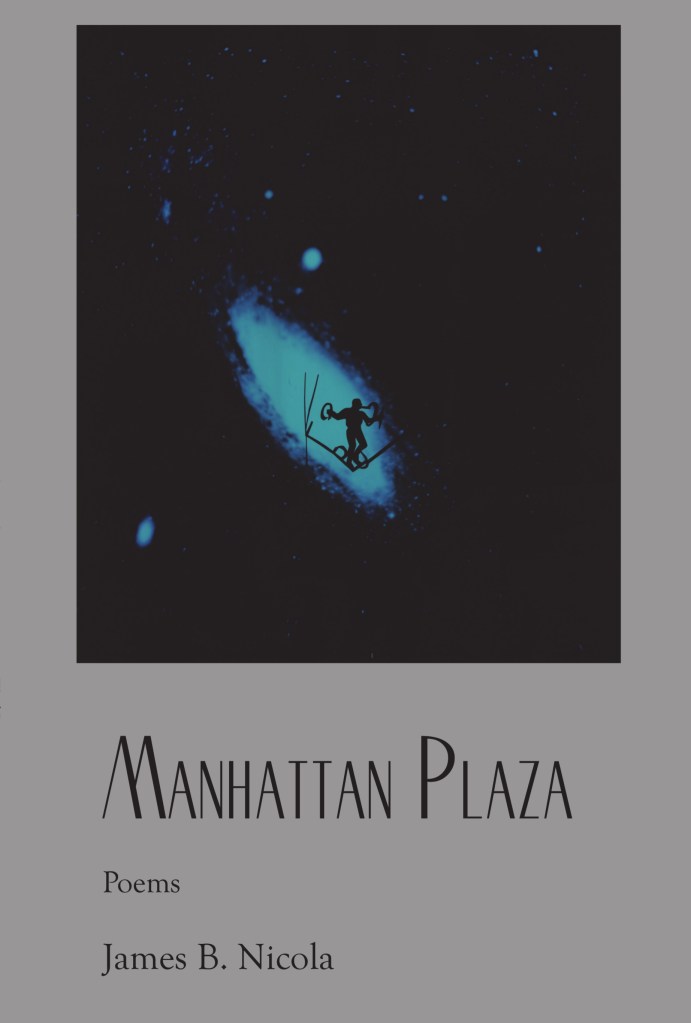
James B. Nicola writes: “If anyone cares to perform ‘Everyone’s Friendly, Just about….,’ you can either enhance the repeated end-of-line words (slightly), or try to ‘enjamb’ through them. In this way, you may notice it exploits the sestina form to serve as a bridge between the ‘poetic/special/heightened’ and the ‘conversational/ quotidien/ casual.’ The balance, or tension, between the two is a concern we have in the theater as well, with the actor’s craft. More than once have I coached an actor with: “For heaven’s sake, don’t let anyone catch you acting!” The poem is the first sestina of mine ever published. It is from my first poetry collection, Manhattan Plaza.”

James B. Nicola has authored six collections of poetry, the latest being Fires of Heaven: Poems of Faith and Sense. Decades of theater work culminated in the nonfiction book Playing the Audience: The Practical Guide to Live Performance, which won a Choice award. Residence: New York City; born: Worcester, Massachusetts.
https://sites.google.com/view/james-b-nicola

Launch: Potcake Chapbook 11, ‘Lost Love’

‘Lost Love – poems of what never happened, and of the end of things that did’… how bittersweet; but what a collection of poets, and what a diversity of stories and observations!

Seventeen poets are packed into this chapbook. Seven have appeared before: Marcus Bales, Melissa Balmain, Michael R. Burch, Vera Ignatowitsch, Martin Parker, Gail White and myself. Ten are new to the series, with wicked little pieces from Brooke Clark, Cody Walker and three from Wendy Cope, and with longer poems from N.S. Thompson, James B. Nicola, Mary Meriam, Helena Nelson, David Whippman, Richard Fleming and Vadim Kagan. Bios, photos and links to read more of their work can all be found on the Sampson Low site’s Potcake Poets page, while all the chapbooks in the series, showing which poets are in which, are here. Each of the 11 chapbooks is profusely illustrated (of course) by Alban Low, and can be yours (or sent to an ex) for the price of a coffee.

Heartbreak has never had a happier manifestation!