Tag Archives: nature

F.F. Teague, ‘Lament of the Leaning Trees’

We were planted to stand, not to sprawl in this way
  by the larger of lakes in the park,
to stare straight at the sky through the night and the day,
  not to ogle our own shades of bark.

But the lake has swelled swampily over the years,
  seizing soil in her cool clammy clench,
with a treasure of twigs-and-grass, sweet chestnut spheres,
  and a hoard of hard wood, once a bench.

How we cling to the earth with our tendrilous toes
  while the lake laps in sinister sheen,
rousing daily and nightly our powerless throes
  as we lean, and we lean, and we lean.

*****

​’Lament of the Leaning Trees’ was first published in The HyperTexts, July 2021​

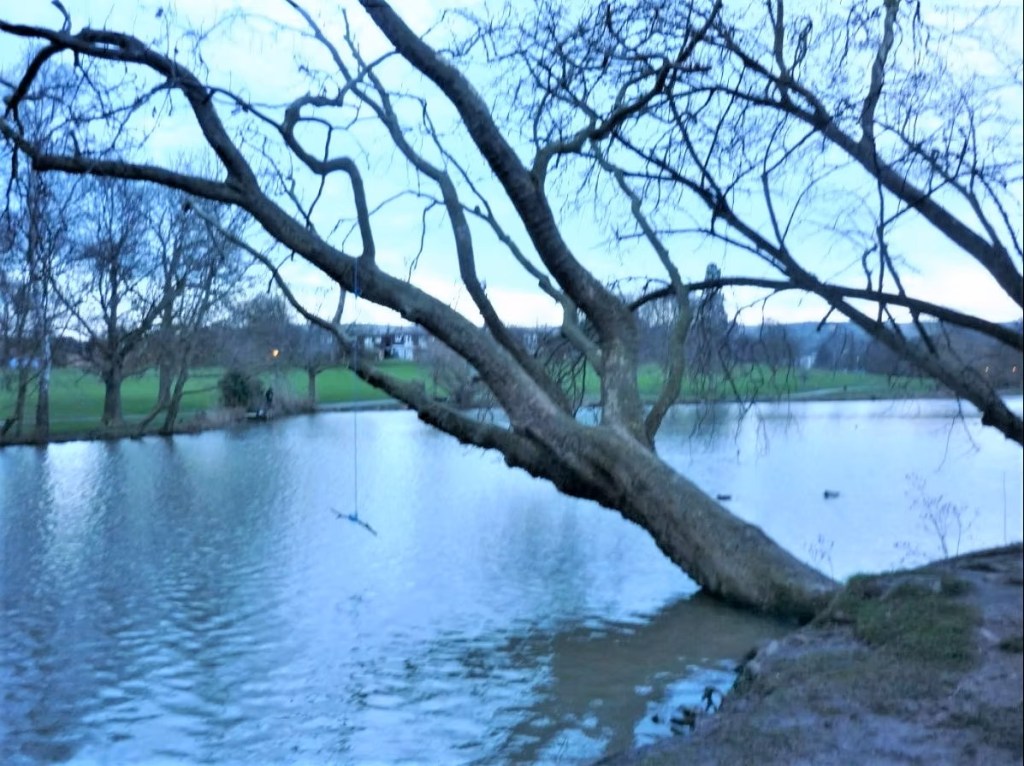
F.F. Teague writes: “I composed this in January 2021, while recovering from a broken leg and a few complications. A photo of the leaning trees appeared on the Facebook page Pittville Swans & Friends. I hadn’t been out for a while and it was lovely to see the Leaning Trees again. Suddenly I started thinking about being able to leave my flat one day, which made me feel a bit more cheerful about things. When I got out, I took the above photo.
“The trees have been leaning ever since I can remember. I lived in an area of Cheltenham called Fairview, not far from Pittville, for about nine months in 2001 and they were certainly leaning at that point. Every time I visit the park, I half-expect to see at least one tree lying in the water. But they must have very strong roots, because they just keep leaning. The council has removed a few branches over the years yet the shape of the trees remains distinctive.”

Felicity Teague (Fliss) is a copyeditor by day and a poet come nightfall. She lives in Pittville, a suburb of Cheltenham (UK). Her poetry features regularly in the Spotlight of The HyperTexts; her work has also appeared in AmethystLighten Up OnlineNew Verse ReviewSnakeskinThe Dirigible Balloon, and The Ekphrastic Review. Her first collection (2022) is titled From Pittville to Paradise; her second (forthcoming 2025), Interruptus: A Poetry Year. Other interests include art, film, and photography.

Photo by F.F. Teague
Sonnet: RHL, ‘Atavistic’

Just past the new development’s array,
beyond the parking lot, the flowers, the fence,
the land becomes uneven, falls away
into an area of no pretence,
abandoned cars, some rocks, some weeds, a bog.
Here are drawn children and eccentrics both,
searching for wild flowers, or a snake, a frog,
to nature lurking in the undergrowth,
beyond the ordered asphalt, lineal law;
drawn by our lower brain of hunter, ape,
where food is found or killed and eaten raw,
life is survival, and sex may mean rape.
Bricks, debris, rubble, condoms, empty beer…
yet, strangely, life-long loves have started here.

*****

I subscribe to the Nietzschean view of humans as a rope stretched over an abyss, animal on the one side, posthuman on the other. I think the ape is very alive within us, as is the drive to reach beyond ourselves to something vastly greater.

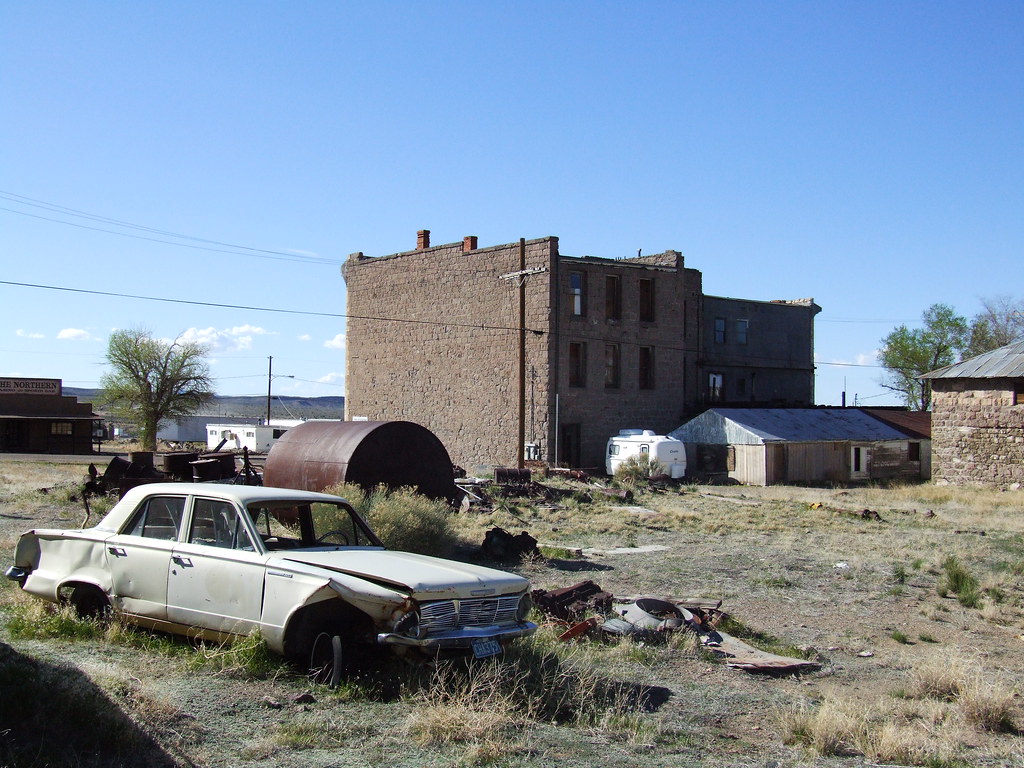
This sonnet was originally published in Rat’s Ass Review (thanks, Roderick Bates) but I’ve modified one line here to match the photo I found for illustration.

Photo: “Vacant Lot” by Curtis Gregory Perry is licensed under CC BY-NC-ND 2.0.

Potcake Poet’s Choice: Martin Elster, ‘The Woolly Bear’

Along a sylvan lane, you spy a critter
creeping with a mission, a woolly bear
fattened on autumn flora. So you crouch,
noting her triple stripes: the middle ginger,
each end as black as space. Her destination
is some unnoticed nook, a sanctuary
to settle in, greet the fangs of frost,
then freeze, wait winter out—lingering, lost
in dreams of summer, milkweed, huckleberry.
Though she’s in danger of obliteration
by wheel or boot, your fingers now unhinge her.
She bends into a ball of steel. No “ouch”
from bristles on your palm as you prepare
to toss her lightly to the forest litter.

She flies in a parabola, and lands
in leaves. Though she has vanished, both your hands
hold myriad tiny hairs, a souvenir
scattered like petals. When this hemisphere
turns warm again, she’ll waken, thaw, and feast
on shrubs and weeds (the bitterer the better)
then, by some wondrous conjuring, be released
from larval life. At length she will appear
a moth with coral wings—they’ll bravely bear
her through a night of bats or headlight glare,
be pulverized like paper in a shredder,
or briefly flare in a world that will forget her.

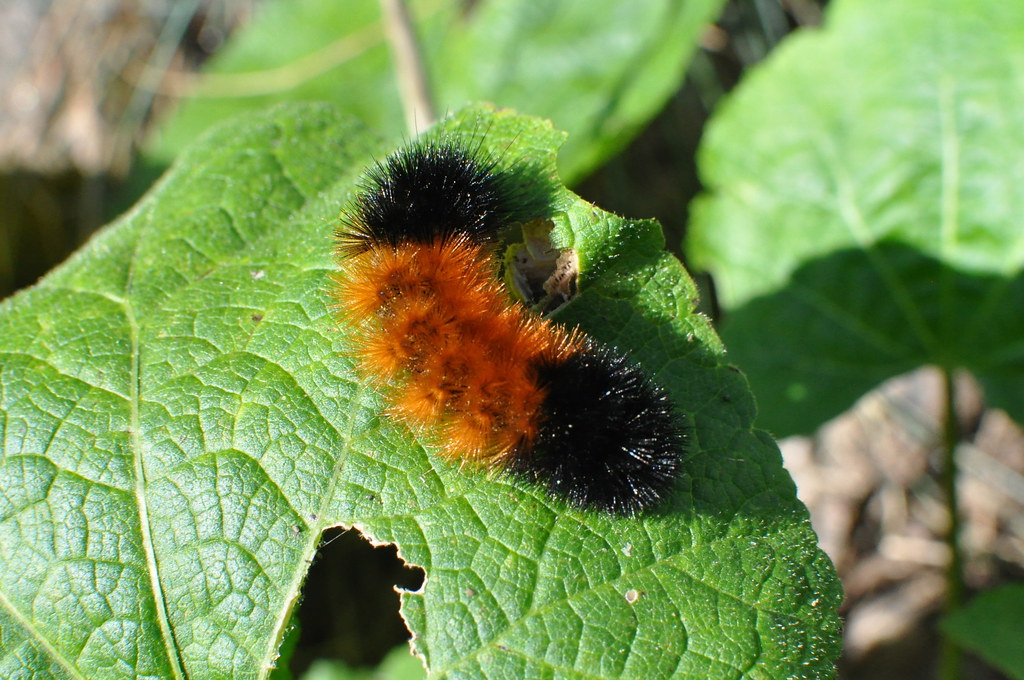
Martin Elster writes: “In the New England autumn, the leaves aren’t the only colorful feature in the landscape. Caterpillars are on the move, so they are more easily chanced on. A few years ago I lived briefly in a mainly rural and hilly town called New Hartford in the state of Connecticut. On my daily walks, I encountered many kinds of animals, including numerous lepidopterans (moths and butterflies), one species of which inspired this poem, an appropriate poem, I think, for late autumn or early winter.
The Isabella tiger moth (Pyrrharctia isabella) in its larval form is called the “banded woolly bear” (or “woolly bear” or “woolly worm”). The most remarkable attribute about the little critter is this (from Wikipedia):
“The banded woolly bear larva emerges from the egg in the fall and overwinters in its caterpillar form, when it literally freezes solid. First its heart stops beating, then its gut freezes, then its blood, followed by the rest of the body. It survives being frozen by producing a cryoprotectant in its tissues. In the spring it thaws.”
Covered in thick, fluffy-looking hair, the woolly bear sports bands of black and reddish-brown. There’s an age-old belief that the amount of brown on this critter can predict the severity of the coming winter. The more brown, the milder winter will be.
For the geeks: the rhyme scheme of the first stanza of the poem, similar to the bands on a woolly bear (ABA), is a chiasmus: ABC . . . CBA.

Martin Elster, who never misses a beat, was for many years a percussionist with the Hartford Symphony Orchestra (now retired). He finds contentment in long woodland walks and writing poetry, often alluding to the creatures and plants he encounters. His honors include Rhymezone’s poetry contest (2016) co-winner, the Thomas Gray Anniversary Poetry Competition (2014) winner, the Science Fiction Poetry Association’s poetry contest (2015) third place, and four Pushcart nominations. A full-length collection, Celestial Euphony, was published by Plum White Press in 2019.
This poem has appeared in The Road Not TakenAutumn Sky Poetry Daily, and The HyperTexts. His work has appeared in the Potcake ChapbooksCareers and Other Catastrophes‘ and ‘Robots and Rockets‘.

“Banded Woolly Bear (Isabella Tiger Moth) Caterpillar, Virginia” by Dave Govoni is licensed under CC BY-NC-SA 2.0

Potcake Poet’s Choice: Julia Griffin, ‘The Buck Stops’

A buck stopped here last Saturday early,
Just as the streets were turning blue.
A fine six-pointer, bronzed and burly:
What had it come for? Nobody knew.

It took its stand at the central bus stop,
Silent, proud-footed, thorny-topped.
There perhaps it had once seen us stop;
All that morning, nobody stopped.

It hardly seemed the thing to confront it.
We’ve little practice with bucks or deer;
Anyway, nobody tried to hunt it;
Anyway, nobody asked it here,

Maimed it, lamed it, blamed or shamed it!
This, in fact, is the most one can say:
A buck stopped here and nobody claimed it.
It waited a while, then it wandered away.

Julia Griffin writes: “I like the central image of a buck stopping. And it seems so widely applicable… I turn everything into an animal poem if I can.”

Julia Griffin lives in south-east Georgia/ south-east England. She has published in Light, LUPO, Mezzo Cammin, and some other places, though Poetry and The New Yorker indicate that they would rather publish Marcus Bales than her.

More of her poetry can be found in Light, at https://lightpoetrymagazine.com/?s=julia+g&submit=Search