Offered bread,
I asked for a stone.
The stone was good,
but I ate alone.
I took my bows
in a hail of rocks,
and built my house
of stumbling blocks.
But its walls are aligned
so true and tight
that they keep out the wind
that blows all night.
*****
Susan McLean writes: “And when the tempter came to him, he said, If thou be the Son of God, command that these stones be made bread.” Matthew 4:3 (King James Version)
“Or what man is there of you, whom if his son ask bread, will he give him a stone?” Matthew 7:9 (King James Version)
“I am not a religious believer, nor have I been one for many decades. But the poetry of the Old Testament and the metaphorical language of the New Testament both left their mark on me. Paradoxes and counterintuitive arguments, so integral to parables, are also at the core of poetry. Bread and stones—what does it mean to refuse the former in favor of the latter? To reject the normal and necessary, while choosing the impossible and unsustaining, can only lead to being misunderstood and rejected oneself, possibly even persecuted. Yet in this poem I argue that, paradoxically, taking the hard and lonely path has its own rewards. A stumbling block is solid; with a sufficient number of them, one can build a shelter that can withstand the strongest winds.
“The slant rhymes in lines 1 and 3 of each stanza, with their hint of dissonance, meet the resolution of the true rhymes in lines 2 and 4. Because dimeter lines, with just two stresses per line, can quickly become monotonous if the lines are too regular, I chose to use accentual meter instead of the more predictable accentual-syllabic meter. Therefore, the number of syllables per line varies from a low of three to a high of six. “This poem, originally published in the online journal The Chimaera, later appeared in my second poetry book, The Whetstone Misses the Knife.”
Susan McLean has two books of poetry, The Best Disguise and The Whetstone Misses the Knife, and one book of translations of Martial, Selected Epigrams. Her poems have appeared in Light, Lighten Up Online, Measure, Able Muse, and elsewhere. She lives in Iowa City, Iowa.
https://www.pw.org/content/susan_mclean
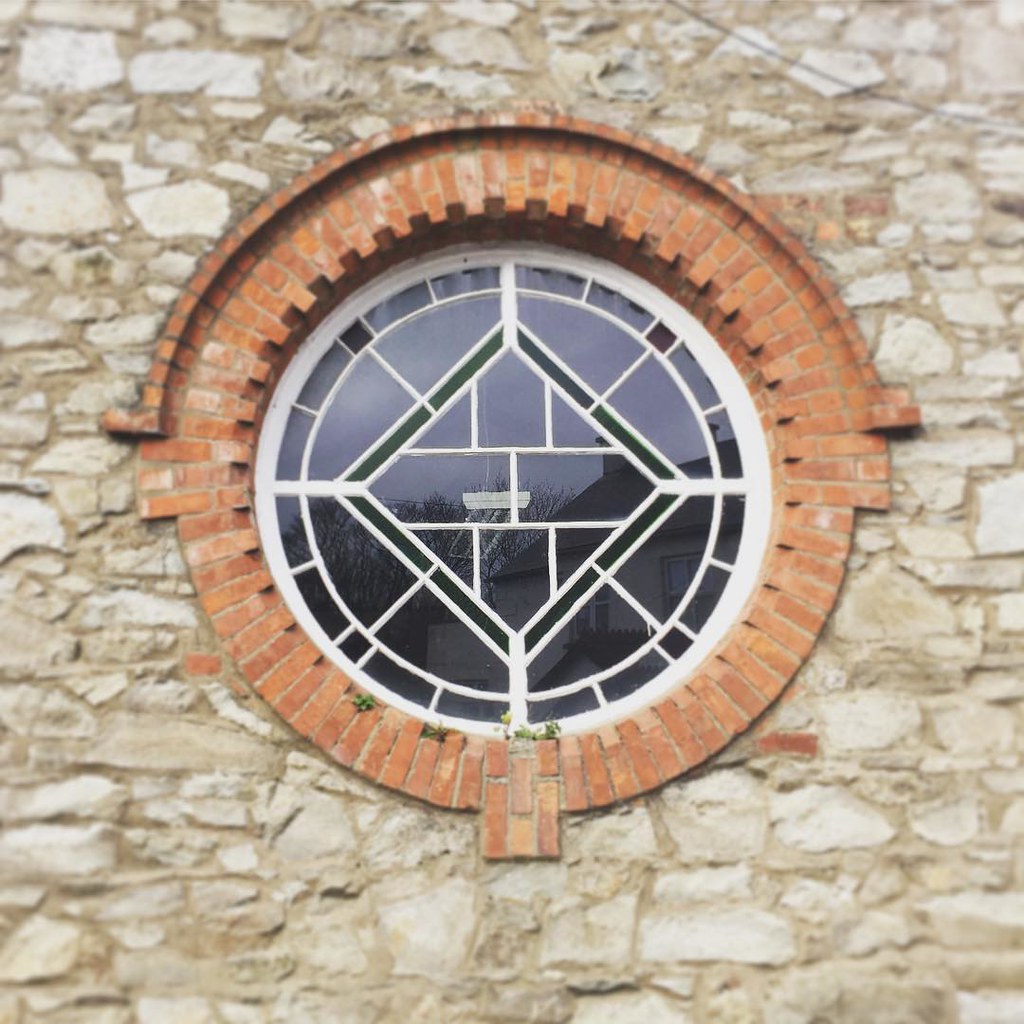
Photo: “Beautiful circular window and rough stone wall on this quaint little former school house in Arklow from the 1800s #windows #arklow #irisharchitecture” by irishhomemagazine is licensed under CC BY-SA 2.0.
 Form in Formless Times