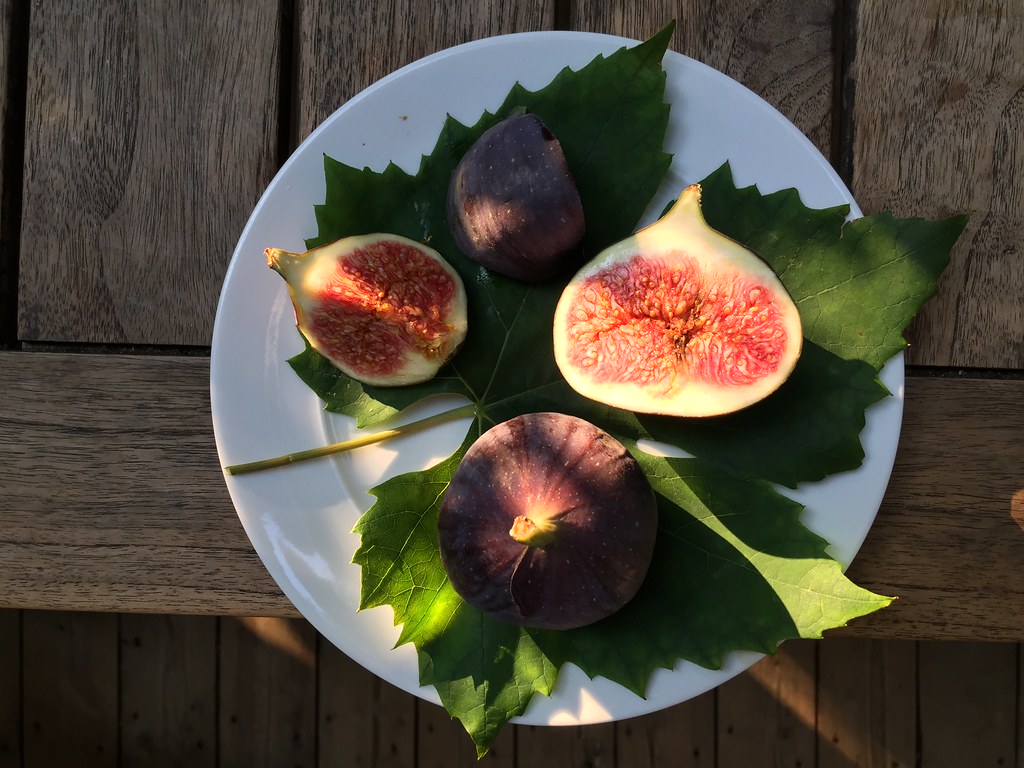
Because they don’t grow this far north; because
when I’m in Italy or France, it’s June
or earlier; because my parents raise them,
but when I visit, always it’s too soon
or late for that year’s crop; because they’re sold
in tiny cartons at outrageous cost
and not for long; because they’re slippery
and sweet as sin inside, and outside, soft
as breasts; because, once ripe, they split apart,
and rot or wasps destroy their fragile treasure;
because I know I’ll never get enough,
I always eat them with a groan of pleasure.
*****
Susan McLean writes: “I grew up in Maryland, in the suburbs of Washington, DC; it is a very mild climate zone, so when my sister gave my parents a fig seedling to grow, it flourished. By that time I was living in Iowa and Minnesota, where fig trees can’t survive the winters. I was a college professor, so I could visit my parents in summer or during the winter break, yet their figs didn’t ripen until late August and September, when I would be back at work. I liked traveling in Europe, too, during the summer vacation, but was usually there before the local figs had ripened. Thus, the only way I could eat fresh figs was by buying them imported from warmer locales, and they were extremely pricey and perishable. It became a sort of forbidden fruit for me, and therefore infinitely desirable.
“This poem is in the form of a litany, in which the introductory clauses all start with the same wording. It is a form familiar from the Bible (the Beatitudes, for example: “Blessed are . . .”) and from religious rituals, such as the repetition of a creed (“I believe in . . .”). I chose that form as a nod to the original forbidden fruit in Genesis. I alternate unrhymed lines with rhymed ones to mirror the tension between desire and fulfilment. The repetition of the “because” clauses without a main clause to finish the idea creates mystery and suspense, which is only resolved in the poem’s final line, evoking a sigh of satisfaction. The poem appeared in my first poetry book, The Best Disguise.”
[Figs are just so evocative; I can’t help linking to my own poem on them. RHL]
Susan McLean has two books of poetry, The Best Disguise and The Whetstone Misses the Knife, and one book of translations of Martial, Selected Epigrams. Her poems have appeared in Light, Lighten Up Online, Measure, Able Muse, and elsewhere. She lives in Iowa City, Iowa.
https://www.pw.org/content/susan_mclean
“Black figs on a vine leaf” by CharlesFred is licensed under CC BY-NC-SA 2.0.
 Form in Formless Times