Tag Archives: social issues

Sonnet: Maryann Corbett, ‘Saturday Edition’

Page one, above the fold: the world in flames.
A luxury hotel gapes like a sore.
In mammoth type, the headlines yell the names
of prophets stoking hells of holy war.

In Business, meanwhile, there is calm discussion
of sales rates for the sexy underclothes
pitched by Victoria’s Secret, and a fashion
for surgical revision of the nose.

It isn’t news to those who sell the paper:
their readers can take only so much hell.
They proffer me the surgeon and the draper
as pastures where my bovine brain may dwell,

ignoring, while it chews on this confection,
the screams of children from the other section.

*****

Maryann Corbett writes: “My records tell me that ‘Saturday Edition’ is one of my very earliest sonnets and very earliest acceptances, appearing in The Barefoot Muse in 2007 and included in Mary Meriam’s Irresistible Sonnets in 2014. It was among the poems that gave me the lightbulb realization that I tend to write sonnets when I’m angry.”

Maryann Corbett earned a doctorate in English from the University of Minnesota in 1981 and expected to be teaching Beowulf and Chaucer and the history of the English language. Instead, she spent almost thirty-five years working for the Office of the Revisor of Statutes of the Minnesota Legislature, helping attorneys to write in plain English and coordinating the creation of finding aids for the law. She returned to writing poetry after thirty years away from the craft in 2005 and is now the author of two chapbooks and six full-length collections, most recently The O in the Air (Franciscan U. Press, 2023). Her work has won the Willis Barnstone Translation Prize and the Richard Wilbur Award, has appeared in many journals on both sides of the Atlantic, and is included in anthologies like Measure for Measure: An Anthology of Poetic Meters and The Best American Poetry.

Photo: “UN School in Gaza Attacked” by United Nations Photo is licensed under CC BY-NC-ND 2.0.
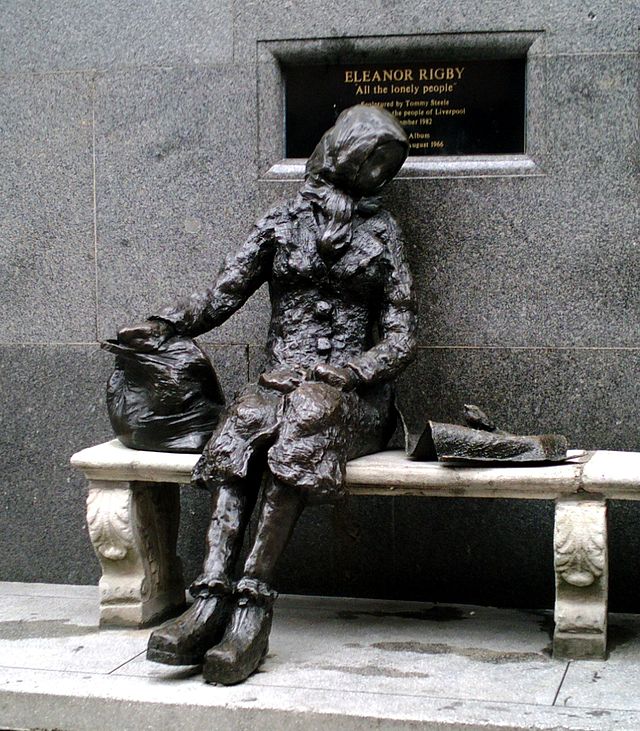
Songs as poems: Lennon-McCartney, ‘Eleanor Rigby’

Eleanor Rigby picks up the rice in the church where a wedding has been,
Lives in a dream.
Waits at the window, wearing the face that she keeps in a jar by the door,
Who is it for?

All the lonely people,
Where do they all come from?
All the lonely people,
Where do they all belong?

Father McKenzie writing the words of a sermon that no one will hear,
No one comes near.
Look at him working, darning his socks in the night when there’s nobody there,
What does he care?

All the lonely people, (etc)

Ah, look at all the lonely people!

Eleanor Rigby, died in the church and was buried along with her name,
Nobody came.
Father McKenzie, wiping the dirt from his hands as he walks from the grave,
No one was saved.

All the lonely people, (etc)

Written and released in 1966 on the Revolver lp and also as a double-A-side single with Yellow Submarine, ‘Eleanor Rigby’ was part of the Beatles’ dramatic move away from simple pop love songs into a vastly larger realm of portraits and social concerns and musical experimentation. Here, in a few lines, we have the protagonist’s lonely day-to-day life and unattended funeral, weaving back and forth with the empty church and its equally lonely priest. If Paul Simon’s ‘I Know What I Know’ is like a condensed Alice Munro short story, ‘Eleanor Rigby’ could be a full-length novel by Knut Hamsun or Kazuo Ishiguro… reduced to three 4-line verses and a refrain or two. The ideas are expressed as simple visual events, without speech. The words are straightforward, the rhymes uncomplicated–and some are slant rhymes, almost unnoticeable in song: been/dream, from/belong, grave/saved. But the impact is very powerful.

So who is the poet behind the song? Its article in Wikiwand states:

McCartney wrote the first verse by himself, and the Beatles finished the song in the music room of John Lennon’s home at Kenwood. John Lennon, George Harrison, Ringo Starr and Lennon’s childhood friend Pete Shotton all listened to McCartney play his song through and contributed ideas. Harrison came up with the “Ah, look at all the lonely people” hook. Starr contributed the line “writing the words of a sermon that no one will hear” and suggested making “Father McCartney” darn his socks, which McCartney liked. It was then that Shotton suggested that McCartney change the name of the priest, in case listeners mistook the fictional character in the song for McCartney’s own father.

McCartney could not decide how to end the song, and Shotton finally suggested that the two lonely people come together too late as Father McKenzie conducts Eleanor Rigby’s funeral. At the time, Lennon rejected the idea out of hand, but McCartney said nothing and used the idea to finish off the song, later acknowledging Shotton’s help.

Lennon was quoted in 1971 as having said that he “wrote a good half of the lyrics or more” and in 1980 claimed that he wrote all but the first verse, but Shotton remembered Lennon’s contribution as being “absolutely nil”. McCartney said that “John helped me on a few words but I’d put it down 80–20 to me, something like that.” Historiographer Erin Torkelson Weber has studied all available historical treatments of the issue and has concluded that McCartney was the principal author of the song, while speculating that Lennon’s assertions to the contrary were the result of lingering unresolved anger and the influence of manager Allen Klein.

John Lennon may have the stronger reputation as a poet, but this gem appears to be Macca’s. (Sorry; Sir Paul’s.)

Wikiwand credit: CC BY-SA 4.0 license