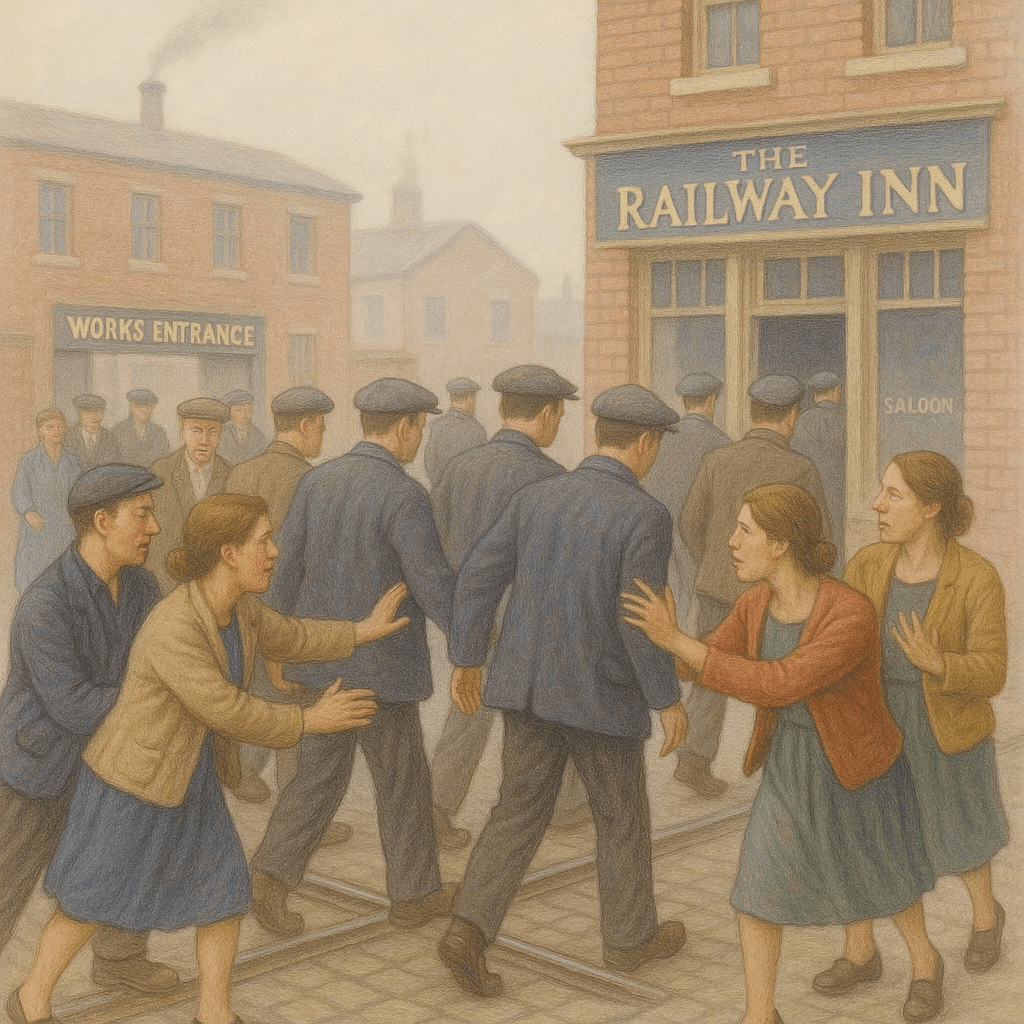
My dad’s plant was across the railroad tracks
from half a dozen shot and chaser bars,
and on paydays the bars were visited
and stocked with stacks of bills by armored cars,
and women waited at the gates and tracks
at shift changes, to try to intercept
their thirsty husbands in the passing throng
before they cashed and drank up half their check.
At the time, I didn’t think about
how desperate those women must have been
to go out on a crowded public street
and chase after their irresponsible men;
I guess I found it droll. But if I’d been
more aware, what could I have done or said?
When people’s lives are going off the rails
strangers only frown and shake their heads.
*****
David Stephenson writes: “When I was in high school, my dad worked at John Deere Plow-Planter—now called Seeding and Cylinder—in Moline, Illinois. This was before direct deposit, so the workers got paper paychecks. As with many factories, there were several taverns nearby, any of which would happily cash a paycheck. If I borrowed Dad’s car, I would have to pick him up and drop him off, so I was sometimes there during shift changes. On paydays you would see armored cars outside the bars, and at the end of the afternoon shift you would see women waiting on the railroad tracks, as described in the poem. It didn’t really register with me at the time, but later on I realized it was quite sad. I wrote the first two stanzas of the poem four or five years ago, but was stuck as to how to proceed, since I didn’t know what to say about the scene. What can you say? I finally came up with the current ending, which says there isn’t anything to say, but says it well.”
‘Payday’ was first published in Snakeskin.
David Stephenson is a retired manufacturing engineer from Detroit, and the editor of Pulsebeat Poetry Journal. His most recent collection is Wall of Sound (Kelsay Books, 2022).
Illustration: RHL and ChatGPT
 Form in Formless Times
Whenever I see David’s name in a journal, his poems are among the first ones I jump to and read. I admire his human, nuanced explorations of scenes and topics that are clearly grounded in experience and his ability to paint these scenes in natural, contemporary formal verse. His work often makes me feel like I am getting a privileged look at a world I have not experienced and have maybe even imagined less than I had realized.
LikeLiked by 1 person
That’s a very thoughtful comment on a thought-provoking poem!
LikeLiked by 1 person