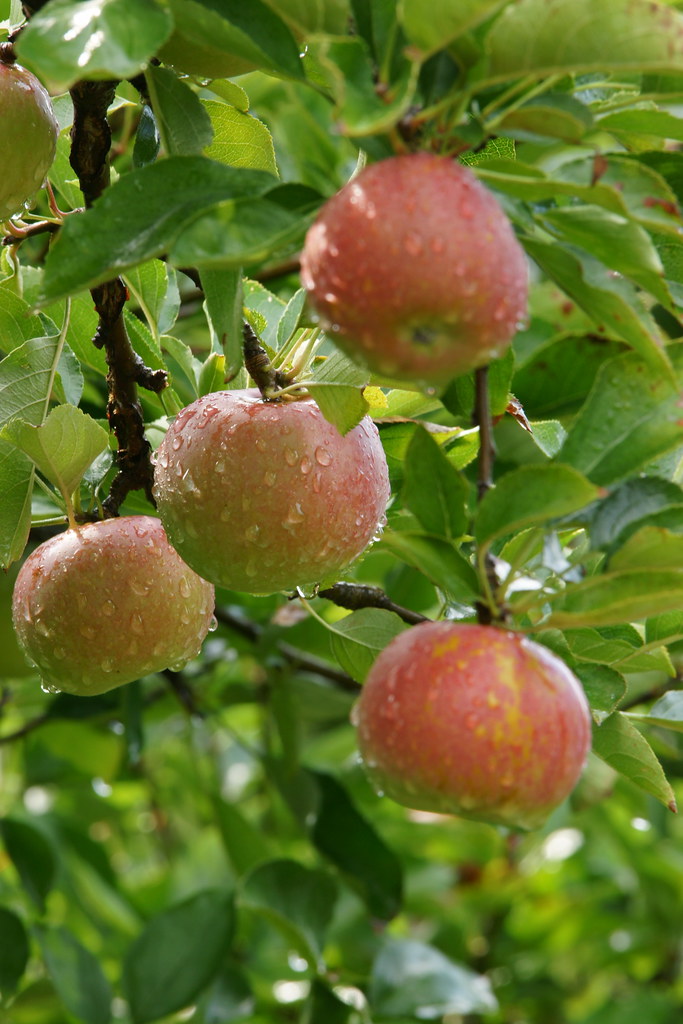
Loneliest of trees, a cherry blooms Unseen by you whose spartan rooms Have windows that are far too high For views of anything but sky.
Now with your nineties in full swing, You’ve doubtless started wondering If last year’s rides to see spring’s glory Were the last ones in your story.
And so you’re gamely making do With what’s available to you: A faded sprig from Mother’s Day; Pink sneakers; blushing fruit puree.
*****
Melissa Balmain writes: “This poem was indeed written for my mother-in-law, the irreplaceable Anne Cilurzo FitzPatrick. She died the following winter, in 2023, after a life devoted to family, music, writing, volunteer work, and the tireless pursuit of dark chocolate. Her obituary can be found here.”
‘For My Mother-in-Law’ appears in Melissa Balmain’s third poetry collection, Satan Talks to His Therapist, available from Paul Dry Books (and from all the usual retail empires). Balmain is the editor-in-chief of Light, America’s longest-running journal of comic verse, and has been a member of the University of Rochester’s English Department since 2010.
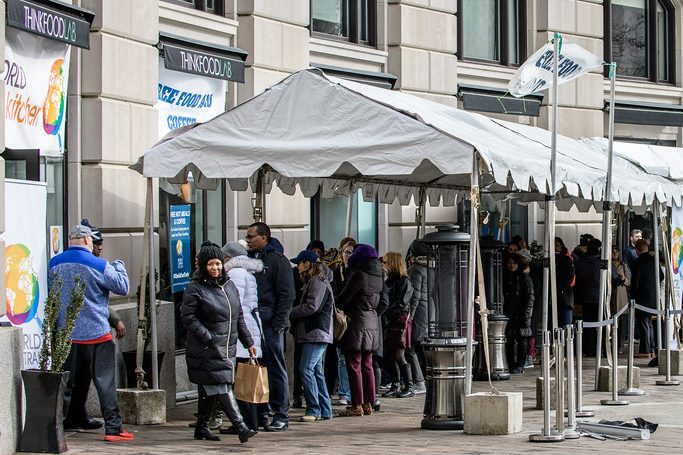
The sign. The side door. Come inside. We’re here by nine or ten. She sobbed. Pack extra peas. The dealer robbed His boss. No soups. They need a ride
To get their tags. Some coffee too. He’s had a stroke. It’s just a sprain. She can’t mow lawns for all the rain. She’s starved, but not for food. She’s blue
But cackles. Eggs. A constant cough. No chicken. You apologize: We don’t have diapers in that size. We’ll pay before they cut you off
And let you freeze. Her son’s on pills And so’s the wife. For seven weeks They’ll keep the kids. His engine leaks. She’s out of propane. Bring the bills
But come by five. Her swollen knees Are healing slow. His wife dropped dead On Christmas. Have some frozen bread, A bladder wash, a bag of cheese,
A pack of chocolate shakes, a pound Of venison, a protein bar, A couple sleeping in their car, A case of noodles, barren ground
On farmhands’ faces, cracked and worn. When silence falls, go find a shelf, Collect your neighbors as yourself And stack them up, like cans of corn.
*****
Jeff Sypeck writes: “Usually I write about history, and my poetry tends to focus on the past, but sometimes the here and now come calling, with tough and immediate needs.”
Jeff Sypeck is the author of the pop-history book Becoming Charlemagne and co-author of I Have Started for Canaan, the first full-length history of a Reconstruction-era African American community in Maryland. His latest book is an annotated, peer-reviewed translation of a Carolingian calendar poem. He lives in an agricultural reserve an hour outside Washington, D.C. www.jeffsypeck.com www.quidplura.com
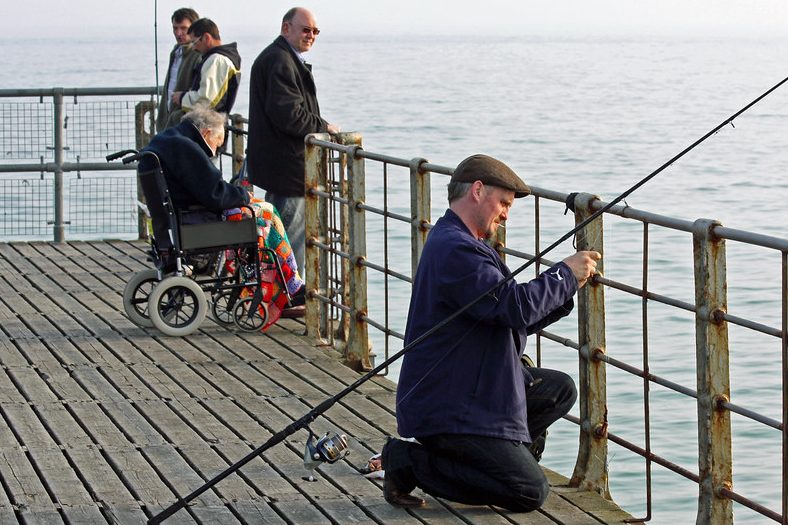
The old man wakens to a mute caregiver pushing his chair past gulls along a railing. This is the morning when he gets the river. Surrendering to wind and a prevailing
saline tang kicked up from the Atlantic, he lets whatever strikes him resonate. A taut rod wrangling with a snagged and frantic flounder whisks him to a lake upstate
where he, a wee one, tumbled off the dock, his virgin perch still flapping in his grip. A ferry, then, so very on the clock, transports him to the boxy convoy ship
he steered through moonlit breakers toward Pyongyang with perfect timing: his approach kissed land at dawn. He dropped the ramp, and roughnecks sprang out of the gangway onto commie sand.
Joggers, though, tug him back home from the war. Whole herds of them keep gallivanting by as thunder like they own the slate-paved shore. He has to sit there coveting their high.
Sneakered and young as far as he can see, they just keep leaving him behind to long for liberty and the serene esprit he got to savor when his legs were strong.
*****
Aaron Poochigian writes: “About the poem, all I want to say is that I think of it as flash fiction. I’ve started doing more studies of fictional characters in verse.”
Aaron Poochigian earned a PhD in Classics from the University of Minnesota and an MFA in Poetry from Columbia University. His latest poetry collection, American Divine, the winner of the Richard Wilbur Award, came out in 2021. He has published numerous translations with Penguin Classics and W.W. Norton. His work has appeared in such publications as Best American Poetry, The Paris Review and Poetry. aaronpoochigian.com americandivine.net
By evolution born and bred with something extra in the head (and maybe also in the heart) that sets us markedly apart
from all the teeming life on Earth, we sapiens, for what it’s worth, create and feel and comprehend, but to what purpose, to what end?
Wisely foolish, cruelly kind, with jumbled passions, muddled mind, we’re oxymorons through and through. In what we do or fail to do
a pestilential gifted ape with a history we can’t escape. Our future tenuous and stark, we stumble onward in the dark.
*****
Richard Meyer writes: “I’ve always been amused that our species defines itself as Homo sapiens, meaning “wise man” or “wise human.” The history of humanity contains much that is wonderful, beautiful, and commendable, but it also records much that is horrible, dreadful, and appalling. The verdict as to which tendency will prevail remains uncertain. It’s difficult to be optimistic when the Doomsday Clock was recently set at 85 seconds to midnight. In addition, the political situation in the United States is grim. So, we stumble onward.”
Richard Meyer, a former English and humanities teacher, lives in Mankato, MN. His book of poems Orbital Paths was a silver medalist winner in the 2016 IBPA Benjamin Franklin Awards. He was awarded the 2012 Robert Frost Farm Prize for his poem “Fieldstone.” His poetry has appeared in a variety of print and online journals and has also received top honors several times in the Great River Shakespeare Festival sonnet contest. He is also the author of Wise Heart, a memoir of his mother Gert who was born in poverty, came of age during the Great Depression, enlisted in the army during World War II, served overseas, achieved the rank of first sergeant, and was awarded the Bronze Star for meritorious service performed during the Battle of the Bulge. Richard’s most recent book is Stumbling Onward, a collection of new and selected poems. His books are available on Amazon.
Blessed now be Arius, although condemned as odd: his Jesus was created and was thus distinct from God.
Blessed be Pelagius who held there was no Fall. Blessed be the Mormons polygamy and all.
Blessed be the Adamites, who (being free from sin) went naked into churches, dressed only in their skin.
Blessed too be Origen, of mind so well behaved he liked to think that in the end the Devil would be saved.
Blessed be all doctrines held in Christendom’s dominions, and blessed be the Lord God who varies men’s opinions.
*****
Gail White writes: “I wrote this the other day while attempting to put my own irreverent thoughts on theology in the form of a Jewish prayer.”
Gail White is a widely published Formalist poet and a contributing editor to Light. She won the Rhina P. Espaillat Poetry Award from Plough magazine for 2025, and her latest chapbook, Paper Cuts, is out on Amazon or from Kelsay Books. She lives in Breaux Bridge, Louisiana, with her husband and cats.
By now you shall have counted out my fears on many fingers, and I count them, too, because I know I am already you remembering myself from your old years.
How loved you were: your hands, your heavy breasts, your laughter, and the secret talk of eyes, the vivid mouth, the spreading lap of thighs (beloved woman, warm and fully blessed
whose laughter lined our face with troughs for tears!) I write this down in order to prepare a kind of perfume for your sallow hair, a kiss, a love song for your wrinkled ears.
*****
Barbara Loots writes: “Following a form of Yeats (“When you are old and gray and full of sleep…”) I wrote this note to myself in my 30s. Now closing in on my 80s, I feel not in the least wistful or decrepit, still waiting for that imagined “old age”. With the perspective of some fifty years, I can say that old age is not at all as dismal as this poem would suggest. For one thing, my hair turned a rather dazzling white. And love faileth not.”
After decades of publishing her poems, Barbara Loots has laurels to rest on, but keeps climbing. The recent gathering at Poetry by the Sea in Connecticut inspired fresh enthusiasm. Residing in Kansas City, Missouri, Barbara and her husband Bill Dickinson are pleased to welcome into the household a charming tuxedo kitty named Miss Jane Austen, in honor of the 250th birthday year of that immortal. She has new work coming in The Lyric, in the anthology The Shining Years II, and elsewhere. She serves as the Review editor for Light Poetry Magazine (see the Guidelines at lightpoetrymagazine.com)
Melissa Balmain’s third poetry collection, Satan Talks to His Therapist, is available from Paul Dry Books (and from all the usual retail empires). Balmain is the editor-in-chief of Light, America’s longest-running journal of comic verse, and has been a member of the University of Rochester’s English Department since 2010.
No bitterness and no recriminations, no flesh hacked off in gladiatorial sport, no claims for unpaid debts, no scornful laughter to mock experience so dearly bought.
But differences all gently papered over, cracks filled and memory’s cobwebbed cupboards cleared. Receipts for all the good times carbon copied our life divides more simply than we’d feared,
with dogs and books and vinyl all apportioned, all ledgers balanced with forgiveness sought and paid for with a parting smile. For this had once been love – or so we’d thought.
*****
Martin Parker writes: “Sadly I can offer no significant thoughts about its background. I simply wrote it then left it in a drawer for about ten years as it did not seem to fit with anything I was writing at the time. But I do remember hoping that I had written something gentler and more civilised and sympathetic than much of what was appearing on the net at the time. And my ancient hope seems to have been justified in the light of recent reactions to the poem.
“My website at www.martinparker-verse.co.uk gives details and excerpts from my two hopefully humorous and only occasionally wrily depressing books in which parody, pastiche, satire, farce and poetic irreverence should appeal to all but the most po-faced of poetry fans.”
‘Fifty Ways to Leave a Lover. No. 51’ was originally published in Snakeskin.
Martin Parker is a writer of mainly light and humorous verse much of which has appeared in national publications including The Spectator, The Oldie and The Literary Review. In 2008 Martin founded the quarterly light verse webzine, Lighten Up Online at www.lightenup-online.co.uk, now edited by Jerome Betts.
“This was Mr Heaney’s room. The peat’s From off his boots. It got into the rug And won’t be Hoovered out. Likewise the sheets And pillow case.” Solemn, I nod and shrug,
Expecting little better, as I note The sad brace of dried heads, the shards of flint, The coprolites and drafts that Heaney wrote Lying untidied here. “He liked his pint,
Did Mr Heaney, but you know the Irish. That and a roasted spud. He didn’t pay The last two weeks and more. You know the Irish.” And so it is I lie where Heaney lay
And watch the twilight dripping with the murk Lurking beyond short curtains. Left alone, I ponder what she’d said: “He’d often work My bit of bogland like it was his own–
He liked the muck and suck. But then one day He got some kind of letter from the Swedes, Got all excited and he went away. Now the whole plot is given over to weeds.”
Such cause for wonderment: Did Heaney ask No better than a spade or pen or hoe To kill his time? Nothing to ease the task– Girls, say? Or hurling pools? I just don’t know.
*****
R.S. (Sam) Gwynn writes: “It just came out of the similarity between the two names. With Heaney I always think of him out digging in a peat bog, etc.”
*****
The poem plays off Philip Larkin‘s description of himself moving into a boarding house, renting a room formerly lived in by ‘Mr Bleaney‘:
‘This was Mr Bleaney’s room. He stayed The whole time he was at the Bodies, till They moved him.’ Flowered curtains, thin and frayed, Fall to within five inches of the sill,
Whose window shows a strip of building land, Tussocky, littered. ‘Mr Bleaney took My bit of garden properly in hand.’ (…)
(But if) at his age having no more to show Than one hired box should make him pretty sure He warranted no better, I don’t know.
What happened to Bleaney? He stayed there “till they moved him”. As for Heaney, he got that letter from the Swedes and went off to collect his Nobel Prize. – Editor
*****
R. S. (Sam) Gwynn was born in Leaksville (now Eden), North Carolina, in 1948. After attending Davidson College, he entered the graduate program at the University of Arkansas, where he earned his M. F. A. From 1976, he taught at Lamar University, where he was Poet-in-Residence and University Professor of English. He retired in 2016. His first two collections were chapbooks, Bearing & Distance (1977) and The Narcissiad (1980). These were followed by The Drive-In (1986) and No Word of Farewell: New and Selected Poems 1970-2000. His latest collection is Dogwatch(2014) from Measure Press (which includes this poem). His criticism appeared regularly in the Hudson Review and other publications, and he was editor of the Pocket Anthology Series from Pearson-Longman. He lives in Beaumont, Texas, with his wife, Donna. They have three sons and seven grandchildren.
Photo with thanks to the Bobbie Hanvey Photographic Archive/Boston College.
My dad’s plant was across the railroad tracks from half a dozen shot and chaser bars, and on paydays the bars were visited and stocked with stacks of bills by armored cars,
and women waited at the gates and tracks at shift changes, to try to intercept their thirsty husbands in the passing throng before they cashed and drank up half their check.
At the time, I didn’t think about how desperate those women must have been to go out on a crowded public street and chase after their irresponsible men;
I guess I found it droll. But if I’d been more aware, what could I have done or said? When people’s lives are going off the rails strangers only frown and shake their heads.
*****
David Stephenson writes: “When I was in high school, my dad worked at John Deere Plow-Planter—now called Seeding and Cylinder—in Moline, Illinois. This was before direct deposit, so the workers got paper paychecks. As with many factories, there were several taverns nearby, any of which would happily cash a paycheck. If I borrowed Dad’s car, I would have to pick him up and drop him off, so I was sometimes there during shift changes. On paydays you would see armored cars outside the bars, and at the end of the afternoon shift you would see women waiting on the railroad tracks, as described in the poem. It didn’t really register with me at the time, but later on I realized it was quite sad. I wrote the first two stanzas of the poem four or five years ago, but was stuck as to how to proceed, since I didn’t know what to say about the scene. What can you say? I finally came up with the current ending, which says there isn’t anything to say, but says it well.”
David Stephenson is a retired manufacturing engineer from Detroit, and the editor of Pulsebeat Poetry Journal. His most recent collection is Wall of Sound (Kelsay Books, 2022).