I struggle with his life. In that warm land
of his self-exiled end, a graveyard stone
hushes his willfullness, but when the sand
first mixed his ashes, didn’t London frown
and sneer that the infidel would now command
a truer view of God? And all I’ve read
about his careless loving (women as things
to take, enjoy, and jettison) has fed
a crabbed dislike. But let the poems appear
in their own strength—raging at old, mad kings,
hymning the autumn, moaning black despair,
packing in fourteen lines the whole decay
of human tyrants’ pride—and they strip bare
my morals: Wonder sweeps his sins away.
*****
Maryann Corbett writes: “What sparked this poem, quite simply, was an invitation from Ken Gordon of The Sonneteer to write a bouts-rimés with the end-rhymes of Ozymandias, in celebration of Shelley’s birthday. I fooled around with a subject unrelated to Shelley himself but decided that, given my instructions, the poem had to be about Shelley, so I’d have to do something with my conflicted feelings about the man.”
Maryann Corbett earned a doctorate in English from the University of Minnesota in 1981 and expected to be teaching Beowulf and Chaucer and the history of the English language. Instead, she spent almost thirty-five years working for the Office of the Revisor of Statutes of the Minnesota Legislature, helping attorneys to write in plain English and coordinating the creation of finding aids for the law. She returned to writing poetry after thirty years away from the craft in 2005 and is now the author of two chapbooks and six full-length collections, most recently The O in the Air (Franciscan U. Press, 2023). Her work has won the Willis Barnstone Translation Prize and the Richard Wilbur Award, has appeared in many journals on both sides of the Atlantic, and is included in anthologies like Measure for Measure: An Anthology of Poetic Meters and The Best American Poetry. A seventh book, Notifications from the Unseen, is forthcoming from Slant Books.
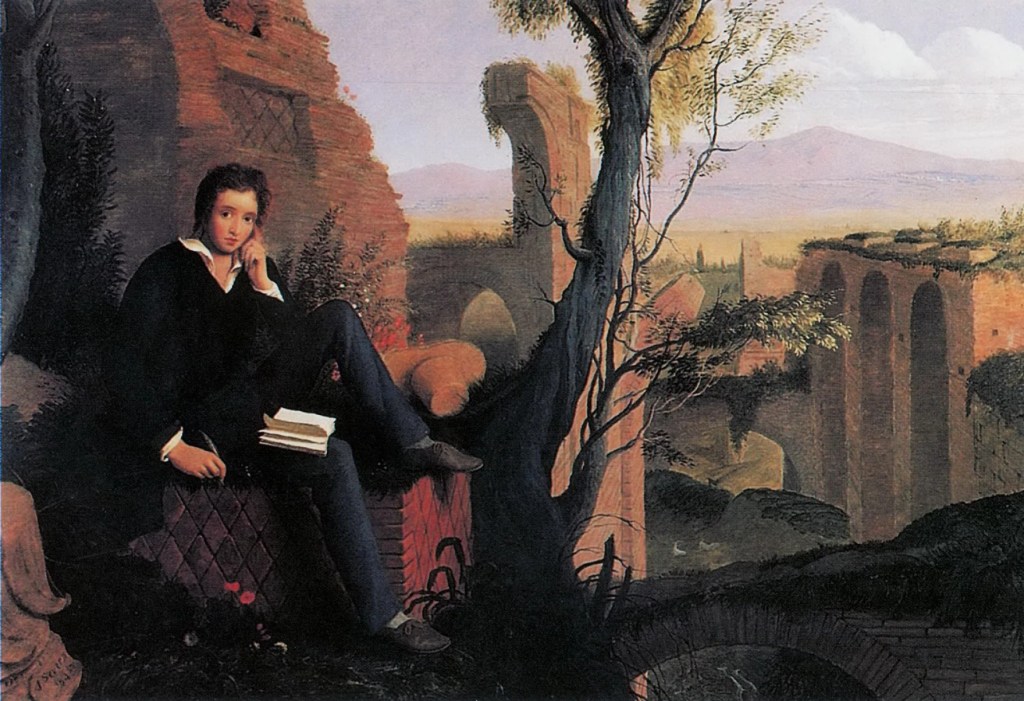
Illustration: Joseph Severn’s portrait of Percy Bysshe Shelley, in Wikimedia. The radical 19th century poet practiced the politics of the plate. For Shelley and other liberals of his day, keeping sugar out of tea was a political statement against slavery.


Brava!
LikeLiked by 1 person
This is marvelous!
LikeLiked by 1 person