
Category Archives: Chapbooks

Updated Call for Submissions: Potcake Chapbooks

I am always keen to read and consider rhymed and metered verse that has already been published. There are several chapbooks that are jostling in the queue for completion and publication:

City! Oh City! (urban life)
Just a Little Naughty
Portraits Unpleasant
Various Heresies (religion)
The Horror of Spring! (seasons)
a Christmas season chapbook, needs Hanukkah, Divali, Festivus, etc

and there are more; but a recent one, ‘Robots and Rockets’, wasn’t part of my original plans: I just ran across a bunch of Science Fiction poems that I liked, and they filled a chapbook nicely. So I’m an unashamed opportunist. I’ll modify my plans if I think something better is available. All the chapbooks listed above are nearly full already but, as with all of them, if I run across another poem I really like, I’ll include it. And if I receive enough good poems on an unplanned theme, that theme will get slotted in.

And if I receive more good poems than I can fit in a chapbook, there is a good chance of a second chapbook on the same theme. The most recent, ‘Travels and Travails’, is similar to the very first, ‘Tourists and Cannibals’; and the upcoming ‘Lost Love’ (which has gone to Alban Low for illustrating) is similar to the second chapbook, ‘Rogues and Roses’.

When there is enough good material on a single theme to fill 13 pages of a chapbook (still leaving room for Alban’s artwork, of course), then it may become the next project. But until a chapbook actually goes to print everything is subject to change. An even better poem may show up and displace one tentatively placed. A slew (or slough) of poems on a new theme may cause a reprioritisation of planned chapbooks.

This is one of the reasons that I prefer to consider only poems that have already been published–so that I don’t feel guilty about having a bunch of poems that will sit with me for months, years, and may or may not be included in the Potcake series. I have flagged a thousand poems that interest me; but I can only publish a dozen in a chapbook, and only a few chapbooks will get produced in a year.

Poems in the chapbooks run from two or three lines to some 40 lines in length–obviously, with space at a premium, poems over 20 lines and running over one page are less likely to be included… but it does happen. Other criteria: I’m looking for wit, elegance, a variety of traditional and nonce forms, a variety of voices and moods: happy, sad, angry, sardonic, meditative… anything interesting I can scrounge. If you have something you think I might like, on any topic, please send it along to robinhelweglarsen@gmail.com. Submit:

  • Formal, or traditional verse: rhymed and metrical
  • Previously published
  • Must be your own work, you must have the rights to it
  • Send 3 to 10 poems in a single attachment, or in the body of the email
  • In a covering note, include a link to where I can read more of your work

I can’t promise to use your work, but I will read it and reply!
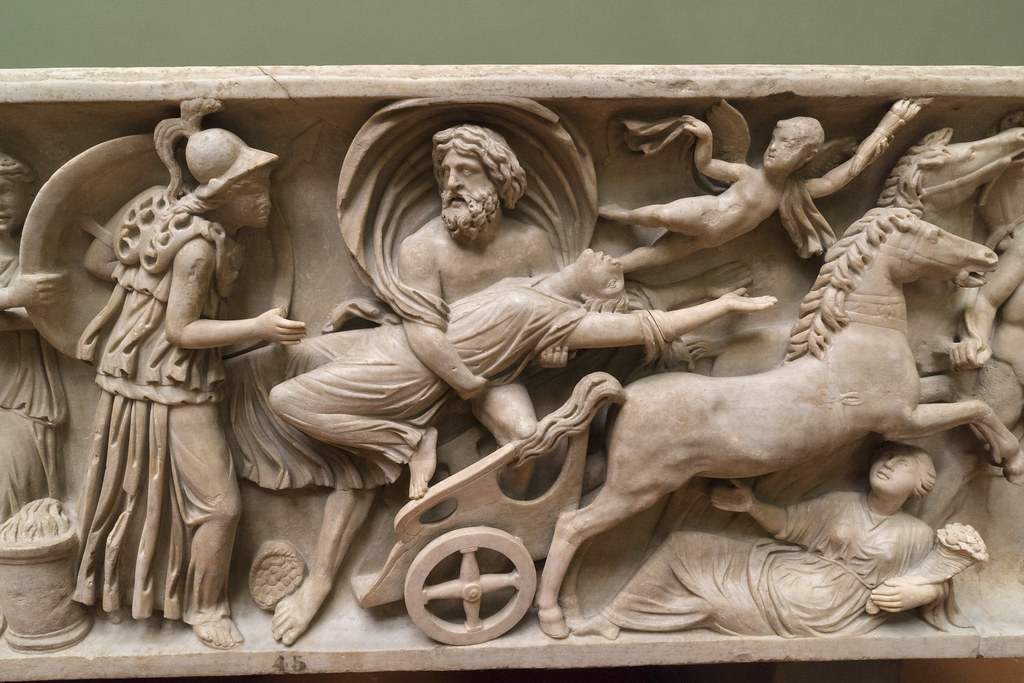
Potcake Poet’s Choice: Mindy Watson, ‘(Under)worlds Collide – (an ovillejo chain)’

Makaría, my girl, though you’ve heard 
Every word 
Of this myth I’ve recounted before, 
I implore 
You—indulge me again. For at last 
You’ve surpassed
Fragile childhood’s constraints. Now hold fast 
And let fantasy shift into creed. 
You’re Persephone’s daughter; please heed
Every word, I implore. You’ve surpassed 

Expectations I set at your birth.
From my dearth 
You drew bountiful joy; from disgrace 
You forged grace.
And it’s clear that your eyes could induce 
Mighty Zeus
To devise an elaborate ruse 
That would send you careening unseen
Down to Hades, where I was once queen. 
From my dearth, you forged grace mighty Zeus—

Who, three decades ago sent me bound 
Underground
As a chthonian bride—would aspire 
To acquire. 
Once, Demeter’s stray heart, all aglow
For the beau
She’d just met, allowed Zeus to sow woe.
He pared back the earth’s crust, laying waste 
To her harvest and left me displaced 
Underground to acquire. For the beau

Who then claimed me, I burned seven years. 
Through her tears, 
Fair Demeter cursed Earth and repealed
Springtime’s yield,
Vowing Winter would linger ‘til I
Bid goodbye 
To the underworld. Hades complied, 
For the innocent girl he’d once craved 
Was no more. As I rose, Mother waved 
Through her tears. Springtime’s yield bid goodbye

To its seven-year drought. But although
Status quo 
Seemed to flourish again, when detained
I’d retained 
Hades’ seed. It entrenched its black song
For so long 
In my belly, no matter how wrong,
The abyss still enthralled me. When eight 
More years passed, I spit out the innate 
Status quo I’d retained for so long,

And descended at twenty to reign
Hell’s domain.
Disavowing my schooling to seek 
Dark’s mystique,
In the city, I stripped on a stage
To assuage 
What convention had trapped in a cage.
And I deemed each male patron a thrall
On whose worship I’d draw to recall
Hell’s domain—dark’s mystique. To assuage 

The lacuna lost innocence spread 
In its stead,
I sought lust, ‘til a man who’d paid much 
Dared to touch 
Me as Zeus had once touched. But his ploy
To destroy
My esteem served instead to deploy 
Comprehension. Mercurial youth
Had to forfeit illusion that truth,
In its stead, dared to touch—to destroy.

While these decades I’ve learned to delight
In the light,
I acknowledge I’ll always endure
Dark’s allure. 
For the Hades against which I strain 
Lives to reign.
Makaría, I’ll need not explain
When, from underworld’s embers you rise
And return to me, blinking your eyes 
In the light—dark’s allure lives to reign.

Originally appeared in Star*Line, Fall 2018

Mindy Watson writes: “‘(Under)worlds Collide,’ which originally appeared in Star*Line’s Fall 2018 issue, constitutes my most ambitious attempt at restructuring a prior creative nonfiction/memoir essay (the initial ‘Underworlds Apart: A Story for Ailie’ piece appeared in Adelaide Magazine’s online March 2017 edition) into poetic form—in this case, an 8-stanza string of linked ovillejos. While the poem follows the original memoir’s metaphorical trajectory and overarching narrative—that is, a mother leverages a well-known Greek myth’s parallels to her own coming of age story to relay a “moral” (of sorts) to her burgeoning young daughter—I wanted the compressed, verse form to read less like a dark bedtime story and more like a literary song… but without losing the original’s intensity. While in hindsight I concede that my chosen form’s line/length constraints hampered my ability to clearly align my real-world characters to their mythological counterparts (a far easier feat via prose), I believe the form’s stipulation that each terminal ovillejo line contain a convergence of previously distinct phrases conferred a sense of interconnectedness between one elapsed past and another possible future that no mere prose ever could. I applaud George Simmers for penning ‘Strip,’ which made me remember my prior manifesto, and Robin for posting it.”

Mindy Watson is a formal verse poet and federal writer who holds an MA in Nonfiction Writing from Johns Hopkins University. Her poetry has appeared in venues including Snakeskin, Think Journal, the Poetry Porch, Orchards Poetry Journal, Better Than Starbucks, Eastern Structures, the Quarterday Review, and Star*Line. She’s also appeared in Sampson Low’s Potcake Poets: Form in Formless Times chapbook series and the Science Fiction and Fantasy Association’s 2019 Dwarf Stars Anthology. You may read her work at: 
https://mindywatson.wixsite.com/poetryprosesite.

Photo: “Persephone’s Rape at Uffizi -II” by Egisto Sani is marked with CC BY-NC-SA 2.0.

Potcake Poet’s Choice: George Simmers, ‘Strip’

The pub’s old-fashioned, and is somewhat seedy.
The clientele, all male, look lumpish, needy,
And when the stripper comes, their eyes are greedy.

A smile fixed firm upon her painted face,
She starts gyrating with a teasing grace,
Smoothly undressing at a languorous pace.

She struts through routine choreography
Removes her bra, and lets her breasts go free
The silent men watch her impassively.

And still they stare unmoving as she slips
The golden panties from her mobile hips,
Pauses a sec, then sensually unzips

Her smooth pink skin, and flings it open wide, 
To show the flesh and beating heart inside.
Her audience observes all this, dead-eyed.

The flesh from bone she now expertly rends,
And now it’s just her skeleton bops and bends
Seductively until the music ends.

Silence. She picks up flesh and skin, and drawers
So often dropped before on grubby floors.
The men are stirred to offer mild applause.

She dresses quickly, picks up a pint glass,
And then begins the customary pass
Among the men, who goggle at her arse,

Say nothing, but poke fivers in the pot
Because that is expected. They do not
Even try to meet her eye, or speak of what

They’ve seen, but, weekly ritual complete,
Get up, and, bodies drooping with defeat,
They head out to the grey indifferent street.

George Simmers writes: “It must be thirty years ago that I was in a run-down district of some industrial city, looking for a pub that would sell me a pint and a sandwich. I passed one with a sign that said ‘Stripper: 1.30’ and I thought: ‘Why not?’
The audience was very much as described in the poem, though the performance was less extreme. It was a fairly melancholy occasion, and one that stayed in my memory. It was a long while ago, and the pot that day probably filled with £1 notes (maybe even ten bob) rather than fivers, but I thought £5 would be the appropriate donation today – if lunchtime pub strippers still exist. They’re an endangered species in the North of England, I gather, and lockdown has probably killed them off completely.
I wrote this in triplets because the first three lines came to me together, and I thought I’d see how well I could continue. I feel the form somehow suits the subject, or at any rate is better than couplets, which tend to be faster-moving. The triplets seem (to me at least) sluggish and a bit unusual.
I dimly remember years ago seeing an animated film in which a stripper goes on to unzip her skin, so to that extent the poem is not original. But it was the deliberately unimpressed audience I really wanted to write about, and making them still stolid even after watching the impossible made my point, I hoped.
This is one of a series of poems that I’ve written over the past couple of years, telling stories that are extreme or somewhat gothic. I may get some of them together into a short collection later in the year.”

George Simmers used to be a teacher; now he spends much of his time researching literature written during and after the First World War. He has edited Snakeskin since 1995. It is probably the oldest-established poetry zine on the Internet. His work appears in several Potcake Chapbooks.
https://greatwarfiction.wordpress.com/
http://www.snakeskinpoetry.co.uk/

Photo: “luchavavoom stripper” by ourcommon is marked with CC BY-NC-ND 2.0.

Potcake Poet’s Choice: Marcus Bales, ‘Miniver Cheever III’

Miniver Cheevy Junior’s kid
Despised his own contemporaries,
Like his poetic forebears did,
As functionaries.

Miniver missed old apartheids,
South Africa and Mississippi,
And longed to go on freedom rides
And lay a hippie.

Miniver yearned for days gone by,
For free love’s newly bra-less boobies,
For Woodstock, rock and roll, tie-dye,
And smoking doobies.

Miniver mourned for Owsley Blue,
The name, he understood, for acid.
At Kool-Aid Tests and love-ins, too,
He’d be less flaccid.

Miniver loved the Beatles, Stones,
Frank Zappa, Zep, and, yes, the Monkees;
He didn’t care, he had a jones
For tuneful junkies.

He cursed the mosh-pit debutantes,
And viewed hip-hop with open loathing;
He missed the sight of Mary Quant’s
Bell-bottomed clothing.

He metaphored and analogued
And similed to try to flout it;
Miniver blogged, and blogged, and blogged,
And blogged about it.

And so there’s Miniver number three,
Who’s no more dour but no less bitter.
He shakes his head and sighs. Then he
Logs in to Twitter.

Marcus Bales writes: “Here’s one that has its own built-in reason for writing it: DF Parry had done such a good job, who could resist? But Miniver Cheevy III was written so long ago, now, that possibly it’s time to explore IV.”

Not much is known about Marcus Bales except that he lives and works in Cleveland, Ohio, and that his work has not been published in Poetry or The New Yorker. However his “51 Poems” is available from Amazon. He has been published in several of the Potcake Chapbooks (“form in formless times”), and would like you to be familiar with the forerunners to his ‘Miniver Cheevy III’:

‘Miniver Cheevy, Jr.’ by D.F. Parry

Miniver Cheevy, Jr., child
Of Robinson’s renowned creation
Also lamented and reviled
His generation.

Miniver similarly spurned
The present that so irked his pater,
But that langsyne for which he yearned
Came somewhat later.

Miniver wished he were alive
When dividends came due each quarter,
When Goldman Sachs was 205
And skirts were shorter.

Miniver gave no hoot in hell
For Camelot or proud Troy’s pillage;
He would have much preferred to dwell
In Greenwich Village.

Miniver cherished fond regrets
For days when benefits were boundless;
When radios were crystal sets
And movies soundless.

Miniver missed the iron grills,
The whispered word, the swift admission,
The bath-tub gin, and other thrills
Of Prohibition.

Miniver longed, as all men long,
To turn back time (his eyes would moisten),
To dance the Charleston, play mah jong
And smuggle Joyce in.

Miniver Cheevy, Jr., swore
And drank until the drink imperiled
Health, then sighed, and read some more
F. Scott Fitzgerald.

The original, of course, is Miniver Cheevy‘ by Edwin Arlington Robinson:

Miniver Cheevy, child of scorn,
Grew lean while he assailed the seasons;
He wept that he was ever born,
And he had reasons.

Miniver loved the days of old
When swords were bright and steeds were prancing;
The vision of a warrior bold
Would set him dancing.

Miniver sighed for what was not,
And dreamed, and rested from his labors;
He dreamed of Thebes and Camelot,
And Priam’s neighbors.

Miniver mourned the ripe renown
That made so many a name so fragrant;
He mourned Romance, now on the town,
And Art, a vagrant.

Miniver loved the Medici,
Albeit he had never seen one;
He would have sinned incessantly
Could he have been one.

Miniver cursed the commonplace
And eyed a khaki suit with loathing;
He missed the mediæval grace
Of iron clothing.

Miniver scorned the gold he sought,
But sore annoyed was he without it;
Miniver thought, and thought, and thought,
And thought about it.

Miniver Cheevy, born too late,
Scratched his head and kept on thinking;
Miniver coughed, and called it fate,
And kept on drinking.

Potcake Poet’s Choice: Max Gutmann, ‘Raindroppings’

Can anyone make out
The quality inherent
In being with an umbrella, that makes people without
Completely transparent?

On the rainiest days,
In the hardest of showers,
People with umbrellas courteously step out of other umbrella’d people’s ways
Right into ours.

Or, if as it starts
To really pour, ya
Dash for the shelter of a little awning, sure as rain’s wet someone with an umbrella darts
Under it before ya.

And you look at the fella
As you stand in the steady
Downpour, but he ain’t gonna budge, ’cause, as any one-eyed idiot could plainly see, his umbrella
Is wet enough already.

Beyond disputation,
We already hear a lot
About the many forms of indiscriminate discrimination
Our world has got.

Still, I wish some teller’d
Deign to tell us
The reasons for the way the umbrellered
Treat the umbrell’less.

Max Gutmann writes: “In ‘Raindroppings,’ a line of OgdenNashian length is part of each otherwise regularly metered quatrain. These lines get longer and longer, and then shorter and shorter. I hope this helps the poem feel both sillily loose, and formally structured: the topic, though it may sound invented, is an actual aspect of human nature, trivial in itself but reflective of more serious attitudes.”

Max Gutmann has worked as, among other things, a stage manager, a journalist, a teacher, an editor, a clerk, a factory worker, a community service officer, the business manager of an improv troupe, and a performer in a Daffy Duck costume. Occasionally, he has even earned money writing plays and poems.

linkmaxgutmann.com

‘Raindroppings’ was first published in Light Quarterly

Photo: “Downpour” by roeyahram is marked with CC BY-NC-ND 2.0.

Potcake Poet’s Choice: Claudia Gary, ‘Phonograph’

Remember, dear, when this was the one way
to make a disk sing? Full-size, not compact—
and both the disk and player would obey
only if you possessed your share of tact:
You’d lift the tone arm, puff a bit of air
across its fragile needle to remove
new dust, or use a brush of sable hair
to coax it out. After each vinyl groove
was polished with the softest chamois cloth,
you’d spin a record on its table, place
the needle over it, light as a moth—
you must remember! For the way you trace
the path of every melody I store
shows gentleness I’ve never known before.

Claudia Gary writes: “In case anyone still thinks art and science belong in different categories, it may help to remember that long before there were computer nerds, there were music nerds (audiophiles). Back then, enjoying high fidelity sound at home required paying close attention to detail and taking good care of fussy, sensitive machines. They may not have been as cavalier as today’s machines that demand upgrades at their own convenience; but yesterday’s machines did need a lot of TLC in exchange for beautiful music. And so does love.”

Claudia Gary lives near Washington, D.C., in Northern Virginia, and teaches workshops on Villanelle, Sonnet, Natural Meter, Poetry vs. Trauma, Poetry for Musicians, etc., at The Writer’s Center (writer.org) and elsewhere, currently via Zoom teleconference. Author of Humor Me (David Robert Books, 2006, in which Phonograph was published), and of chapbooks including Genetic Revisionism (2019) and Bikini Buyer’s Remorse (2015), she is also a health science writer, visual artist, and composer of tonal chamber music and art songs. See pw.org/content/claudia_gary; follow her on Twitter at @claudiagary.

Photo credits:
“1968 … all in one portable stereo phonograph!” by x-ray delta one is licensed under CC BY-SA 2.0
Claudia Gary photo by John Flannery

Potcake Poet’s Choice: Gail White, ‘Snails’

This morning, at my garbage can,
just underneath the lid,
two snails in the embrace of love
connubially hid.

Who knows what dangers they had passed,
how high they had to climb,
in order to achieve at last
this interchange of slime?

I left you unmolested, snails,
beneath your plastic shelf,
because on Friday nights I look
ridiculous myself.

Gail White writes: “This is a favorite light verse of mine, first published in Light. Our sexual nature gives us something in common with even the lowliest life forms, a fact which caused me to spare the snails from eviction.”

Gail White is the resident poet and cat lady of Breaux Bridge, Louisiana. Her books ASPERITY STREET and CATECHISM are available on Amazon. She is a contributing editor to Light Poetry Magazine (lightpoetrymagazine.com). “Tourist in India” won the Howard Nemerov Sonnet Award for 2013. Her poems have appeared in the Potcake Chapbooks ‘Tourists and Cannibals’, ‘Rogues and Roses’, ‘Families and Other Fiascoes’ and ‘Strip Down’.
https://www.amazon.com/Asperity-Street-Gail-White/dp/1927409543

“snails mating” by tonrulkens is licensed under Openverse from WordPress.org

Potcake Poet’s Choice: D.A. Prince, ‘Horatio’

Always in shadow, on the edge, the light
falling on someone else. I’m used to it—
fidus Achates, and half-acolyte.
Besides, the sidelines are a safer bet
so I survive—at least, upon the page,
though never in imagination.
The curtain falls: I vanish with the stage.
Even Rosencrantz and Guildenstern live on
in other times but I—the dutiful
and sober pal, the philosophic friend—
dissolve. I fade. Meanwhile, the beautiful
capture your soul beyond the play’s neat end
where I’m to set, with due fidelity,
the record straight. You won’t remember me.

From: Common Ground, HappenStance Press, 2014.

D.A. Prince writes: “In the middle of a lively debate about which actor had played the definitive Hamlet, I realised I had no memory at all of any actor playing Horatio. There would have been an equal number, obviously. Horatio is on Elsinore’s battlements in the opening scene, questioning the existence of ghosts, and he’s there in the final scene, surrounded by corpses, giving the penultimate speech. In between he hovers in Hamlet’s shadow, necessary but—if I’m a typical theatre-goer—unmemorable. He doesn’t even get to cross the stage in Tom Stoppard’s Rosencrantz and Guildenstern are Dead. The world is full of people like Horatio so I thought I would give him a brief
acknowledgement: for turning up, for hanging on, for being there.”

D A Prince lives in Leicestershire and London. Her first appearances in print were in the weekly competitions in The Spectator and New Statesman (which ceased its competitions in 2016) along with other outlets that hosted light verse. Something closer to ‘proper’ poetry followed, with three pamphlets, followed by a full-length collection, Nearly the Happy Hour, from HappenStance Press in 2008. A second collection, Common Ground, (from the same publisher) followed in 2014 and this won the East Midlands Book Award in 2015. HappenStance published her pamphlet Bookmarks in 2018 and will bring out a further collection in 2022. There’s just the little matter of a title to resolve first.

Illustration: Hamlet and Horatio in the Graveyard (Eugène Ferdinand Victor Delacroix)

Potcake Poet’s Choice: Jane Blanchard, ‘The Kahler Grand Hotel (near the Mayo Clinic)’

I see the waitress cock her head to try
to figure out what I just said. Across
the booth my husband will not meet my eye
until she leaves to place our order. Sauce
for goose and gander holds that I will get
a turn to laugh (or not) at him. Neither
of us can hide where we are from. I let
him think his accent less than mine—either
of us can drawl a syllable into
a sentence. Fine. Most locals here speak plain
Midwestern as they welcome others who
seek remedies for matters inhumane.
How I may talk does not mean one iota
when visiting Rochester, Minnesota.

Jane Blanchard writes: “The Kahler Grand Hotel appeared in Third Wednesday (Winter 2020) right before COVID-19 changed all of our lives. This sonnet discloses how Jimmy and I tried to cope with a different medical crisis several years earlier. A little humor can go a long way when dealing with a scary situation. To this day we appreciate the many kindnesses shown to us when we were very vulnerable and very far from home.”

A native Virginian, Jane Blanchard lives and writes in Georgia. Her latest collection with Kelsay Books is Never Enough Already (2021).

Potcake Poet’s Choice: Mindy Watson, ‘Her Mother’s Face’

Amidst a sere Midwestern winter night 
December 1917, she’s born,
A staunch Germanic woman’s child. Bedight
In dearth and loss, she learns too young to mourn
A mother’s death. She knows a woman must
Prepare the meals, evoke good cheer, and thrust
Her bitter tears inside where no one sees.
She weds a Coast Guard vet and oversees 
His household — bears three girls, subsists on grace.
And steadfast ‘til succumbing to disease,
Upon her own, she wears her mother’s face.

Unwanted infant hurtles toward the light
In 1944, her mam too worn
And poor to greet her daughter with delight.
The wealthy gent who claims the babe has sworn
To sate her whims, exchange her doubts for trust.
But Virgin-named, she’s Snake incarnate, trussed
In greed. She flaunts her swindling expertise, 
Yet knows that costly baubles won’t unfreeze
Her heart, or fill an absent mother’s space.
And void, despite full coffers overseas, 
Upon her own, she wears her mother’s face.

She’s born in 1945, clasped tight
Within her mother’s arms. And ne’er forlorn,
This nurtured daughter dreams she’ll wed a knight
Who’ll grant her nuptial bliss, and — fast foresworn 
To loyalty — a doe-eyed child who’ll just
Love her. When falseness renders faith to dust
And pregnant prayers produce no guarantees,
She nonetheless adheres to memories
Of Mother’s happy tales. She weighs her case,
Then smiling, phones adoption agencies.
Upon her own, she wears her mother’s face.  

From birth, a target of her small town’s spite,  
She sprints through cornfields, fleeing bullies’ scorn,
Hurled stones, and taunts of “freak”! Wisconsinite
In ragtag 1980s garb, she’s borne 
Her share of tyranny. Her heart’s robust
Enough to weather gibes, but grief’s the gust
She can’t withstand. At forty-one, she frees
Herself and downs the sleeping pills that squeeze
Her breath away. Her mother deems her base
Look odd, but with some rouge — an eyebrow tweeze — 
Upon her own, she wears her mother’s face.

Abandoned infant left upon a white
Korean orphanage’s stoop, she’s shorn
Of roots upon her trans-Pacific flight
To Heartland serendipity. She’s torn
Between identities, but must adjust: 
Refute all claims of foreignness. Nonplussed,
Her heart aligns to these: Wisconsin cheese
And apple pie. She’d always deemed “Chinese”
A slight, but now she sees each buried trace
Of her within her children’s eyes. And pleased,
Upon her own, she wears her mother’s face.

A steadfast matron, serpent quick to tease,
She’s part Korean, one-eighth Japanese,
Idealist, rebel geek without a place — 
My post-millennial, she’s all of these.
Upon her own, she wears her mother’s face.

Mindy Watson writes: “I’m probably most proud of this chant royal titled ‘Her Mother’s Face’ that narratively links the most influential women in my life, ultimately culminating in my daughter’s overall connection to her (mostly unknown) maternal lineage. It was an unconventional topic for me (as my go-to inspirations are normally bugs, science, mythology, etc. and I’ve a hard-wired aversion to delving into my lost cultural roots—Midwestern U.S. white Protestant upbringing and all that), but it just intuitively sprang from the 11-line stanza/repeated refrain/converging envoi-type structure. Humorously, the poem’s impetus was a poet e-friend of mine mentioning that this form (I’d never heard of) was the most difficult he’d ever tried and hadn’t ever conquered—so of course I took that as a dare/challenge, lol… but I ended up unexpectedly enjoying the composition process (and reminiscing about a few souls lost too soon. Also I disagree with my friend—I personally think pantoums are among the most vexing forms…”

Mindy Watson is a formal verse poet and federal writer who holds an MA in Nonfiction Writing from Johns Hopkins University. Her poetry has appeared in venues including Snakeskin, Think Journal, the Poetry Porch (where ‘Her Mother’s Face’ was first published, April 2018), Orchards Poetry Journal, Better Than Starbucks, Eastern Structures, the Quarterday Review, and Star*Line. She’s also appeared in Sampson Low’s Potcake Poets: Form in Formless Times chapbook series and the Science Fiction and Fantasy Association’s 2019 Dwarf Stars Anthology. You may read her work at: 
https://mindywatson.wixsite.com/poetryprosesite.