Category Archives: nature poems

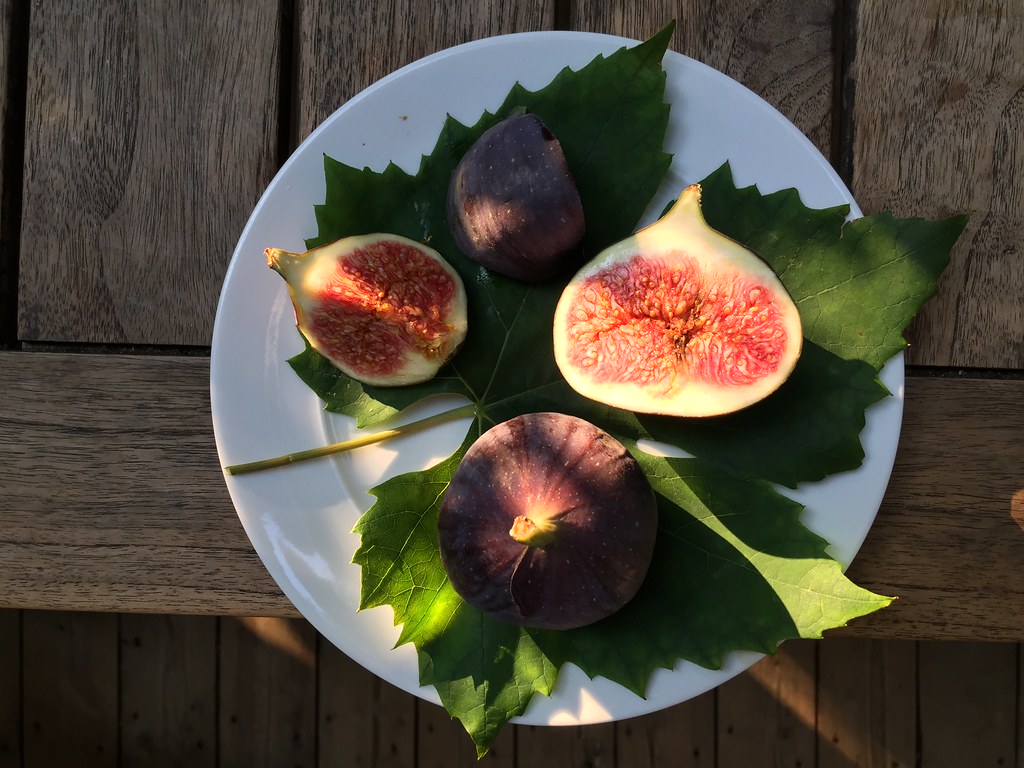
Susan McLean, ‘Figs’

Because they don’t grow this far north; because
when I’m in Italy or France, it’s June
or earlier; because my parents raise them,
but when I visit, always it’s too soon
or late for that year’s crop; because they’re sold
in tiny cartons at outrageous cost
and not for long; because they’re slippery
and sweet as sin inside, and outside, soft
as breasts; because, once ripe, they split apart,
and rot or wasps destroy their fragile treasure;
because I know I’ll never get enough,
I always eat them with a groan of pleasure.

*****

Susan McLean writes: “I grew up in Maryland, in the suburbs of Washington, DC; it is a very mild climate zone, so when my sister gave my parents a fig seedling to grow, it flourished. By that time I was living in Iowa and Minnesota, where fig trees can’t survive the winters. I was a college professor, so I could visit my parents in summer or during the winter break, yet their figs didn’t ripen until late August and September, when I would be back at work. I liked traveling in Europe, too, during the summer vacation, but was usually there before the local figs had ripened. Thus, the only way I could eat fresh figs was by buying them imported from warmer locales, and they were extremely pricey and perishable. It became a sort of forbidden fruit for me, and therefore infinitely desirable.

“This poem is in the form of a litany, in which the introductory clauses all start with the same wording. It is a form familiar from the Bible (the Beatitudes, for example: “Blessed are . . .”) and from religious rituals, such as the repetition of a creed (“I believe in . . .”). I chose that form as a nod to the original forbidden fruit in Genesis. I alternate unrhymed lines with rhymed ones to mirror the tension between desire and fulfilment. The repetition of the “because” clauses without a main clause to finish the idea creates mystery and suspense, which is only resolved in the poem’s final line, evoking a sigh of satisfaction. The poem appeared in my first poetry book, The Best Disguise.”

[Figs are just so evocative; I can’t help linking to my own poem on them. RHL]

Susan McLean has two books of poetry, The Best Disguise and The Whetstone Misses the Knife, and one book of translations of Martial, Selected Epigrams. Her poems have appeared in Light, Lighten Up Online, Measure, Able Muse, and elsewhere. She lives in Iowa City, Iowa.
https://www.pw.org/content/susan_mclean

Black figs on a vine leaf” by CharlesFred is licensed under CC BY-NC-SA 2.0.

Susan Jarvis Bryant, ‘Armadillo’

A hand for the bandit in leathery livery
Advancing through grass to go grubbing in shrubbery –
Escaping the squeal and the squish of the rubbery
To comb and to roam neath the sun.

A bow to the wow of the charmer in armor,
A friend to the poet, a foe to the farmer –
This bug-crunching muncher, this flowerbed harmer,
Is digging up dirt just for fun.

A nod to the plod of this sod-lobbing critter
Whose shovel-shaped nose prods the gardeners bitter –
He begs me to bless him with lexical glitter
Till wittiest ditties are spun.

*****

Susan Jarvis Bryant writes: “When I first arrived in Texas from the UK, I had an overwhelming urge to feast my curious eyes upon an armadillo. I saw plenty of squished unfortunates callously labeled “roadkill”, but there wasn’t a live one in sight… until five years later on a bike ride at the local wildlife refuge, I saw my first wild armadillo (silver armor gleaming in the midday sun) rooting for grubs on the grass verge. Brimming with joy, I leapt off my bicycle and oohed and aahed from as near as I could possibly get. A lady walked towards me. My husband warned me not to get too exciteable about my find, as armadillos weren’t the most charming of Texas critters. I beg to differ, and the lady (from northern parts, apparently) was as excited as I was. To my husband’s undisguised surprise, we simply couldn’t get enough of this fascinating fellow. I had heard many stories (nearly all bad) and simply had to honor him the only way I know how – hence this poem. I love British hedgehogs and the armadillo is most certainly up there with his Kentish-countryside counterpart.”

Susan Jarvis Bryant is originally from the UK and now lives on the coastal plains of Texas. Susan has poetry published on The Society of Classical Poets, Lighten Up Online, Snakeskin, Light, Sparks of Calliope, and Expansive Poetry Online, The Road Not Taken, and New English Review. She also has poetry published in The Lyric, Trinacria, and Beth Houston’s Extreme Formal Poems and Extreme Sonnets II anthologies. Susan is the winner of the 2020 International SCP Poetry Competition and was nominated for the 2022 and 2024 Pushcart Prize. She has published two books – Elephants Unleashed and Fern Feathered Edges.

Photo: “Nine-banded Armadillo” by http://www.birdphotos.com is licensed under CC BY 3.0.

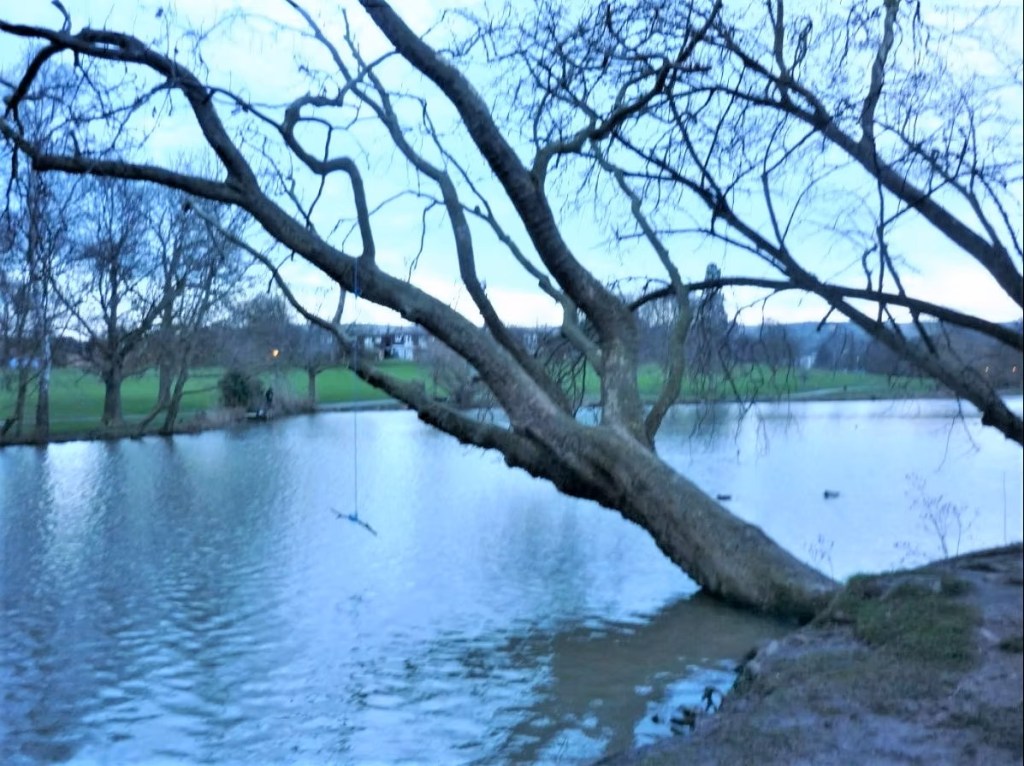
F.F. Teague, ‘Lament of the Leaning Trees’

We were planted to stand, not to sprawl in this way
  by the larger of lakes in the park,
to stare straight at the sky through the night and the day,
  not to ogle our own shades of bark.

But the lake has swelled swampily over the years,
  seizing soil in her cool clammy clench,
with a treasure of twigs-and-grass, sweet chestnut spheres,
  and a hoard of hard wood, once a bench.

How we cling to the earth with our tendrilous toes
  while the lake laps in sinister sheen,
rousing daily and nightly our powerless throes
  as we lean, and we lean, and we lean.

*****

​’Lament of the Leaning Trees’ was first published in The HyperTexts, July 2021​

F.F. Teague writes: “I composed this in January 2021, while recovering from a broken leg and a few complications. A photo of the leaning trees appeared on the Facebook page Pittville Swans & Friends. I hadn’t been out for a while and it was lovely to see the Leaning Trees again. Suddenly I started thinking about being able to leave my flat one day, which made me feel a bit more cheerful about things. When I got out, I took the above photo.
“The trees have been leaning ever since I can remember. I lived in an area of Cheltenham called Fairview, not far from Pittville, for about nine months in 2001 and they were certainly leaning at that point. Every time I visit the park, I half-expect to see at least one tree lying in the water. But they must have very strong roots, because they just keep leaning. The council has removed a few branches over the years yet the shape of the trees remains distinctive.”

Felicity Teague (Fliss) is a copyeditor by day and a poet come nightfall. She lives in Pittville, a suburb of Cheltenham (UK). Her poetry features regularly in the Spotlight of The HyperTexts; her work has also appeared in AmethystLighten Up OnlineNew Verse ReviewSnakeskinThe Dirigible Balloon, and The Ekphrastic Review. Her first collection (2022) is titled From Pittville to Paradise; her second (forthcoming 2025), Interruptus: A Poetry Year. Other interests include art, film, and photography.

Photo by F.F. Teague