Tag Archives: C.P. Cavafy

Julia Griffin: Translation: ‘C.P. Cavafy’s Waiting For The Barbarians’

Why are we here in the agora, say?

We’ve got the Barbarians coming today.

Why are the senators resting their jaws?
Why don’t they legislate?  What about laws?

We’ve got the Barbarians coming today.
Nobody knows how it’s going to play;
If any legislate, it will be they.

Why is our Emperor out of his bed,
Sitting in state at the gate there instead,
Wearing a gorgeous great crown on his head?

We’ve got the Barbarians coming today.
They must be met in an elegant way:
Greeting their chieftain, the Emperor’s goal
Is to award him an exquisite scroll,
Giving him titles to make his eyes roll.

Why do our consuls and praetors appear
Dressed to the nines in their purplest gear?
Why are there amethysts all up their arms,
Emeralds everywhere, greener than palms?
What are those fabulous sceptres they hold,
Fancily fashioned in silver and gold?

We’ve got the Barbarians coming today.
This sort of thing’s their idea of cachet.

Why are our orators keeping us waiting,
Not, as per usual, loudly orating?

We’ve got the Barbarians coming today.
Oratory bores them.  They like a display.

Why does it suddenly seem such a mess?
Why the confusion, the seriousness?
Why is there emptiness now in the square?
Why the pervasively secretive air?

Not one of them came, and the day is now done.
People are saying the war has been won;
Hence there are no more Barbarians.  None.

No more Barbarians – what shall we do?
I’ve not come up with an answer yet.  
                                                         You?

*****

Julia Griffin writes: “I’ve always loved Cavafy’s ‘Waiting for the Barbarians’ and had the thought that it would go well into rhyme.  This somehow necessitated changing the ending a little…” Her translation appears in the current Lighten Up Online.

See also the Wikipedia article, https://en.wikipedia.org/wiki/Waiting_for_the_Barbarians_(poem)

Julia Griffin lives in south-east Georgia/ south-east England. She has published in Light, LUPO, Mezzo Cammin, and some other places, though Poetry and The New Yorker indicate that they would rather publish Marcus Bales than her. Much more of her poetry can be found through this link in Light.

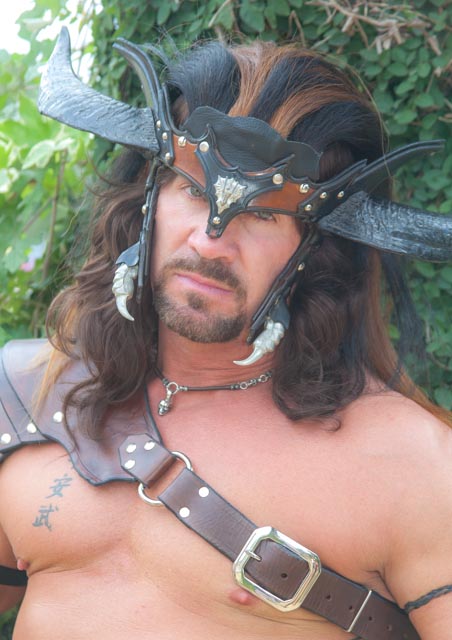
Photo: “Barbarian looking but a real cool dude (8197985443)” by Frank Kovalchek from Anchorage, Alaska, USA is licensed under CC BY 2.0.
Drew Nathaniel Keane, ‘Seventy-Three’

He gave a careless shrug when he had heard
The Delphic Oracle’s prophetic word:
“Beware, my lord, the age of seventy-three”
(For Delphi was renowned for verity).
“I’m thirty now with years to plan for knives
Before the gods’ appointed day arrives.”
Reclining in his litter, bound for home,
Delighted Nero journeyed back to Rome.
 
When he returned, he felt a little drained;
With news like this, how could he be restrained?
Surrendering to pleasure on the way —
To gardens and gymnasia by day,
By night to dance and poetry and drink
In torchlit theatres where bodies slink
Whose dancing ever animates and soothes,
The naked bodies of Achaean youths.
 
Thus Nero rests, while on an arid plain
Far to the west of Rome, in distant Spain,
Old Galba drills his legions secretly,
Old Galba who was spry for seventy-three.

(After C. P. Cavafy’s ‘Η διορία του Νέρωνος’.)

*****

Drew Nathaniel Keane writes: “I’m enchanted by the verse of Constantine Cavafy — ‘a Greek gentleman in a straw hat, standing absolutely motionless at a slight angle to the universe’, as E. M. Forster once described him. In his wry and wistful, gossipy and subtle singing, the Alexandria of Cleopatra feels as immediate as one of his own one-night stands in modern-day Alexandria. It’s quite a contrast to the chest-thumping, hero-worshiping sort of classicism one too often sees on the app formerly known as Twitter. There are already many fine translations of the brief 1915 poem, 
Η διορία του Νέρωνος [‘The Deadline of Nero’], based upon an anecdote in Suetonius’s Life of Nero, of which my favorite is Ian Parks’s paraphrase, published in his little collection The Cavafy Variations (Rack Press, 2013). My paraphrastic version of the poem was inspired by Parks’s, of which one can hear echoes — the “shrug” of line 1, of course, and his turning the punchline into a rhyming couplet gave me the idea to give 
Η διορία του Νέρωνος the Drydenian-Popean treatment I have.

Δεν ανησύχησεν ο Νέρων όταν άκουσε
του Δελφικού Μαντείου τον χρησμό.
«Τα εβδομήντα τρία χρόνια να φοβάται.»
Είχε καιρόν ακόμη να χαρεί.
Τριάντα χρονώ είναι. Πολύ αρκετή
είν’ η διορία που ο θεός τον δίδει
για να φροντίσει για τους μέλλοντας κινδύνους.

Τώρα στην Ρώμη θα επιστρέψει κουρασμένος λίγο,
αλλά εξαίσια κουρασμένος από το ταξίδι αυτό,
που ήταν όλο μέρες απολαύσεως —
στα θέατρα, στους κήπους, στα γυμνάσια…
Των πόλεων της Αχαΐας εσπέρες…
Α των γυμνών σωμάτων η ηδονή προπάντων…

Αυτά ο Νέρων. Και στην Ισπανία ο Γάλβας
κρυφά το στράτευμά του συναθροίζει και το ασκεί,
ο γέροντας ο εβδομήντα τριώ χρονώ.

D. N. Keane (PhD St And) is a Lecturer of English at Georgia Southern University. His verse has been published in Snakeskin (including ‘Seventy-Three’), Spirit Fire ReviewLighten Up OnlineBetter Than StarbucksEarth & Altar, and other venues. More of his work can be found at drewkeane.com

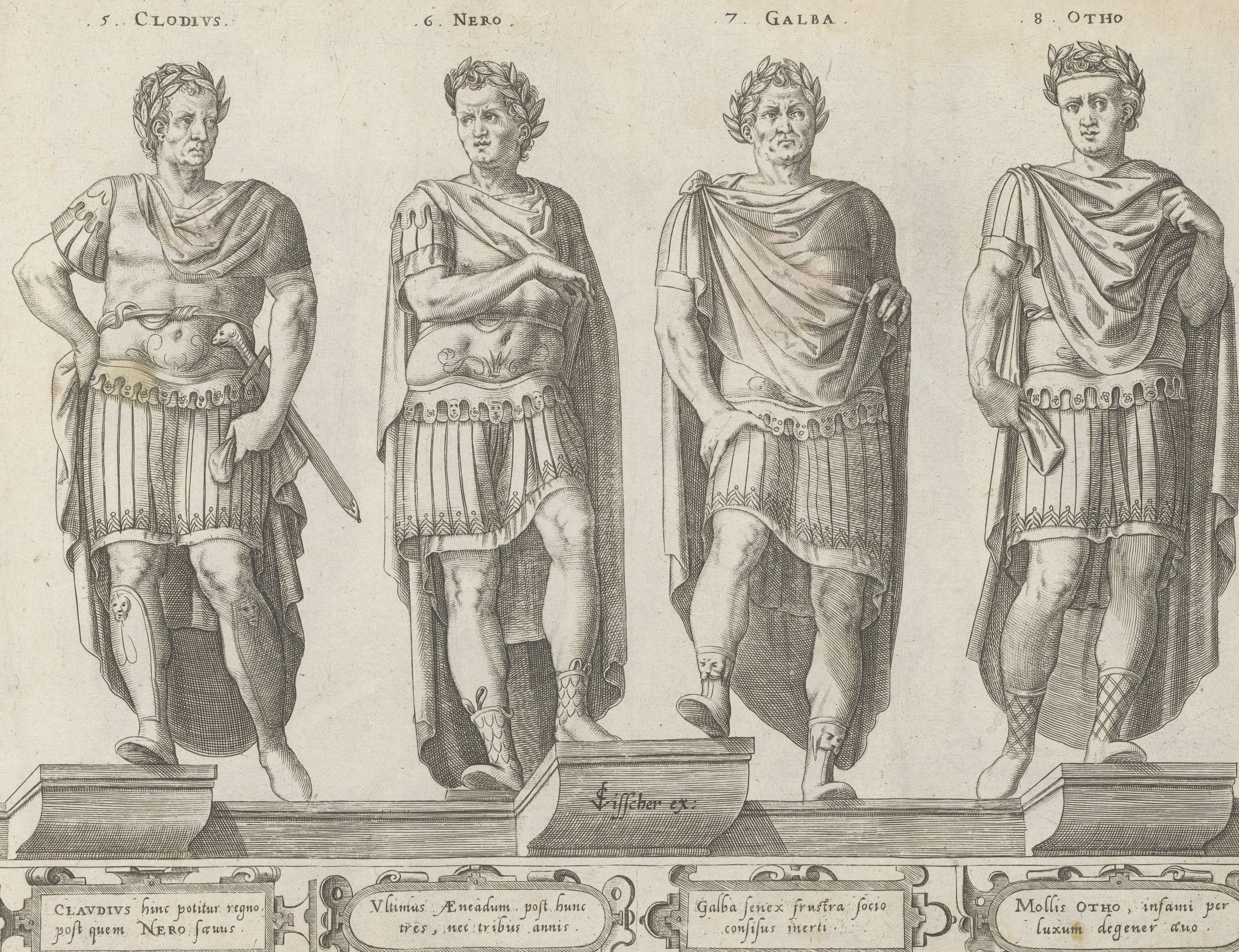
Photo: “Romeinse keizers Claudius I, Nero, Galba en Otho 5. Clodius 6. Nero 7. Galba 8. Otho (titel op object) Van de Roomsche Keyseren en ‘tgevolgh (serietitel) Twaalf Romeinse keizers (serietitel) Den Grooten Figuer-Bibel , RP-P-1982-306-594” by Rijksmuseum is marked with CC0 1.0.