Under a porridge heaven (scourged with black, and prickly-pale as sackcloth) drear and dun, the road lays down its cobbles, mirrored slick with recent rain and half a sickened sun.
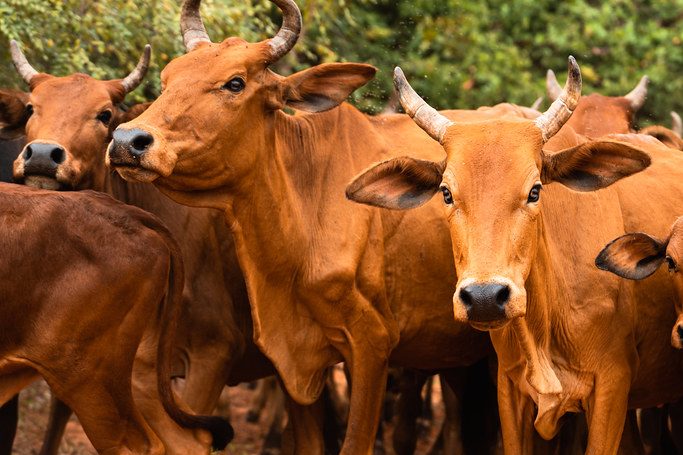
A passer-by or two. Not noticing the shambling creatures going to their deaths. A troop of oxen, slipping on the slime, heading for the abbatoir. Their breaths
resigned and patient; runny eyes that see the emerald grass, the clear, bright streams, the fields, the apple-blossomed ease of Normandy.
Silver-drooling snouts. Sometimes a snort or sniff. But nothing more. Remembering the sea. A passing smell. A passing thought.
*****
John Gallas writes: “I love ‘Oxen’, a little gem you find sometimes when translating from periodical/magazine contributions that mostly sank without trace over time. I’d be delighted. It’s from ‘La Parnasse contemporain’ (only ever 3 editions – 1866, 71 and 76).”
Armand d’Artois (1788 – 1867) was a French playwright and librettist. Here is the original:
LES BŒUFS
Sous un ciel bas, d’un blanc triste, teinté de noir, Qui prend l’aspect blafard et morne d’un cilice, La rue étend au loin son pavé rond et lisse Que l’averse a rendu luisant comme un miroir.
Quelques passants s’en vont, flanant sur le trottoir, Sans voir ces condamnés qui marchent au supplice : Des troupeaux de bœufs, dont le pied trébuche et glisse Sur le chemin qui mène au sanglant abattoir.
Et dans les yeux rêveurs de ces bêtes superbes Sont encor peints les clairs ruisseaux, les hautes herbes Et les pommiers en fleur du gras pays normand.
La bave en fils d’argent tombe de leurs narines, Et parfois l’un d’entre eux renifle longuement, Comme au ressouvenir d’âcres senteurs marines.
John Gallas, Aotearoa/NZ poet, published mostly by Carcanet. Saxonship Poet (see www.saxonship.org), Fellow of the English Association, St Magnus Festival Orkney Poet, librettist, translator and biker. 2025 Midlands Writing Prize winner. Presently living in Markfield, Leicestershire. Website is www.johngallaspoetry.co.uk which has a featured Poem of the Month, complete book list, links and news.
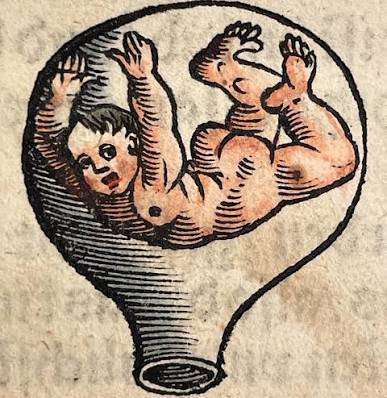
Dear Giacopo, this sad, obscene disaster, forever motherless, and piped of breath, if ever it was living, died too soon, and goes untimely to the feast of death. And are the Humours of its tiny tub sweet milk, or tears? For sure, its mother’s womb, its first and living globe, was made of flesh, and not the glass that rounds it in this tomb. The embryo is dead: long live the corse. Its promised Immortality cut short, it floats in blood, aborted, come to naught. O Man! O Slab Professors! Learn perforce that this is Woman’s flesh and blood: more sweet, more frail than glass; less strong than aquavit.
*****
John Gallas writes: “The ‘Abortion’ poem by Bartolomeo Dotti (1651-1713) is part of a work in progress (a History of Italy in Poems – featuring not the Great Monuments but the lesser poets from the 1st poem in Italian up to a poet b.1935). If you ever want any more, there’s 84. At least 60 rhyme and bounce.”
VII L’ABORTO NELL’AMPOLLA A Giacopo Grandis, fisico e anatomico
Questo, Giacopo mio, sconcio funesto cui diè morto natale il sen materno, se maturo nascea, moria ben presto, e voi d’intempestivo il fèste eterno. Non so se dolce latte o pianto mesto gli sia di quel cristal l’umore interno; so ben che l’alvo suo fu come questo, poi ch’utero da vetro io non discerno. Vive quasi per voi chi per sé langue; embrïone morì, scheletro nacque, fatto parto immortal d’aborto essangue. Uomo, impara! Insegnarti al Grandi piacque che sia ventre di donna e maschio sangue piú fral del vetro e men vital de l’acque.
There is a brief outline of Dotti’s turbulent life here.
John Gallas, Aotearoa/NZ poet, published mostly by Carcanet. Saxonship Poet (see www.saxonship.org), Fellow of the English Association, St Magnus Festival Orkney Poet, librettist, translator and biker. 2025 Midlands Writing Prize winner. Presently living in Markfield, Leicestershire. Website is www.johngallaspoetry.co.uk which has a featured Poem of the Month, complete book list, links and news.
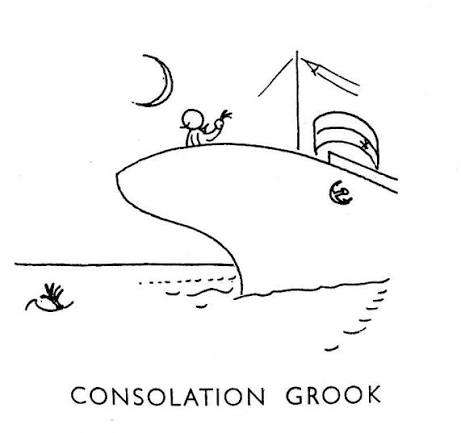
Losing one glove is certainly painful, but nothing compared to the pain, of losing one, throwing away the other, and finding the first one again.
*****
Piet Hein’s original Danish version, ‘Trøstegruk’ reads: Den, som taber sin ene handske, er heldig i forhold til dén, der taber den ene, kasserer den anden . . . og finder den første igen.
Hein did his own translation into English (as he did with hundreds of his Grooks), and sacrificed word-for-word translation for the sake of keeping the rolling rhythm and the rhyme: the original’s word “lucky” has gone, the word “pain” is introduced to rhyme with “again”. I am glad to see a poet translating his own work, and keeping the versifying more important than the literal words. This is what poetry translation is all about, surely.
The poem has an interesting origin story: it was written right after Germany occupied Denmark in April 1940, and was published in the newspaper Politiken’s daily short poem spot. While it passed German censorship as a light comment on the vicissitude of things, the Danish resistance movement (which Hein was active in) spread it as graffiti across the country, a coded message with losing one glove representing losing freedom, and throwing away the second glove representing giving up your patriotism, collaborating, which you will eventually come to regret.
‘Consolation Grook’ was the first Grook published by Piet Hein. He had a rich and varied life, with an academic background in science, art and philosophy; he was a script writer, an inventor, a furniture designer, a game creator; someone Niels Bohr would bounce ideas off, a friend of Einstein, Charlie Chaplin, and the puzzle creator Martin Gardner. Piet Hein was married four times, and before you think that his personal life would have been like his very civilised grooks, I suggest reading about his tendency to violence and the questions it raises about the death of his fourth wife, the Swedish actress Gerd Ericsson: https://pershmail.substack.com/p/piet-heins-problems
Now have I reared a monument more durable than brass, And one that doth the royal scale of pyramids surpass, Nor shall defeated Aquilo destroy, nor soaking rain, Nor yet the countless tide of years, nor seasons in their train. Not all of me shall die: my praise shall grow, and never end, While pontiff and mute vestal shall the Capitol ascend, And so a mighty share of me shall Libitina foil. Where bellows headstrong Aufidus, where, on his arid soil, King Daunus ruled a rural folk, of me it shall be told That, grown from small to great, I first of all men subtly wrought Aeolian strains to unison with our Italian thought. So take thine honours earned by deeds; and graciously do thou, Melpomenè, with Delphic bays adorn thy poet’s brow.
*****
Making a name for himself at Oxford as a conservative orator, Gladstone evolved into a reform-minded politician, enacting legislation that in later years he ruefully called socialist. He was strongly opposed to war and was outspoken against the Opium Wars in which Britain forced China to legalise the importation of opium (“a war more unjust in its origin, a war more calculated in its progress to cover this country with permanent disgrace…”) and the Crimean War for which as Chancellor of the Exchequer he refused to borrow money, but raised the income tax rate by half in order to make the war less popular (“The expenses of a war are the moral check which it has pleased the Almighty to impose upon the ambition and lust of conquest that are inherent in so many nations … The necessity of meeting from year to year the expenditure which it entails is a salutary and wholesome check, making them feel what they are about, and making them measure the cost of the benefit upon which they may calculate.”)
Queen Victoria complained that Gladstone “addressed me as though I were a public meeting” and far preferred his political rival Disraeli. Disraeli published a dozen novels as well as short stories, poetry, drama and nonfiction. Gladstone at least translated a bit of Horace into verse. Here is the original ‘Odes, 3.30’:
Exegi monumentum aere perennius regalique situ pyramidum altius, quod non imber edax, non aquilo impotens possit diruere aut innumerabilis annorum series et fuga temporum. non omnis moriar multaque pars mei vitabit Libitinam; usque ego postera crescam laude recens, dum Capitolium scandet cum tacita virgine pontifex. dicar, qua violens obstrepit Aufidus et qua pauper aquae Daunus agrestium regnavit populorum, ex humili potens, princeps Aeolium carmen ad Italos deduxisse modos. sume superbiam quaesitam meritis et mihi Delphica lauro cinge volens, Melpomene, comam.
I have taken the Gladstone translation from the excellent ‘Poem Into Poem’ (ed. George Steiner, Penguin) which also contains Ezra Pound’s translation:
This monument will outlast metal and I made it More durable than the king’s seat, higher than pyramids. Gnaw of the wind and rain? Impotent The flow of the years to break it, however many. Bits of me, many bits, will dodge all funeral, O Libitina-Persephone and, after that, Sprout new praise. As long as Pontifex and the quiet girl pace the Capitol I shall be spoken where the wild flood Aufidus Lashes, and Daunus ruled the parched farmland: Power from lowliness: ‘First brought Aeolic song to Italian fashion’– Wear pride, work’s gain! O Muse Melpomene, By your will bind the laurel. My hair, Delphic laurel.
I’ll take Gladstone’s version any day. No surprise.
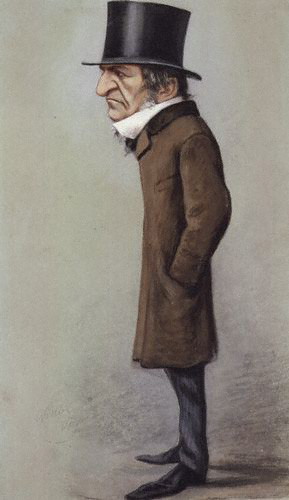
Illustration: drawing of Gladstone by Carlo Pellegrini, published in Vanity Fair 6 February 1869
Throne of my lonely niche, my wealth, my love, my moonlight. My most sincere friend, my confidant, my very existence, my female Sultan, The most beautiful among the beautiful… My springtime, my merry-faced love, my daytime, my sweetheart, laughing leaf… My plants, my sweet, my rose, the one only who does not distress me in this world… My Istanbul, my Caraman, the earth of my Anatolia My Badakhshan, my Baghdad, my Khorasan My woman of the beautiful hair, my love of the slanted brow, my love of eyes full of mischief… I’ll sing your praises always I, lover of the tormented heart, Muhibbi of the eyes full of tears, I am happy.
*****
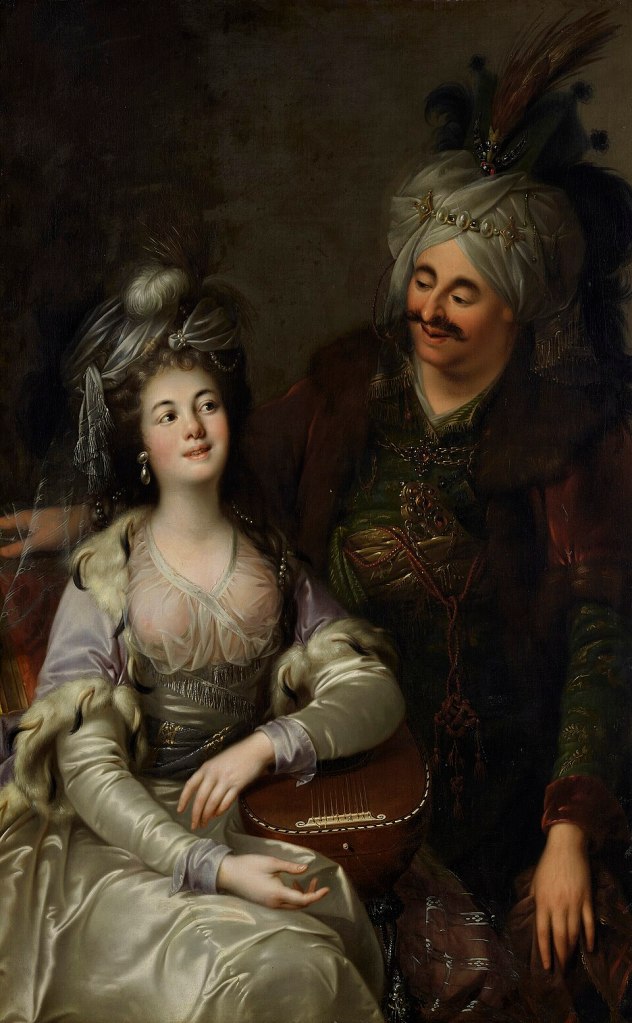
Suleiman the First, born in 1494, was Ottoman emperor from 1520 to 1566. Known to his subjects as The Lawgiver from his extensive reforms of education, society, taxation and criminal law, he was known in the West as The Magnificent for his court surpassing Europeans in grandeur. He formed an alliance with the French against the Hapsburgs, extended the empire in the Balkans and North Africa, and broke with tradition by marrying a Ukrainian or possibly Polish slave from his harem: Roxelana, or Hürrem, the mother of his successor Selim the Second. Under the pen name Muhibbi, he wrote love poems for Roxelana.
Painting: Attributed to Anton Hickel (1745-1798), Roxelana and Suleiman the Magnificent
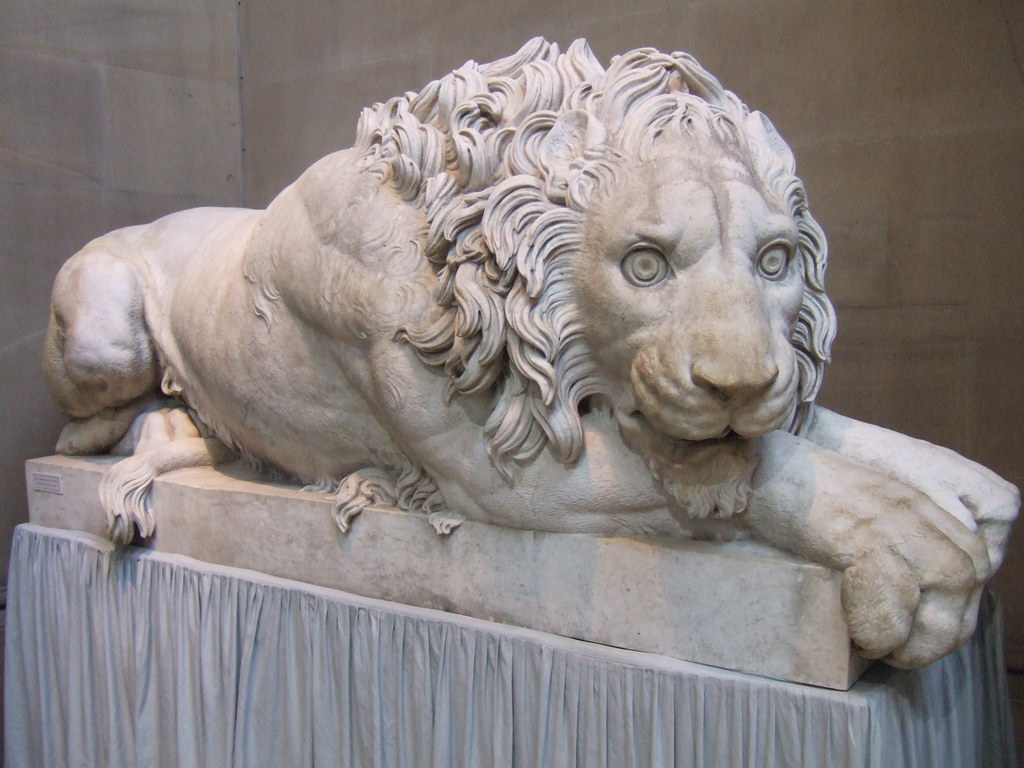
Lion-Eating Poet in the Stone Den is crafted entirely from the syllable “shi,” distinguished only by tonal variation, yet it still conveys a complete and coherent story in Chinese. The poem was originally written by Hu Mingfu (胡明复) and published by linguist Yuen Ren Chao in Volume 11 of The Chinese Students’s Monthly in 1916.[2][3] It was then refined by Yuen Ren Chao in the 1930s for demonstrative purposes in his lectures.
In Chinese:
“Shi Shì shí shĩ shĩ”
Shíshì shishì Shi Shì, shì shi, shì shí shí shĩ. Shì shíshí shì shì shì shĩ. Shí shí, shì shí shi shì shì. Shì shí, shì Shi Shì shì shì. Shì shì shì shí shĩ, shì shĩ shì, shĩ shì shí shĩ shìshì. Shì shí shì shí shi shi, shì shíshì. Shíshì shĩ, Shì shĩ shì shì shíshì. Shíshì shì, Shì shĩ shì shí shì shí shĩ. Shí shí, shĩ shí shì shí shĩ shĩ, shí shí shí shĩ shĩ. Shì shì shì shì.
English Translation:
In a stone den lived a poet named Shi, who loved lions and had resolved to eat 10 lions. He often went to the market to look for lions. At 10 o’clock, 10 lions had just arrived at the market. At that moment, Shi also arrived at the market. He saw those 10 lions and, using his arrows, slayed them. He brought the bodies of the 10 lions back to the stone den. The stone den was damp, so he asked his servants to wipe it clean. After it was cleaned, he tried to eat the 10 lions. When he began eating, he realized that those 10 lions were actually 10 stone lion statues. Try to explain this matter.
*****
If you chase this odd poem down in more detail, you will find arguments about the original poet’s intent, and the subsequent modifications by Yuen Ren Chao (who apparently claimed full ownership), and which language is appropriate for it, and more, in Wikipedia and elsewhere. I leave you with a long excerpt from pinyin.info:
“Yuen Ren Chao was the leader of the group that designed National Romanization. He knew that National Romanization (Guóyǔ Luómǎzì) could only write “modern vernacular Chinese,” and not Classical Chinese. In order to demonstrate this point he playfully wrote a classical essay consisting entirely of “homophones” entitled “Record of Mr. Shi Eating Lions.” The whole essay is copied as follows:
Shi2 shi4 shi1shi4 Shi1 shi4 shi4 shi1, shi4 shi2 shi2 shi1. Shi4 shi2shi2 shi4 shi4 shi4 shi1. Shi2 shi2, shi4 shi4 shi4, shi4 shi2 shi* shi1 shi4 shi4. Shi4 shi2, shi4 shi4 shi4 shi2 shi1, shi3 shi2 shi2 shi3 shi4, shi3 shi4 shi2 shi1 shi4shi4. Shi4 shi2 shi4 shi2 shi1 shi1 shi4 shi2 shi4. Shi2 shi4 shi1, shi3 shi4 shi4 shi3 shi2 shi4. Shi2 shi4 shi4. Shi4 shi3 shi4 shi2 shi4 shi2 shi1 shi1. Shi2 shi2, shi3 shi4 shi4 shi2 shi* shi1 shi1 shi2 shi2 shi* shi2 shi1 shi1. Shi4 shi2, shi4 shi3 shi4 shi4 shi4shi2. Shi4 shi4 shi4 shi4.” (The original article had no punctuation.) (* The character 硕 shuò, meaning huge, was pronounced as shí in the past.)
The vernacular translation of this essay is:
Shítou wūzi lǐ xìng Shī de shīrén xǐhuan chī shīzi, tā juéxīn yào chīdiào 10 tóu shīzi. Tā shíshí dào shìchǎng shàngqu kàn shīzi. Shí diǎn zhōng, tā dào shìchǎng, gānghǎo 10 tóu zhuàngdà de shīzi láidào shìchǎng. Zhè shíhou, tā kàn le zhè 10 tóu shīzi, yīkào 10 zhī shítou zuò de jiàn, bǎ zhè 10 tóu shīzi shāsǐ. Tā jiǎn qǐ zhè 10 tóu shīzi de shītǐ, huídào shítou wūzi lǐ qù. Shítou wūzi cháoshī. Tā jiào shìzhě mǒgān shítou wūzi. Shítou wūzi mǒgān le, tā kāishǐ chángshì chī zhè 10 tóu shīzi de shītǐ. Chī de shíhou, cái zhīdào zhè 10 tóu zhuàngdà de shīzi de shītǐ, shíjì shì 10 tóu zhuàngdà de shítou shīzi de shītǐ. Zhè shíhou, tā cái míngbai zhè jiàn shì de zhēnxiàng. Qǐng nǐ jiěshì, zhè shì zěnme huíshì?
The English translation of the essay is:
Mr. Shi, a poet who lived in a stone house, liked to eat lions. He vowed to eat ten lions. He often went to the market to look at lions. At ten o’clock, he went to the market, (and) just then ten large lions (also) came to the market. At that time, he saw these ten lions. Relying on the power of ten arrows with stone tips, he caused the ten lions to pass away. He picked up the bodies of the ten lions and went back to his stone house. The stone house was damp, so he told his servant to try and wipe it (dry). After the house had been wiped (dry), he began to try to eat the bodies of the ten lions. As he was eating, he realized that the bodies of the ten large lions were actually bodies of ten large stone lions. Only then did he understand the real situation. Can (you) explain what happened? (Translated by Victor H. Mair)
The point is that, if Chao’s classical essay were written in Hanyu Pinyin, everything would be shi and naturally no one could read and understand it. In other words, it is a kind of tour de force tongue twister. Even if it were written in characters, people still would not be able to understand it when it is read aloud. There are people who use this (playful) piece (that is forced and unnatural even in Classical Chinese) to oppose Hanyu Pinyin. They have completely misunderstood Yuen Ren Chao’s original intention!”
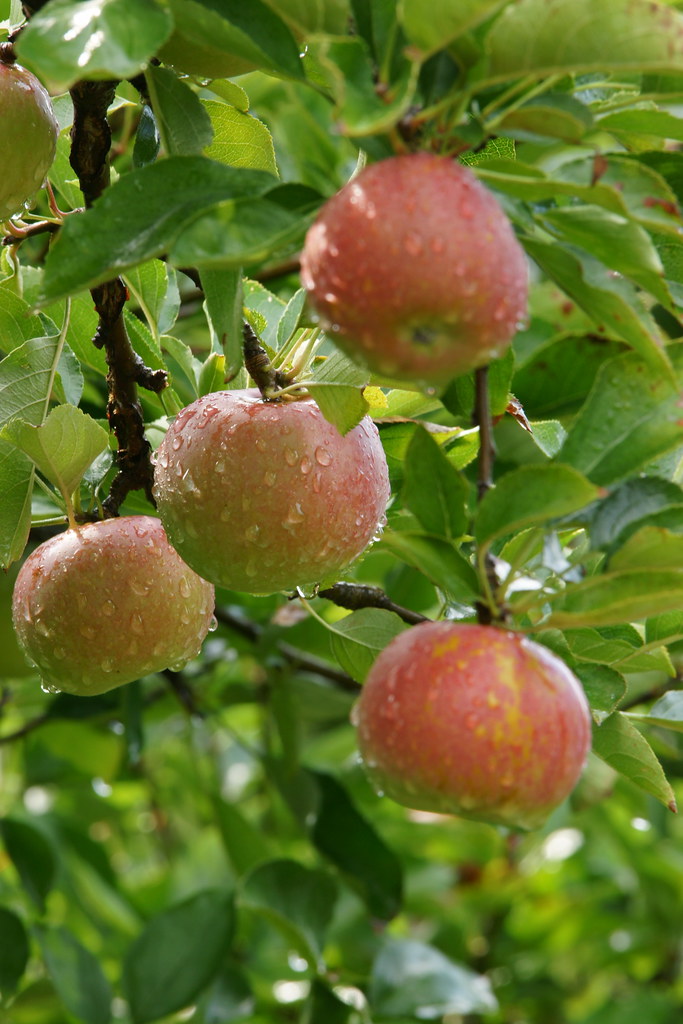
So there you are, clambering amongst the topmost golden apples when – ker-boom! A storm! an avalanche! comes hurtling through, ripping round the orchard-side. And you?
Down that ladder smartish. Catch your breath. Shelter in the shed, whose wobbly walls squeal with lightning-snaps , whose old roof pings and rattles in the hail. And then? Then things
go back to normal. Rosy sky. The grass, perky with flowers, says No Damage Done. So up you go again, and pick the fruit, that beckon, brighterwetter, in the sun.
Parmi les pommes d’or que frôle un vent léger Tu m’apparais là-haut, glissant de branche en branche, Lorsque soudain l’orage accourt en avalanche Et lacère le front ramu du vieux verger.
Tu fuis craintive et preste et descends de l’échelle Et t’abrites sous l’appentis dont le mur clair Devient livide et blanc aux lueurs de l’éclair Et dont sonne le toit sous la pluie et la grêle.
Mais voici tout le ciel redevenu vermeil. Alors, dans l’herbe en fleur qui de nouveau t’accueille, Tu t’avances et tends, pour qu’il rie au soleil, Le fruit mouillé que tu cueillis, parmi les feuilles.
*****
John Gallas writes: “Loved doing these – 3 months, off and on, 50 mornings, to do 50 Verhaeren poems – the ones from ‘The Flems’ (‘Les Flamands’) are wonderful, objective descriptions of loft, orchard, pond, farmyard, cow, cowherd, espaliers, milk, breadbaking etc. Did ’em all. So the whole 50 set is with Carcanet – just sent last week – awaiting a decision: the little feature for ‘Storm’ might be a good sign!”
John Gallas, Aotearoa/NZ poet, published mostly by Carcanet. Saxonship Poet (see www.saxonship.org), Fellow of the English Association, St Magnus Festival Orkney Poet, librettist, translator and biker. 2025 Midlands Writing Prize winner. Presently living in Markfield, Leicestershire. Website is www.johngallaspoetry.co.uk which has a featured Poem of the Month, complete book list, links and news.
How beautiful to view the crown of fire encircling day, to watch its rise, to see its kiss illuminate the brilliant waves, its blaze ignite the skies!
How beautiful in gloomy fall to drink perfume from flower petals still a little moist from morning rain, to breathe in sweetness ‘til you’ve had your fill!
How beautiful to watch as white descends in silent flakes of powdered snow, to gaze at crimson tongues that stir within the hearth that frames their crackling glow!
How beautiful when feeling tired to rest a snoring head on pillows’ fluff, to eat and drink and fatten up! And what a shame these things are not enough!
*****
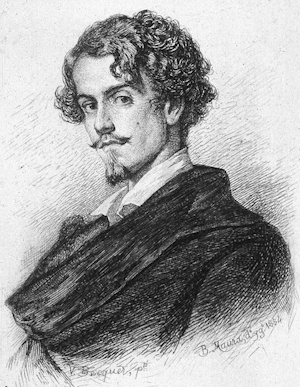
Paul Burgess writes: “Instead of providing a strict, academic translation, I have sought to recreate the experience of reading Bécquer. While recognizing that this is “my” Bécquer, I hope that this version will help contemporary English speakers enjoy the nearly untranslatable musicality and lyricism of one of the finest lyric poets to have ever written in Spanish.”
‘A Translation from Bécquer’ was originally published in Snakeskin.
Rima LXVII: Qué hermoso es ver el día
¡Qué hermoso es ver el día coronado de fuego levantarse y a su beso de lumbre brillar las olas y encenderse el aire!
¡Qué hermoso es, tras la lluvia del triste otoño en la azulada tarde, de las húmedas flores el perfume aspirar hasta saciarse!
¡Qué hermoso es cuando en copos la blanca nieve silenciosa cae, de las inquietas llamas ver las rojizas lenguas agitarse!
¡Qué hermoso es cuando hay sueño dormir bien… y roncar como un sochantre… Y comer… y engordar… y qué desgracia que esto sólo no baste!
Paul Burgess is the sole proprietor of a business in Lexington, Kentucky that offers ESL classes in addition to English, Japanese, and Spanish-language translation and interpretation services. He has contributed work to Blue Unicorn, The Road Not Taken, Light, The Orchards, Snakeskin, Pulsebeat, Lighten Up Online, Apricity, Star*Line, Asses of Parnassus, The New Verse News, and many other publications.
A wonder, that’s me, · what the women wait for with hope, and a handy · help to their near ones. I won’t hurt a soul · but the one who slays me. I’ve a stem that sticks · up straight in the bed and shaggy hairiness · hidden below. The farmer’s girl– · she’s a forward thing, and good to look at– · gets me in a grip and reaches right · for my ruddy self, handles my head · and holds me close clasping me firmly. · She’ll feel my force, the toss-curled tease. · There’ll be tears in her eyes.
*****
Maryann Corbett writes: “Riddle 25: Onion–This poem is a fairly faithful translation of one of the Old English riddles of the Exeter Book. Readers new to the riddles are sometimes surprised that a book preserved in a cathedral library includes such bits of naughty double-entendre.”
Maryann Corbett’s translation is collected in ‘Mid Evil’ (which won the 2014 Richard Wilbur Award). The original reads: Ic eom wunderlicu wiht · wifum on hyhte neahbuendum nyt; · nægum sceþþe burgsittendra nymthe · bonan anum. Staþol min is steapheah · stonde ic on bedde neoðan ruh nathwær. · Neþeð hwilum ful cyrtenu · ceorles dohtor modwlonc meowle · þæt heo on mec gripe ræseð mec on reodne · reafath min heafod fegeð mec on fæsten. · Feleþ sona mines gemotes · seo þe mec nearwað wif wundenlocc. · Wæt bið þæt eage.
Maryann Corbett earned a doctorate in English from the University of Minnesota in 1981 and expected to be teaching Beowulf and Chaucer and the history of the English language. Instead, she spent almost thirty-five years working for the Office of the Revisor of Statutes of the Minnesota Legislature, helping attorneys to write in plain English and coordinating the creation of finding aids for the law. She returned to writing poetry after thirty years away from the craft in 2005 and is now the author of two chapbooks and six full-length collections, most recently The O in the Air (Franciscan U. Press, 2023). Her work has won the Willis Barnstone Translation Prize and the Richard Wilbur Award, has appeared in many journals on both sides of the Atlantic, and is included in anthologies like Measure for Measure: An Anthology of Poetic Meters and The Best American Poetry.
Formerly Portugal presented tribute, now England is paying homage. They have traveled further than Shu Hai and Heng-zhang; My ancestors’ virtue must have reached their distant lands. Though their tribute is nothing special, my heart approves sincerely. Curios and their ingenious devices I do not prize. Though what they bring is meager, in my kindness to men from far away I make generous recompense – Wanting to preserve my good health and power.”
*****
Original Poem:
《红毛英吉利国王差使臣马嘎尔尼奉表贡至,诗以志事》
博都雅昔修职贡,英吉利今效荩诚。
竖亥1横章输近步,祖功宗德逮远瀛。
视如常却心嘉焉,不贵异听物翊2精。
怀远薄来而厚往,衷深保泰以持盈。
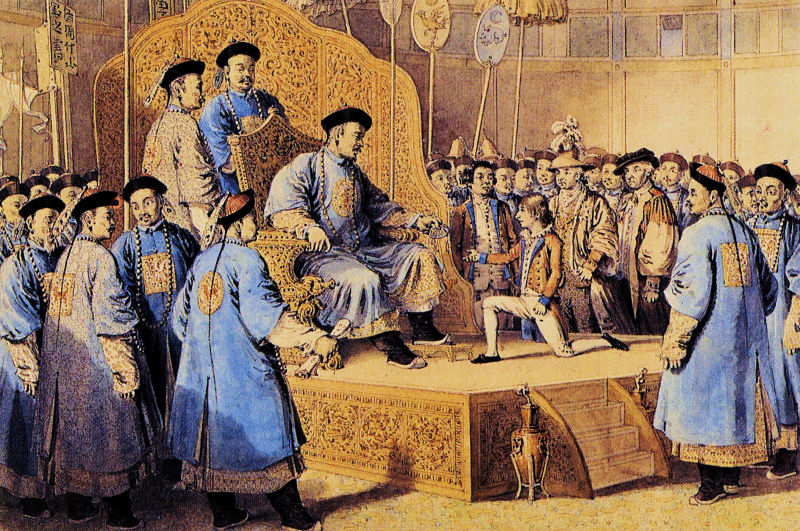
This poem was written by the Qianlong Emperor (25 September 1711 – 7 February 1799; also known by his temple name Emperor Gaozong of Qing, personal name Hongli) after his meeting with the British ambassador Lord Macartney at the Emperor’s grand tent in his Summer resort at Jehol (Chengde) on September 14th, 1793. The embassy was then sent back to Beijing, the Emperor followed and saw the previously prepared British gifts on September 30th. The gifts and embassy did not impress and so they were ordered home on the following day. The whole two-year expedition is detailed here.
Lord Macartney was not impressed either, and wrote: “The Empire of China is an old, crazy, first rate man-of-war, which a fortunate succession of able and vigilant officers have contrived to keep afloat for these 150 years past, and to overawe their neighbors merely by its bulk and appearance, but whenever an insufficient man happens to have the command upon deck, adieu to the discipline and safety of the ship. She may perhaps not sink outright; she may drift some time as a wreck, and will then be dashed to pieces on the shore; but she can never be rebuilt on the old bottom.”
Illustration: William Alexander’s drawing of the reception of the Macartney embassy to China. Young Thomas Staunton (kneeling not kowtowing) receives a gift from the Emperor. Image by William Alexander available under a Creative Commons License