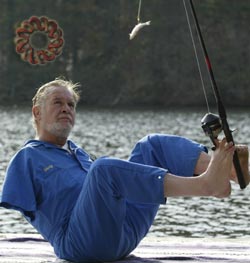
The man with no arms sat on the stool in the diner;
he was shoeless: How else could he drink his coffee,
eat his scrambled eggs?
The man with no arms parked his truck and got out barefoot.
He fired up his chainsaw; he had a landscaping business.
With the log out of the way, he could cut the grass,
push the lawnmower around with his chest.
The man with no arms saw the woman in the burning van,
barefoot, he kicked in the window, so his wife
could reach in and unlock the door, help the woman escape.
Somewhere Kipling’s Creator of All Things must have told him “Play –
play at being who you are,” and he played.
Somewhere Lear’s Aunt Jobiska must have told him “This is the best.”
And he lived, happy with who he was, glad for no arms
because no arms made him who he was, and he liked who he was.
Nor was the man with no arms alone.
The boy with no hands sat in the laundromat, knitting.
He had metal pincers. His mother was washing the clothes.
The girl with two heads, or rather the twins with only one body,
they live, argue, love, share.
And the men with no legs have a chance to run faster than all,
will require a new type of Olympics.
And the child born to die – does that disturb you, “the child born to die”?
The child born to die is me and is you, is all humans, all life,
all planets, stars, galaxies, all.
Listen to Lear’s Aunt Jobiska: This is the best.
Listen to Kipling’s Creator of All Things, and play.
*****
Marty Ravellette was a highly respected inhabitant of Chapel Hill, North Carolina, where he lived the last 16 years of his life – running his landscaping business, taking a break in a local diner, frequently a guest lecturer in journalism at UNC. He was a Baha’i convert, and a hero.
Occasionally I break my own rules about poetry, and write a poem in a style which I consider to be really flash fiction (or flash non-fiction in this case). The things I had to say didn’t present themselves in anything hinting at traditional verse, and therefore I just said them as best I could. But both Snakeskin and The HyperTexts consider it poetry, so I won’t argue. I’m not sure it should be in the formalverse.com blog, however…
Photo: Figure 8 Films


 Form in Formless Times