Tag Archives: Gaza

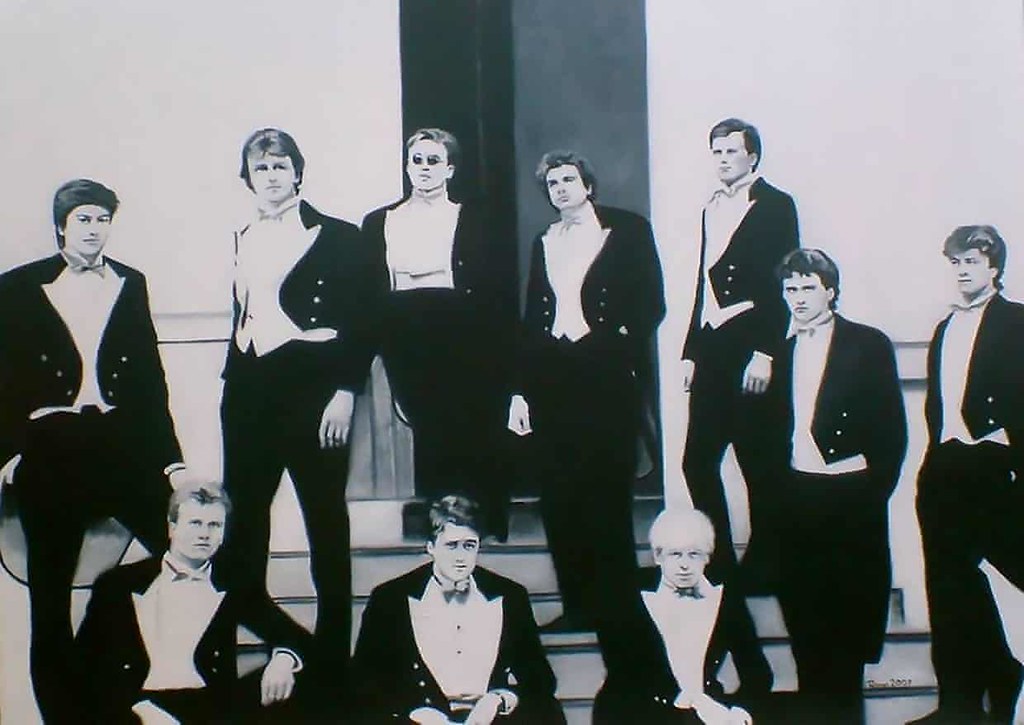
RHL, ‘Privelitch’

Some suffer from a travel itch
but I call that a snivel glitch
I only want to travel rich
and love it: it’s my privelitch.
O privelitch, o privelitch!

I only go to schools most rich,
(and only eat foods superrich),
then college has to be Oxbritch,
for that’s my privelitch.
I love you, love you, bitch!

I wear the robes and coronitch,
I swear by God I’ve found my nitch,
for, be I tubby, tall or titch,
I’ve got my privelitch.
O privelitch, o privelitch,
I love you, love you, bitch!

I never on my class would snitch
(or if I do, it’s just a smitch);
I’m faithful – cept for those I ditch,
for that’s my privelitch.
O privelitch, o privelitch!

I down it nail, I up it stitch,
call me a wizard or a witch,
I’ve got it all, with perfect pitch,
for that’s my privelitch.
I love you, love you, bitch!

My life with none I’d ever switch,
I’m over all, no slightest twitch,
and even when I’m in Death’s ditch
my tomb shouts Privelitch!
O privelitch, o privelitch,
I love you, love you, bitch!

*****

Don’t think I’m unaware of my own privilege: white males with above-average education are a privileged minority in any country. But also you reading this, whoever you are, you are privileged to not be a child in Gaza or any of the other hells that humans make for each other on an otherwise beautiful planet; you are privileged to be alive during this affluent and pivotal time in human history. And of course those who in addition have cultivated a taste for poetry… is there maybe a hint of privilege there?

This poem, like Buccaneer, was recently published in Magma.

Photo: “General Election Bullingdon Club Members in 1987, including Boris Johnson and David Cameron” by Diego Sideburns is licensed under CC BY-NC-ND 2.0.

Happy 2025… RHL, ‘The Sun is Always Setting’

The sun is always setting, always setting on your day;
you sense the dark approaching, wish that it would stay away.
Do you want a life unchanging? Wish to still be a newborn?
Don’t you know life’s not a rosebud, but has root and leaf and thorn?

The sun is always setting and the black drapes are unfurled;
but notice that the sun sets on your world, not on the world:
it’s rolling into brightness in another’s happy land,
and the dark is evanescent and the brightening is grand.

The sun is always setting on the dinosaurs, but birds
are flocking into being, as are Serengeti herds;
and the sun that lights humanity? Of course it’s going to set,
and elsewhere light new tales of which we’ll just be a vignette.

The sun is always setting, but that view is just your choice;
I say the world is turning and evolving; I rejoice.

*****

The winter solstice and the turning of the calendar drive a feeling of sunset that I can’t shake. I may be fit, still climbing trees and running on beaches, but at 74 there is both an awareness of gradual decline and a recognition that you can only hope for another 20 years with a fair amount of luck. “And of my three score years and ten, / None of them will come again…” as it were. That’s the personal bit.

Add to that the strongest country in (and quondam leader of) the world, breaking everything into pieces and throwing them all up in the air with no idea of how anything will land and what will be broken; taking all branches of the federal government (including unfortunately the Supreme Court) and those of half the states and just piling them up for a bonfire.

Add the possibility of runaway AI (such as concerns Harari) being jumpstarted by the Luciferic billionaire firestarter… and it feels like the End of the World.

But let’s be reasonable: it always feels like the end of the world, at least to those no longer in their youth. Because it is, for them. (For us. For me.) Jesus saying the end of the world would come within that generation… Last Days prophecies bubbling up in all religions… Preppers expecting nuclear war, ethnic uprising, climate catastrophe overnight… Doomsday is always imminent, and yet things keep going; just not as before… This is the End of the World as we know it, but will not be as we expected it. (And always the unfortunate eternal evils, regardless of era: Israelis committing genocide on Palestinians since the days of Deuteronomy, and so on.)

I swear there is a highly ambivalent poem in there somewhere, but I haven’t dug it out yet. But hey… Happy 2025!

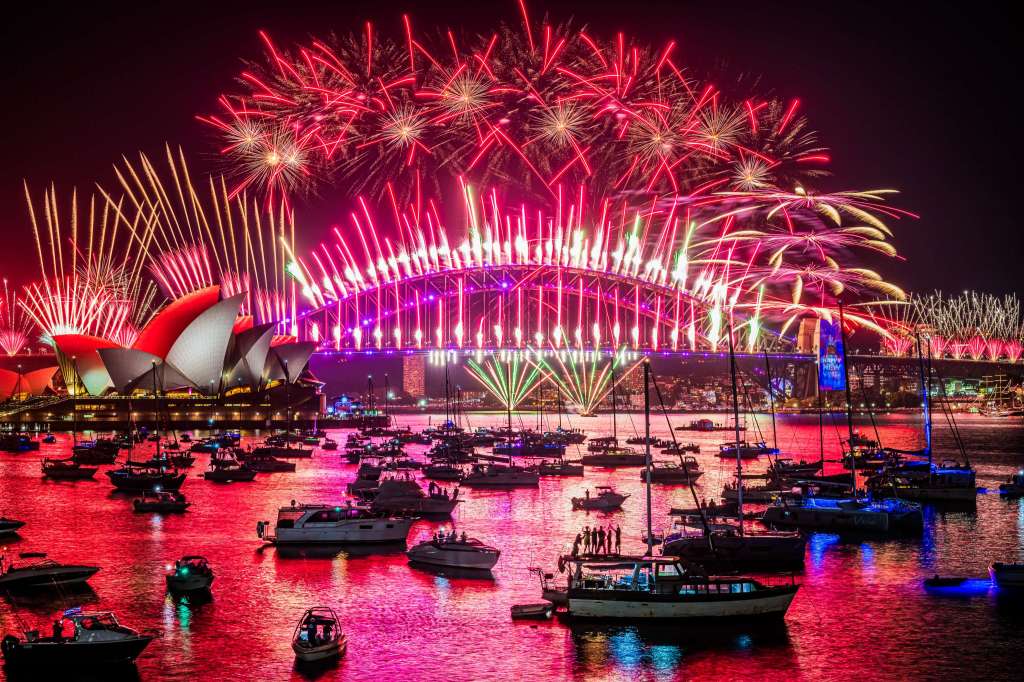
Photo: Keith McInnes | City of Sydney

The Two-State Dissolution (2): Landsman, Burch, Lehr, Foster, Galef, Soderling, Kenny, Helweg-Larsen, Smith, Bales, Shore

Peggy Landsman, ‘Go Tell It On The Mountain

Hagar and Sarah should have talked,
Laughed together when alone.
Who did Abraham think he was?
Ha-Yehudi ha-rishon?*

Ishmael and Isaac should have been
Boon companions, closer than brothers,
Passing their days doing their chores,
Tending their father’s sheep together…

Staying up late entertaining themselves
Arguing over the numbers of stars
Each was the first to have named.

*”Ha-Yehudi ha-rishon” means “The first Jew” in Hebrew.

Michael R. Burch, ‘Frail Envelope of Flesh’
for the mothers and children of Gaza

Frail envelope of flesh,
lying cold on the surgeon’s table
with anguished eyes
like your mother’s eyes
and a heartbeat weak, unstable…

Frail crucible of dust,
brief flower come to this—
your tiny hand
in your mother’s hand
for a last bewildered kiss…

Brief mayfly of a child,
to live two artless years!
Now your mother’s lips
seal up your lips
from the Deluge of her tears…

Quincy Lehr, ‘Passive Voice’

History is back in passive voice.
All you can do is watch. The teams were picked;
the commentary doesn’t match the plays.
The game is rigged, and everybody sees.

The game is rigged, and everybody sees,
but referees ignore it, and debate
is limited to the cheap seats far away.
The villains are the only proper nouns.

The villains are the only proper nouns,
the only ones worth mentioning besides
the nebulous abstractions for the rest.
None believe what everyone accepts.

History is back in passive voice.
The game is rigged, and everybody sees
the villains are the only proper nouns.
None believe what everyone accepts.

Gail Foster, ‘The Heap’

How many does it take to make a right?
Go fling another on. The heap grows high
Before too long it will obscure the light
And then where will we be. The end is nigh
And still it reaches up towards the sky
How many more, the village women weep
Of all our sons and brothers have to die
While we pile wrong on wrong upon the heap

Remember sky, how blue it was and bright
And wide, when only birds and clouds did fly
And moons and stars were visible at night
When women laughed and children didn’t cry
What use is wrong for wrong and eye for eye
The world grows blind and bitter and we reap
What we have sown and see our rivers dry
While we pile wrong on wrong upon the heap

What use a pile of pacifists? The sight
May cause a running man to stop and sigh
The wise man said, and think about the fight
And for a fleeting moment wonder why
They chose to sacrifice themselves, deny
The life force and there lie in peaceful sleep
They make a monument, he said, nearby
While we pile wrong on wrong upon the heap

Dear God, when will it end? When will you try?
The heap grows higher and the sides too steep
We love our neighbours with the guns we buy
While we pile wrong on wrong upon the heap

Daniel Galef, ‘Desert Kite’

These endless shifting sands—
They’re always changing hands,
But you can’t make bricks without breaking a little hay.
With oil the streets are pavèd;
Since Solomon and David,
They draft a brand-new atlas every day.
The apostles! The epistles!
And the fossil fuels and missiles—
Like manna in the wilderness they fall!
The land of Abrahamics
Now hosts General Dynamics
With their guardian angels gliding over all.

Janice D. Soderling, ‘Out of Paradise’

A closely woven stillness lines the air,
like linen bedding in a lifted coffin.
Though silence is a hallmark of our time, not often
has the hush been so oppressive. Where
the sand fox sprawls, sprawls too the shattered hare.
Cadavers of gazelle and roe deer stiffen;
the wadded pods of thorn trees burst. If when
you ponder on this devastated garden,
its wretched shame, its bottomless despair,
think not animal, but human, shreds in Eden.
And human was the animal lately passing there.

Janet Kenny, ‘After’

We saw them sweep in like a wolf on the fold.
We hypocrites judge as if time was involved.

Lament, all you lovers whose loved ones are gone.
Condemn, all you judges now grief is your song.

After the fury what’s left to repair?
Oh impotent jury, your conscience is there.

No poem will save us no tears will avail.
No weapons will spare us from history’s gale.

No art can encompass the scale of this rage.
“Tomorrow” is yesterday trapped in a cage.

Robin Helweg-Larsen, ‘Books’

When Science and Experiment
were done through myth and dream, it meant
that Bronze Age herders showed their bent
in naïve tribal Books.

The Israelites searched 40 years
for good land, unprotected, bare,
and slaughtered all those living there –
justified by their Book.

The Muslims conquered far and wide
(and called it peace, and millions died)
to spread new tales we now deride,
new versions of that Book.

The Christians sent wave after wave
crusading, claiming that they’d save
the “Holy Land”… made it a grave,
thanks to their stupid Book.

You advertise benevolence
but justify intolerance
by quoting this or that sentence
from one or other Book.

You bomb a house, a baby dies…
lift up your eyes so we can rise
above the vicious tribal lies:
those stupid, stupid Books.

J.D. Smith, ‘Report from the Field’

I rang the doorbell
of the demolished house
and was met by its generations,
fully armed.

Marcus Bales, ‘Heal or Hate’

You lift or do not lift the weight;
You’re either dealt-to or you deal.
Pick the other, pick the one,
The choice you have is heal or hate,
And you can’t ever hate and heal

Call it nature, nurture, fate
Genetics, fantasy, or real —
Blame whatever – when you’re done
You lift or do not lift the weight.
You’re either dealt-to or you deal.

Short-term crooked looks like straight;
Short-term truth sounds like a spiel.
In both the short and longer run
The choice you have is heal or hate —
And you can’t ever hate and heal

I know, the choices don’t seem great.
They lack in zip or sex appeal.
But no one said this would be fun.
You lift or do not lift the weight.
You’re either dealt-to or you deal.

You must massage your mental state
To organize the way you feel
In spite of all the bullshit spun.
The choice you have is heal or hate,
And you can’t ever hate and heal

You often have to simply wait
And sift to see what’s really real
Since growing needs both rain and sun.
You lift or do not lift the weight;
You’re either dealt-to or you deal.

Late or early, it’s too late.
You’re living through the slow reveal.
The game is rigged: it can’t be won
Or even stopped once it’s begun.
You lift or do not lift the weight;
And though you’re dealt-to or you deal
The choice you have is heal or hate.
You cannot ever hate and heal.

Marion Shore, ‘Peace’

I came upon a garden in the sun,
where children ran and played among the trees,
and entering, I asked two little ones:
“Why are you here? And where are your families?”
One answered, “I was with my dad and mom.
We went into a café for a Coke.
And then I heard somebody scream ‘a bomb!’
and all that I could see was fire and smoke.”
The other said, “I went outside to play,
the street was crowded. Tanks were all around.
Soldiers were shooting. I tried to run away.
I heard a shot and fell down on the ground.
No one heard me crying for my mother.”
The first child said. “I wish I could go home.”
“So do I. But at least we have each other.”
The sun was rising higher in the sky:
my dream was fading, and as I waved goodbye,
‘Salaam,’ said one. The other said ‘Shalom.’


Yuval Noah Harari: We suffer not from the narrowness of the land, but from the narrowness of the mind. https://youtu.be/Uncfi9cgZWo

It’s all about stories: https://youtu.be/L82XOw9sVkY


Acknowledgements:
Peggy Landsman: ‘Go Tell It On The Mountain’, first published in The HyperTexts
Michael R. Burch: ‘Frail Envelope of Flesh’, first published in The Lyric
Daniel Galef: ‘Desert Kite’, first published in Light
Janice D. Soderling: ‘Out of Paradise’, first published in The Rotary Dial and included in her collection ‘War: Make that City Desolate’

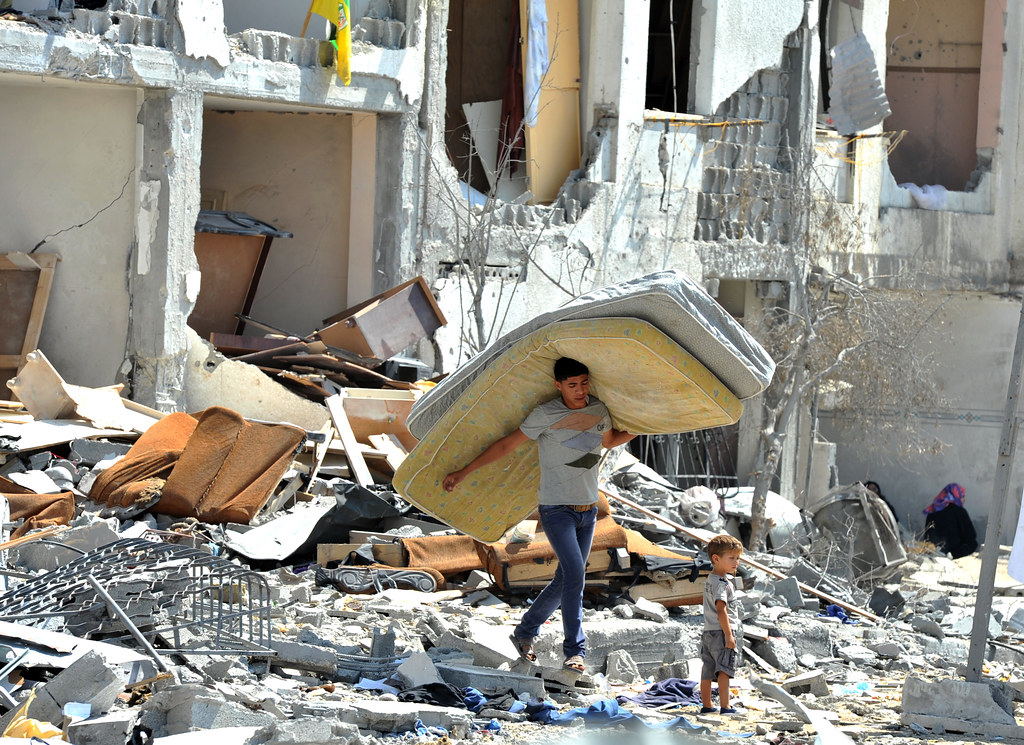
Photo: “Scenes from Gaza Crisis 2014” by United Nations Photo is licensed under CC BY-NC-ND 2.0.
The Two-State Dissolution: Yankevich, Kenny, Helweg-Larsen, Foster, Vaughan, Jackson, Bales, Burch

Leo Yankevich: ‘The Terrorist’

Only six, she stands before a tank,
looking at its armour, while inside
soldiers heed orders from a higher rank.
There isn’t any place for her to hide,
no door to head for, no abandoned car
to slide beneath. Pure terror rules her land.
When finally crushed, she rises past the star
of David, with a stone clutched in her hand.

Janet Kenny: ‘Didn’t They Know?’
(In memory of a lost poem by Robert Mezey)

Didn’t they know that when they swarmed
and slashed and slaughtered what they saw
as an oppressor’s nest, the rage
that they aroused would turn and pour
with molten heat back on their house?

Their captive children now must pay,
small targets in a concrete cage.
No treaty, pact, no peace no truce.
Didn’t they know? Didn’t they know?

No map to show another way.
Olive farmers pay for crimes
of other nations, other times.
No mercy here, no one is just.
Two agonies, two brains concussed.

Nothing to see here. False alarm.
Police not needed to disarm
two weeping peoples each aware
that no solution slumbers there.
Hearth and cradle now makes clear
an ancient poem brought them here.

Where is the psalm that both can share?

Robin Helweg-Larsen: ‘Both Sides Justify Their Terrorism’

When pleas for justice are of no avail,
when governments praise death and theft,
and courts say you’re in error;
when the UN is blocked to fail,
the only recourse left
is terror.

When no one cares that Yahweh willed
that Jews alone should have this land
(and God’s never in error)
and prior residents must be killed,
yet they won’t leave, they force your hand:
to terror.

Gail Foster: ‘On The Occasion of Benjamin Netanyahu Quoting Dylan Thomas’

Don’t tell me that you fight a righteous fight
How many children have you killed today
I’ll give you rage. I’ll give you rage alright

Your anger and your ego burning bright
Are razing all that’s standing in your way
Don’t tell me that you fight a righteous fight

How many have you sent into the light
Before they even had the time to pray
I’ll give you rage. I’ll give you rage alright

How many have you saved or sent in spite
Up to the sky in ashen clouds of grey
Don’t tell me that you fight a righteous fight

In clouds as those who in the fog and night
Were put in trains and disappeared away
I’ll give you rage. I’ll give you rage alright

You speak as if your soul was white as white
Yet deep inside you darkness holds its sway
Don’t tell me that you fight a righteous fight
I’ll give you rage. I’ll give you rage alright

Tom Vaughan: ‘The Land’

Let’s pretend that the war
could be over, and peace
reigned even if only
this evening. O please

pick up your anger
and soak it with mine
in six large barrels
of miracle wine

and then let us dance
like lovers, as though
this land’s many meanings
didn’t all signal no

and we could make ploughshares
out of our swords
and translate the past
into one shared world

and even if dawn
will scatter the night
and send us both stumbling
into the light

where smooth olives glisten
in the warm sun
like belts of bright bullets
ripe for a gun.

Jean MacKay Jackson: ‘War’

Some say that war is bright flares and drama,
A glory of fireworks illumining skies.
This is all lies.
War is a child calling out for his mama
And getting no answer.
War is a merchant of hatred and grief:
War is a thief,
War is a cancer.
Some say that war is hell. Perhaps that is so.
Yet hell has a lack
Of innocent bystanders, hell has no
Collateral damage, no accidental black
Body-bags for old women and babies.
Hell has no maybes;
Everything makes sense.
In hell there is no defense:
You belong there. You chose your path.
Hell has a cold, hard justice drained of wrath.
War is the horrified look in the eye
Of a young person dying without knowing why.

Tom Vaughan: ‘Aleppo’

Never again we say, each time
never, never again,
and every time we mean it so
when it happens again

we watch it on our screens, and say
never, never again

we meet and vote and all agree
never, never again.

Marcus Bales: ‘Genocide is Genocide’

Genocide is genocide. There’s no
Legitimacy on the table. None.
Your killing and your maiming only show
What horrors piled on horrors you have done.

The US taught the method to the Germans
The Trail of Tears leads to the Holocaust.
And now Israeli policy determines
They’ll do the same in Gaza. That boundary’s crossed.

Why not, instead, a reconciliation,
Where all the old and evil wounds can be
Accepted by each side without probation?
With zealotry forgiven, all are free.

Until that happens, hate corrupts you all,
With “Ams Yisrael Chai” the new decree —
Unless it turns out that the final call
That wins is “From the river to the sea.”

And that’s the choice: that each side does the worst
That it can do to keep the hatreds growing,
Shouting slogans of revenge, and cursed
To trade atrocities that keep the business going.

The other choice is reconciliation.
Yes, all the old and evil wounds will be
Accepted by each side without probation,
And zealotry forgiven, to be free.

If “Look at what they did to us!” is your
Refrain, then all you’ve done is to condemn
Your children to a world where they’ll endure
Their children’s gloat: “Look what we did to them!”

There’s always someone left to live resenting
The evils your revenges made you do —
And they will spend their hearts and souls inventing
A suitable revenge to take on you.

Be strong enough for reconciliation
Where all the old and evil wounds must be
Accepted by each side without probation.
With zealotry forgiven, all are free.

Michael R. Burch: ‘Epitaph for a Palestinian Child’

I lived as best I could, and then I died.
Be careful where you step: the grave is wide.

*****

Acknowledgements:

Leo Yankevich: ‘The Terrorist’, collected in ‘Tikkun Olam & other poems’, Counter Currents, 2012
Tom Vaughan: ‘The Land’, published on Hull University Middle East Study Centre website, 2022, and in Professor Raphael Cohen-Almagor’s December 2022 Politics Newsletter
Tom Vaughan: ‘Aleppo’, published in Snakeskin 233, October 2016
Michael R. Burch: ‘Epitaph for a Palestinian Child’, first published in Romantics Quarterly, and many places since. Michael R. Burch is the founder and editor-in-chief of The HyperTexts, and its extensive collections of poetry include ones on both the Holocaust and the Nakba.

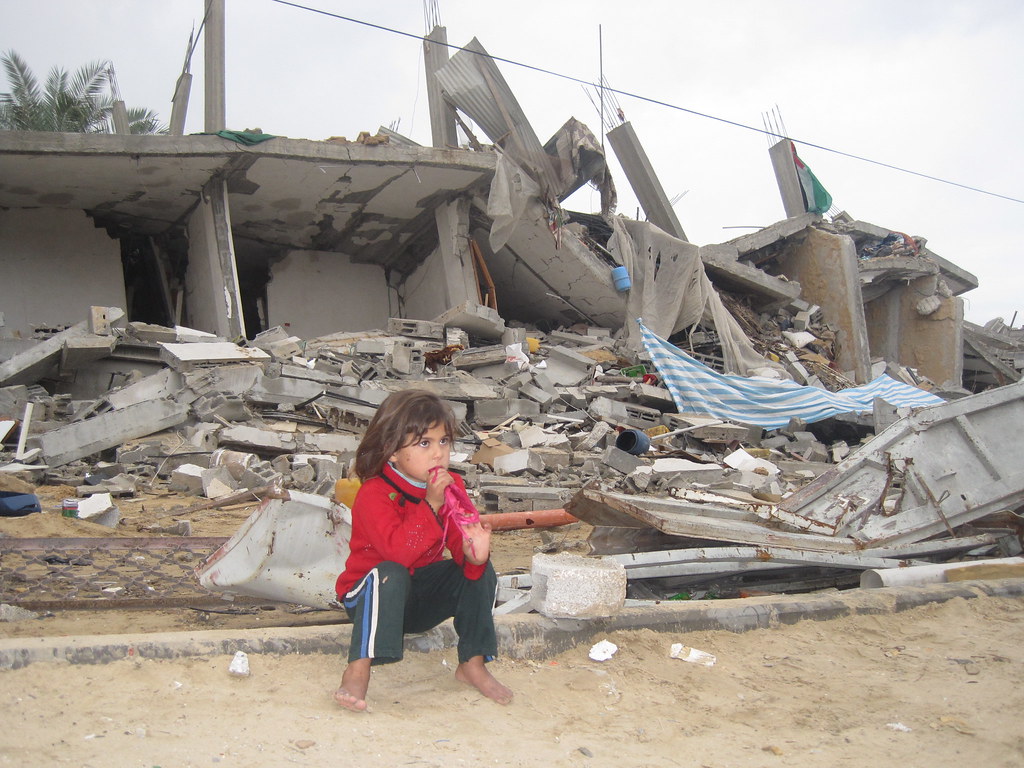
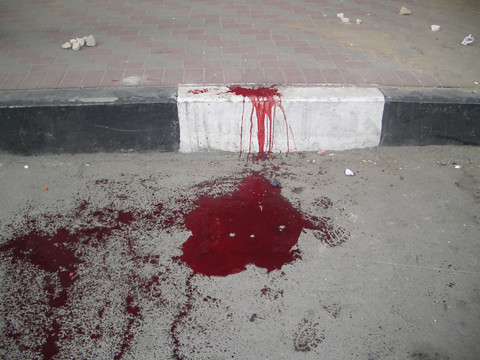
Photo: “Gaza war Nov2012” by EU Civil Protection and Humanitarian Aid is licensed under CC BY-NC-ND 2.0.
Using form: Villanelle: Discoveria, ‘October 7’

Your actions have unleashed a living hell.
Each day Israelis, Palestinians die;
Netanyahu, Hamas: go fuck yourselves.

October 7: gunfire and the smell
of death in the kibbutzim testify:
your actions have unleashed a living hell.

The siege of Gaza, ground invasion, tell
the UN of the “risk of genocide”.
Netanyahu, Hamas: go fuck yourselves.

And when the hospitals are bombed as well,
and there’s no water, food, or power supply,
your actions have unleashed a living hell.

Across the world the rage and hatred swell
and everyone feels forced to pick a side.
Netanyahu, Hamas: go fuck yourselves.

This one cannot be silent, for the bells,
they toll for everybody; none shall hide.
Your actions have unleashed a living hell;
Netanyahu, Hamas: go fuck yourselves.

*****

Discoveria writes: “I wrote this piece as a response to what was, at the time, a perception that people were being demanded to pick a side in the conflict between Hamas and the Israeli government, leaving no room for legitimate criticism of both. I wanted to express my anger and frustration at the situation, in which both sides have chosen the path of death and cyclical violence. The repeated refrains in the villanelle form emphasise these emotions. The piece was written overnight and posted in the early hours of Remembrance Day, 11/11/2023, after a little doomscrolling. I cannot pretend that there is much subtlety to the poem; it is what it is.”

Discoveria publishes much of their work at AllPoetry, saying “Due to the politically sensitive topic of the poem I would prefer to be credited under my username.”

Photo: “17 year old boy killed by Israeli army during demonstration in solidarity with Gaza” by ISM Palestine is licensed under CC BY-SA 2.0.

Michael R. Burch, ‘Suffer the Little Children’

for the children of Gaza

I saw the carnage . . . saw girl’s dreaming heads
blown to red atoms, and their dreams with them . . .

saw babies liquefied in burning beds
as, horrified, I heard their murderers’ phlegm . . .

I saw my mother stitch my shroud’s black hem,
for in that moment I was once of them . . .

I saw our Father’s eyes grow hard and bleak
to see his roses severed at the stem.

How could I fail to speak?

*****

Michael R. Burch writes: “Three decades ago, I began working with Jewish Holocaust survivors and other Jewish poets to publish translations of previously unpublished poems written in Polish and Yiddish by victims of the Holocaust. Some were written by children. In some cases the poems survived but the names of the poets did not. I considered it a sacred task and believed we were saying “Never again!” to any and all Holocausts. But in my discussions with my Jewish friends, it became apparent that “Never again!” did not apply to the Palestinians. When I asked questions about Israel’s brutal abuses of Palestinians and the theft of their land – armed robbery – my Jewish friends became defensive and told me, essentially, to shut up and never question Israel. Their sudden change in attitude convinced me that something was wrong, deeply wrong. I decided to research the subject independently, invested considerable time, and came to the conclusion that the Palestinian Nakba (“Catastrophe”) is a Holocaust sans ovens, a modern Trail of Tears. And while my country, the United States, has opposed other Holocausts, it is funding this one and supplies Israel with terrible weapons that are being used to mass murder children and their mothers, fathers and families. I will continue to say “Never again!” to any and all Holocausts and invite readers to join me and do what they can to end and prevent such atrocities.”

‘Suffer the Little Children’ has been published by Art in Society (Germany), Pick Me Up Poetry, Jadaliyya (Egypt), The HyperTexts andMESPI (Middle East Studies Pedagogy Institute). According to Google the poem now appears on 462 web pages.

Michael R. Burch is an American poet who lives in Nashville, Tennessee with his wife Beth, their son Jeremy, two outrageously spoiled puppies, and a talkative parakeet. Burch’s poems, translations, essays, articles, reviews, short stories, epigrams, quotes, puns, jokes and letters have appeared in hundreds of literary journals, newspapers and magazines. He is also the founder and editor-in-chief of The HyperTexts, a former columnist for the Nashville City Paper, and, according to Google’s rankings, a relevant online publisher of poems about the Holocaust, Hiroshima, the Trail of Tears and the Palestinian Nakba. Burch’s poetry has been taught in high schools and universities, translated into 19 languages, incorporated into three plays and two operas, set to music by 31 composers, and recited or otherwise employed in more than a hundred YouTube videos. To read the best poems of Mike Burch in his own opinion, with his comments, please click here: Michael R. Burch Best Poems.   

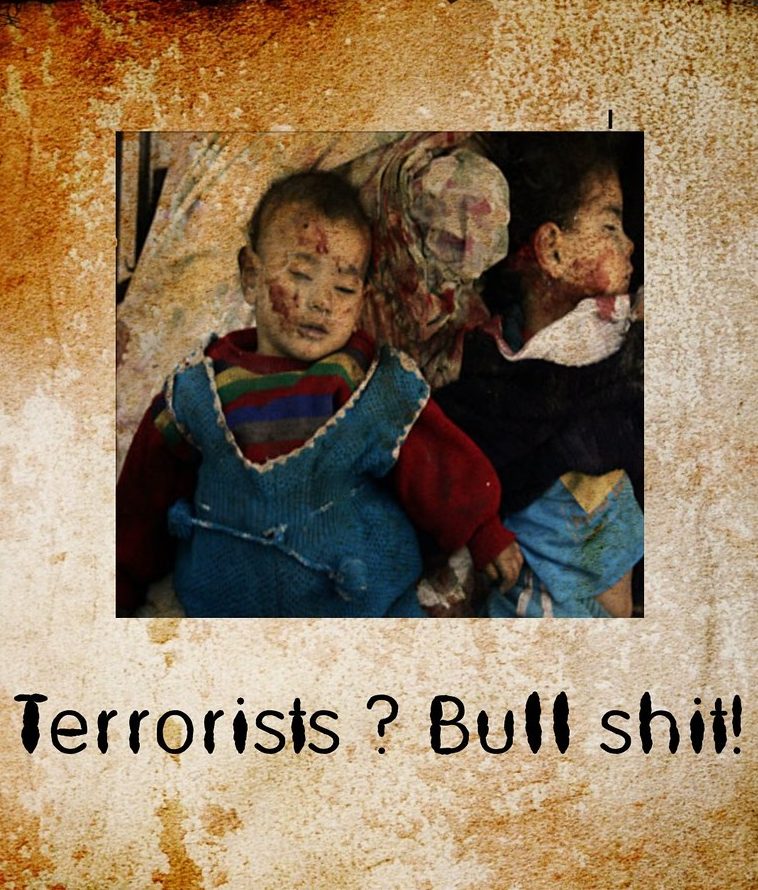
Photo: “Untermensch – Hannukah 2008 – Palestinian children killed by Israel in Gaza” by smallislander is licensed under CC BY-NC-SA 2.0.