Jeremy Desmon writes: “RhymeHamster is a rhyming dictionary I edit by hand. What may interest formal poets most is that perfect rhymes are kept strict, so near misses don’t slip into the list. Slant rhymes are kept separate, on a dial you can adjust. It’s free, with no ads and no login.”
When Jeremy approached me with his rhyming dictionary, my first action was to check for rhymes with ‘orange’. This is a tricky word, as different people treat it differently: as one syllable or as two. Versification is complicated in English by words like this. ‘Fire’ and ‘child’ come to mind – they create interesting opportunities for metre as well as challenges for rhyme. Anyway, RhymeHamster doesn’t list ‘sporange’, ‘the Blorange’ or ‘Daniel Gorringe’ which (to me) are all perfect rhymes.
Jeremy Desmon is a musical theater bookwriter and lyricist. For twenty years he has taught a playwriting workshop at Princeton, focused on musicals and songwriting. www.jeremydesmon.com www.WeWriteMusicals.com
Üç beyaz köpek bite me up in the hills. The nurse is a Kurdish giant. She says that it’s Fear that kills.
So I keep my wobbly composure. We go to Empire of Ants, we go to Diyarbakırspor and Feyyaz makes me some pants.
Now that I’m safe and sound, I sometimes think that I died. Dogs shriek when I touch them. Death is the vampire inside.
*****
John Gallas wrote in June: “Safe (just) back from my 10-day annual Wales Stiwdio Maelor hideaway adventure: much biking and tramping, but did have to get mopped up (along with 7 others) descending Cader Idris on the hottest May day ever recorded in Wales, by Mountain Rescue. Well, I had got to the top, then half way down … flop.
Evenings – no wifi – very writing-productive. I sorted ’10X10′ by chucking out ‘Lawrence of Australia’ (a 10 formal-poem tale) – sadly, it just didn’t work and I couldn’t torture it into acceptable shape – and writing replacement 10 ‘Retractions of Death’ – my 10 most near-fatal life moments – a merry bunch, as of course I survived ’em all! One attached for you…”
(“Üç beyaz köpek” is Turkish for “three white dogs”; “Diyarbakırspor” is the football club in Diyarbakır. – RHL)
John Gallas, Aotearoa/NZ poet, published mostly by Carcanet. Saxonship Poet (see www.saxonship.org), Fellow of the English Association, St Magnus Festival Orkney Poet, librettist, translator and biker. 2025 Midlands Writing Prize winner. Presently living in Markfield, Leicestershire. Website is www.johngallaspoetry.co.uk which has a featured Poem of the Month, complete book list, links and news.
Illustration: “Rabies in Diyarbakır 2015” as interpreted for RHL by GPT-5.6 Sol Light
Added harshness in this comic comes from the rollover text: “The crank doesn’t actually do anything, but it makes the humans happy” – plus the red button’s additional picture of the poet thinking “I hope the STEM crankers don’t look down on me.”
I am delighted by this comic, as usual; even though as a poet impressed with the ever-increasing quality of AI-driven or -augmented verse, I suspect that Zach Weinersmith is worryingly prophetic.
Illustration: ‘Crank‘ by Zach Weinersmith, who publishes a Saturday Morning Breakfast Comics (or SMBC) cartoon daily. He is the author of several brilliant and provocative books, including the previously reviewed ‘Shakespeare’s Sonnets: Abridged Beyond the Point of Usefulness‘.
I who am dead a thousand years, And wrote this sweet archaic song, Send you my words as messengers The way I shall not pass along.
I care not if you bridge the seas, Or ride secure the cruel sky, Or build consummate palaces Of metal or of masonry.
But have you wine and music still, And statues and a bright-eyed love, And foolish thoughts of good and ill, And prayers to them who sit above?
How shall we conquer? Like a wind That falls at eve our fancies blow, And old Maimonides the blind Said it three thousand years ago.
O friend unseen, unborn, unknown, Student of our sweet English tongue, Read out my words at night, alone: I was a poet, I was young.
Since I can never see your face, And never shake you by the hand, I send my soul through time and space To greet you. You will understand.
*****
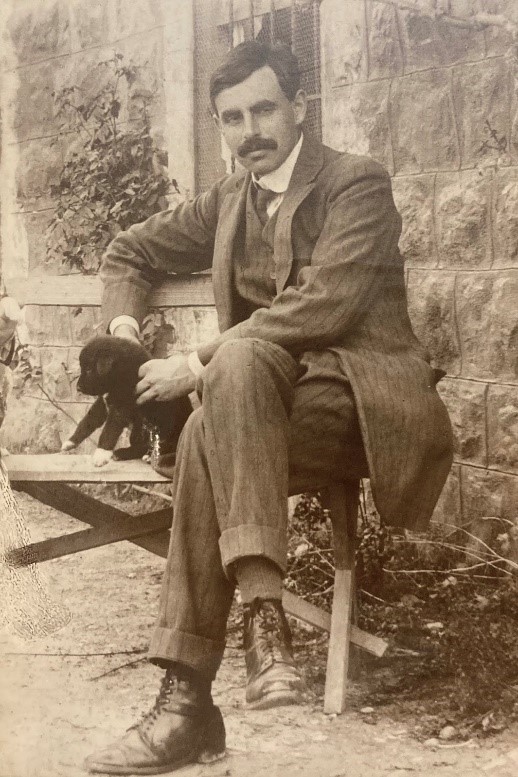
Herman Elroy Flecker – who switched his first name to James – was born in England in 1884 and died in Davos, Switzerland in early 1915. Flecker is one of those poets with 4 or 5 memorable poems, with the rest being very dated stylistically and thematically. ‘To a Poet a Thousand Years Hence’, ‘The Piper’ (barely), ‘War Song of the Saracens’ (for the rollicking rhyme), ‘Yasmin’, ‘The Old Ships’… but, especially, ‘The Golden Journey to Samarkand’ (Prologue and Epilogue, part of a stage play produced after the poet’s death in 1915). If you don’t like those poems, don’t even bother with the rest. He worked in the British consular services in the Eastern Mediterranean, and his work is loaded and larded with Greek, Ottoman and Arabic influences.
Photograph of James Elroy Flecker [c.1911-1914], Oxford, Bodleian Libraries, MS. 21234/1
He doesn’t have the time, he pleads, For long and patient wooing. A mortal man with urgent needs, He would be up and doing.
He’d worship for two hundred years Your left breast, then your right, He swears, but can’t because he fears Death’s swift-encroaching night.
He notes how brief are human lives. He says you mustn’t tease, For once that chariot arrives, You’ll have no days to seize.
Though you know joining him in bed Is what you’ll likely do, You’re certain romance will be dead Before the two of you.
*****
Chris O’Carroll writes: “Dorothy Parker’s verse paints her enthusiastic about sex but skeptical about romance. I wanted to incorporate both of those outlooks into her imagined response to Marvell’s famous come-hither argument.”
‘Dorothy Parker on Andrew Marvell’ was first published in Snakeskin.
Chris O’Carroll is the author of four books of poems — The Joke’s on Me, Abracadabratude, Quantum Creed, and the newly published Ridiculous Positions. He is a Light magazine featured poet and a contributor to Love Affairs at the Villa Nelle, Extreme Sonnets, New York City Haiku, and The Great American Wise Ass Poetry Anthology, among other collections.
When I was young and bold and strong, Oh, right was right, and wrong was wrong! My plume on high, my flag unfurled, I rode away to right the world. “Come out, you dogs, and fight!” said I, And wept there was but once to die.
But I am old; and good and bad Are woven in a crazy plaid. I sit and say, “The world is so; And he is wise who lets it go. A battle lost, a battle won– The difference is small, my son.”
Inertia rides and riddles me; The which is called Philosophy.
*****
Dorothy Parker (August 22, 1893 – June 7, 1967). The source of innumerable witty, caustic poems and quotable squibs. Her philosophical stance is one of Cynicism and Idealism; Socialism, Feminism and Civil Rights; and Literary American Modernism. She was wonderful.
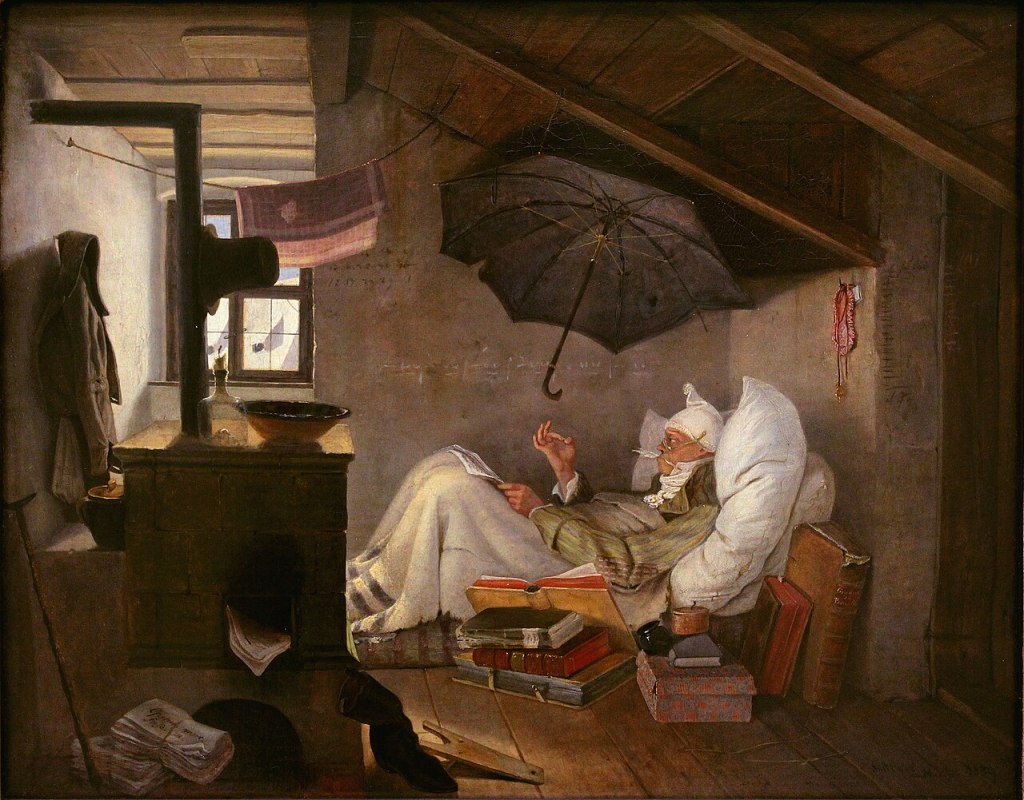
Der Arme Poet (best-known painting by Carl Spitzweg, 1839)
If only I can hatch a heartfelt rhyme, (with thought and frowns, it can’t be very hard), I’ll take my rightful place with the sublime.
O, gradus ad parnassum. One quick climb. I’ll be crème de la crème and avant-garde, if only I can hatch a heartfelt rhyme.
Top hat, cravat and walking stick meantime are ready—attributes to reap regard. I’ll take my rightful place with the sublime.
No more damp attic life; no fleas or grime. My poem will be perfection—a petard! If only I can hatch a heartfelt rhyme.
My peers will shout, “Alors, a paradigm! Such lofty wit, a wise camelopard.“ I’ll take my rightful place with the sublime.
I bite my quill: crime, slime, Mülheim, enzyme. The world will bow, salute and call me bard. If only I can hatch a heartfelt rhyme, I’ll take my rightful place with the sublime.
*****
Janice D.Soderling writes: “This poem is ekphrastic, generated from a preceding work of art. “About the mysterious motor that generates, I can say little. But no composer, artist, poet, sculptor works ex nihilo. Earliest man, woman, looked at their handprint, their footprint, and a thought rose, an urge to express what they felt – a primitive fear of death perhaps – and off they went to the caves to imprint their hand, or to carve a footprint on the rockface by the sea. A shout-out that Kilroy was here. “We hear music in the babbling brook, in the sighing wind, in the raindrop falling from leaf to leaf and plopping into the puddle below. There is poetry in the emotive sounds we make and hear: tinkling laughter, cooing seduction, growling rage, keening sorrow, barking grief. Of such, language is made; of language Shakespeare made Sonnet 73. “All art is imitation, from birdsong to a symphony orchestra, from the walking stride to the metrical verse. All art is a denial of death. Even the comic art.“
Janice D. Soderling is an American–Swedish writer who lives in a small Swedish village. Over the years, she has published hundreds of poems, flash and fiction, most recently at Mezzo Cammin, Eclectica, Lothlorien Poetry Journal and Tipton Poetry Journal. Collections issued in 2025 are The Women Come and Go, Talking (poems) and Our Lives Were Supposed to Be Different (short stories).
‘The Poor Poet’ was originally published in American Arts Quarterly, and republished in the current Well Met, where links at the bottom will take you to other poets in the issue.
Pic credit: Carl Spitzweg, The Poor Poet (via Wikipedia)
Just ask the poet, life’s a dumb thing. Button, button, eating, swilling. Life isn’t much but, still, it’s something.
Existence is a rule-of-thumb thing. Buying now with later billing. Just ask the poet, life’s a dumb thing.
To dream, to sleep, a ho-and-hum thing. Boring, boring, mulling, milling. Life isn’t much but, still, it’s something.
Mum’s the word, the word’s a mum thing. Button lips and no bean spilling. Just ask the poet, life’s a dumb thing.
Life, of course–the known-outcome thing. Death and taxes. God is willing. Life isn’t much but, still, it’s something.
Life is short, a bit-of-crumb thing. Dormouse summer, daddies grilling. Just ask the poet, life’s a dumb thing. Life isn’t much but, still, it’s something.
*****
In his 2021 collection ‘That Shakespeherian Rag‘, Ed Conti threads poetic references throughout (the title is from Eliot); ‘Button, Button’ appropriately begins with:
When one subtracts from life infancy (which is vegetation),–sleep, eating and swilling, buttoning and unbuttoning–how much remains of downright existence? – The Summer of a Dormouse, Byron’s Journals.
Much of ‘That Shakespeherian Rag’ (including Button, Button) was first published in Light. The collection is divided into 11 sections, organised from youth through adulthood to the prospect of mortality, and each prefaced with a quote from Shakespeare. The preface for the final Section reads:
Make no noise. Make no noise. Draw the curtains– – King Lear, Act II Scene 6
There is no poem after it.
The charming, delightful, witty and tolerant Edmund Conti died on November 12th, aged 96.
“This was Mr Heaney’s room. The peat’s From off his boots. It got into the rug And won’t be Hoovered out. Likewise the sheets And pillow case.” Solemn, I nod and shrug,
Expecting little better, as I note The sad brace of dried heads, the shards of flint, The coprolites and drafts that Heaney wrote Lying untidied here. “He liked his pint,
Did Mr Heaney, but you know the Irish. That and a roasted spud. He didn’t pay The last two weeks and more. You know the Irish.” And so it is I lie where Heaney lay
And watch the twilight dripping with the murk Lurking beyond short curtains. Left alone, I ponder what she’d said: “He’d often work My bit of bogland like it was his own–
He liked the muck and suck. But then one day He got some kind of letter from the Swedes, Got all excited and he went away. Now the whole plot is given over to weeds.”
Such cause for wonderment: Did Heaney ask No better than a spade or pen or hoe To kill his time? Nothing to ease the task– Girls, say? Or hurling pools? I just don’t know.
*****
R.S. (Sam) Gwynn writes: “It just came out of the similarity between the two names. With Heaney I always think of him out digging in a peat bog, etc.”
*****
The poem plays off Philip Larkin‘s description of himself moving into a boarding house, renting a room formerly lived in by ‘Mr Bleaney‘:
‘This was Mr Bleaney’s room. He stayed The whole time he was at the Bodies, till They moved him.’ Flowered curtains, thin and frayed, Fall to within five inches of the sill,
Whose window shows a strip of building land, Tussocky, littered. ‘Mr Bleaney took My bit of garden properly in hand.’ (…)
(But if) at his age having no more to show Than one hired box should make him pretty sure He warranted no better, I don’t know.
What happened to Bleaney? He stayed there “till they moved him”. As for Heaney, he got that letter from the Swedes and went off to collect his Nobel Prize. – Editor
*****
R. S. (Sam) Gwynn was born in Leaksville (now Eden), North Carolina, in 1948. After attending Davidson College, he entered the graduate program at the University of Arkansas, where he earned his M. F. A. From 1976, he taught at Lamar University, where he was Poet-in-Residence and University Professor of English. He retired in 2016. His first two collections were chapbooks, Bearing & Distance (1977) and The Narcissiad (1980). These were followed by The Drive-In (1986) and No Word of Farewell: New and Selected Poems 1970-2000. His latest collection is Dogwatch(2014) from Measure Press (which includes this poem). His criticism appeared regularly in the Hudson Review and other publications, and he was editor of the Pocket Anthology Series from Pearson-Longman. He lives in Beaumont, Texas, with his wife, Donna. They have three sons and seven grandchildren.
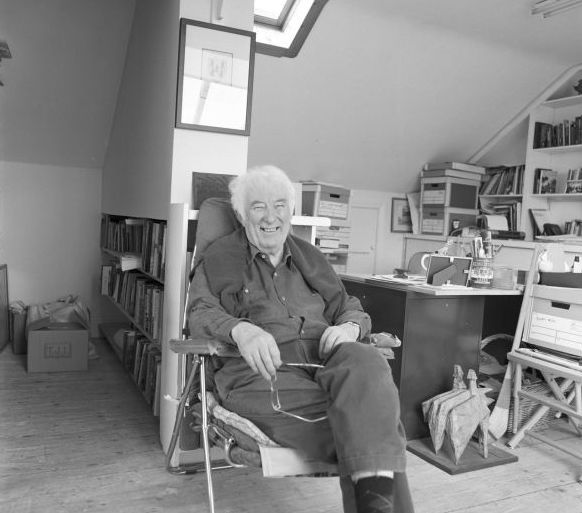
Photo with thanks to the Bobbie Hanvey Photographic Archive/Boston College.
“Auden thought the triolet was too trivial a form to bother with…” –James Fenton
Practally dactally W. H. Auden Mastered his verse forms with Scarcely a miss.
Some he found slight. There’s no Abecedarius, No triolet, and he Didn’t write this.
*****
When I first started thinking about double dactyls I made a list of words and when I saw that James Fenton quote I knew I had a poem. I no longer recall what word got paired with Kevin E. Federline.
Reese Warner lives in Toronto and does things with computers for money. Reese’s poems have shown up in journals such as Asses of Parnassus, The Malahat Review, The Rotary Dial, The Dalhousie Review among others. For more information see http://pubs.reesewarner.com
Double Dactyl was first published in The Asses of Parnassus.