Tag Archives: Leaving Camustianavaig

Using form: Amphibrachic tetrameter: John Beaton, ‘Regeneration’

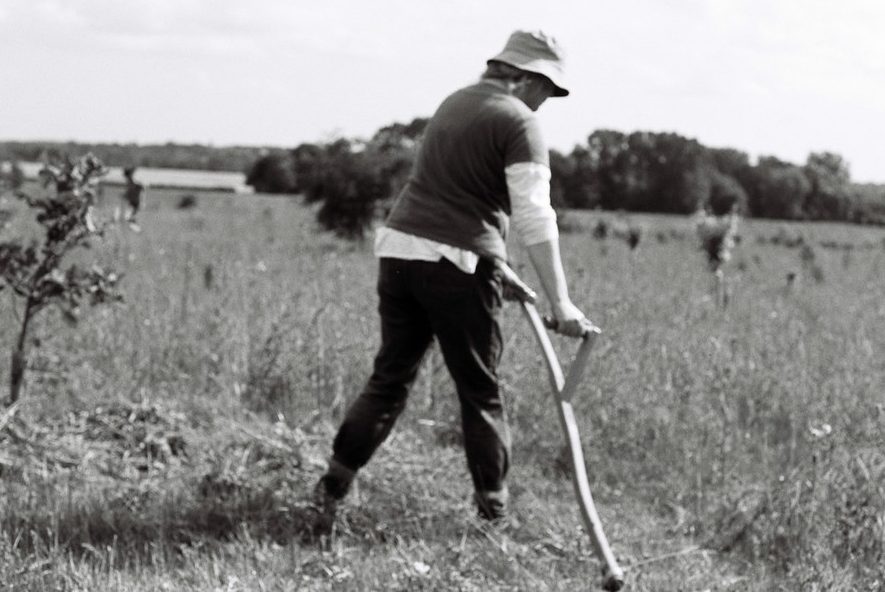
Hay ripens. I sharpen my tapering scythe blade
and chamfer its wafer of paper-thin steel
with stone swoops; it’s hooked like a peregrine’s talon.
The snaking shaft sweeps and the first swathe is side-laid
beside me, clean slain. As I swing I can feel
the gravid field yielding. Sheaves kneel and then fall in
the breeze in formation. Their early seeds dance there
like next April’s rain-showers shining in air.
The cocksfoot and rye-grass and fescue are falling,
the rogue oats, the sedges—I harvest the field where
they shaded the clover; and none do I spare.
The sun sets on stubble where hay-stalks lie sprawling;
my father stood here in the old days like one
of the stalks that made hay as they fell in the sun.

*****

John Beaton writes: “My father grew up in a croft on Skye and he’d scythe hay crops. As a boy, I saw him do it and, as a young man, I did it myself. I never forgot the rhythmic ease of his cutting. He’d been born to it. Anyone can scythe but there’s a skill in being able to do it effortlessly for whole days. It’s all in the rhythm and the precision of the swing.
One day, when I was scything dry hay and watching seeds scatter then fall, reseeding the ground, I thought of how I was succeeding my father. And I wrote this poem.
To capture the rhythm of the scythe, I used amphibrachic tetrameter lines with a mixture of masculine and feminine endings. For instance, the first two lines go:
da DA da da DA da da DA da da DA da
da DA da da DA da da DA da da DA
The other lines follow these patterns in varying order. The rhymes are abcabcdd effegg and the overall pattern is a modified sonnet. Strong internal rhyme and alliteration keep the lines swinging. I hope the reader sweeps and sways through it.”

John Beaton’s metrical poetry has been widely published and has won numerous awards. He recites from memory as a spoken word performer and is author of Leaving Camustianavaig published by Word Galaxy Press. Raised in the Scottish Highlands, John lives in Qualicum Beach on Vancouver Island.
https://www.john-beaton.com/

Scything” by London Permaculture is licensed under CC BY-NC-SA 2.0.
Using form: John Beaton, ‘Killing a Coho’

I grip its tail, hammock its back,
and swing its head down with a crack
on rock, then feel its spasms judder
through my hands as, with a shudder,
it stills,
a grand finale that fulfills
some ancient impulse in my mind.

Poking my finger through a gill,
I cause the raker fronds to spill
blood that drip drips as I carry
the silver deadweight of my quarry,
my kill,
toward a tidal pool
the sunset has incarnadined.

My knife begins behind its throat
and blood-clouds billow out and bloat
then seep into an outflow, seaward,
where baitfish burrow in the seaboard
in schools,
their heads in sand, small fools
kidding themselves they’re hard to find.

I slit its stomach. From that sac
their half-digested eyes peer back,
sandlance dumbstruck at being hunted
in shallow flats this prowler haunted,
this fish
whose every feeding flash
signalled flesh to seals behind.

Somewhere nearby a black bear roars;
wolves salivate; an antler gores
a starving cougar; orcas cripple
humpbacks, bite their fins, then grapple
great bulks
till bleeding, savaged hulks
sink; and then there’s humankind.

No kindness here. This salmon swam
full speed to seize my lure then, wham,
became a madcap, hell-for-leather,
death-row inmate on a tether
and fed
the caveman in my head.
This coast is one big hunting blind.

*****

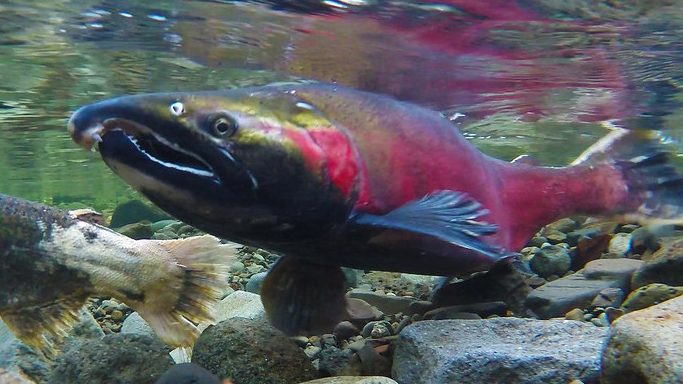
John Beaton writes: “I’m a lifelong fly-fisher but I’ve always had twinges of conscience about hurting and killing fish. Catch-and-release makes me question whether I’m being cruel. But there’s also a part of me that still connects with the beautiful brutality of the eat-or-be-eaten ecosystems in which we live. This poem tries to express that perspective in the context of an actual experience—the catching and killing of a coho salmon off a rocky shoreline near Tofino.

I chose a form to tell the story with some element of shock and violence. Each stanza has seven lines: one and two are tetrameter with masculine rhymes; three and four are also tetrameter but with feminine rhymes to cushion what comes next; five and six are monometer and trimeter respectively with masculine rhymes and these cropped lines set up a sense of surprise and violence; and line seven is tetrameter with a masculine ending that ties the poem together by rhyming with all the other seventh lines.

There’s some justification for killing the coho—the victim is itself a killer. And the turn at the end of the penultimate stanza connects humans with the savagery of the wildlife.

Sometimes you find a ‘eureka’ word—one that fits rhyme, meter, and sense so well you think ‘wow.’ This poem has one I think of that way: incarnadined.”

John Beaton’s metrical poetry has been widely published and has won numerous awards. He recites from memory as a spoken word performer and is author of Leaving Camustianavaig published by Word Galaxy Press, which includes this poem. Raised in the Scottish Highlands, John lives in Qualicum Beach on Vancouver Island.
https://www.john-beaton.com/

Photo: “Coho Spawning on the Salmon River” by BLM Oregon & Washington is licensed under CC BY 2.0.

Using form: John Beaton, ‘Legacy’ (excerpt)

Inside his penthouse office
he views his Inuit artwork,
carvings from a culture
reduced to buy-and-hold,
then scans the evening city,
his bar chart on the skyline
where real estate has grown his stake
but cost him bonds he’s had to break –
he hadn’t meant to so forsake
his parents. They looked old

that day outside the croft house
when cowed farewells were murmured
as cattle lowed in wind blasts
keening from the sea.
His mother and his father
stood waving from the porch step;
next year she’d crack her pelvic bone,
when winter iced that slab of stone,
and never walk again. I’ll phone,
and he was history.

(…)

He downs his drink and glances
again at his computer –
an email from a neighbour:
Your father died last night.
He’d lately gotten thinner
and seldom had a fire on –
what little peat he had was soft.
Some things of yours are in the loft
so mind them when you sell the croft.

The city lights are bright;

he turns again and faces
his metamorphic sculptures
of walruses in soapstone
that never will break free
from rock that locks the sea waves –
past fused against the future.
Another gin? That’s six. Or eight?
So be it. Clarity’s too late.
His real estate’s no real estate –
he’s left his legacy.

*****

John Beaton writes: “This is a composite. Elements of it are taken from my life but I’ve borrowed significantly from the trajectories of others, especially some of my father’s contemporaries who left Camustianavaig physically but never in their hearts. There are also aspects of the lives of some people I’ve known in business. 

I worked out the form so that each stanza would start out steadily and rhythmically for six trimeter lines then build pace for three rhymed tetrameter lines and rein to a halt with a single trimeter line that has a masculine rhyme with line four. Even though they limit word-choices, I thought feminine endings for the first three lines and lines five and six were worth it for the rhythm. And I like how they form a sort of rhyme and closure gradient with lines four and seven to ten.”

John Beaton’s metrical poetry has been widely published and has won numerous awards. He recites from memory as a spoken word performer and is author of Leaving Camustianavaig published by Word Galaxy Press, which includes this poem. Raised in the Scottish Highlands, John lives in Qualicum Beach on Vancouver Island.
https://www.john-beaton.com/

Photo: “‘V for Vendetta’, United States, New York, New York City, West Village, Skyline View” by WanderingtheWorld (www.ChrisFord.com) is licensed under CC BY-NC 2.0.

John Beaton, ‘A Many-Splendoured Thing?’

Is love a beaming, eye to eye? An oath—you-only-till-I-die?
A U that comes before an I? A hullabaloo-cum-lullaby?
A flirt? A tilting of the neck? An art? A Machu Picchu trek
back in time to that valiant peck on virgin cheek, that what-the-heck?

A brace of lovebirds who embrace instead of pecking cheeks, a plaice
whose eyes achieve a state of grace—as one on one side of its face?
A willing ear we learn to ration between soliloquies? A fashion?
The winning chips we hope to cash in from laying on the wheel of passion?

A bridle? Or a bridal dress? An if-you-love-me-you’ll… duress?
A scandal in the gutter press? A touch-me-there-uh-huh caress?
A smile without the crow’s-feet creases? A summer fling that never ceases?
A joining of two jigsaw pieces? A joke? A yoke with quick-releases?

Love grins with its beret askew, climbs up the sky and paints it blue
then turns the sun to shine on you and says, “You’re puzzled? Hey, me too!”

*****

John Beaton writes: “This started with recollection of a joke by British comedian, Benny Hill: there’s quite a difference between ‘What is this thing called love?’ and ‘What is this thing called, love?’ I decided to come up with humorous answers and they started occurring to me in pairs of rhymed pairs.
I want this to be light and playful. I cobbled the answers together in octameter lines, each with two rhymed tetrameter halves, and configured the lines in three quatrains (aabb) and a rhymed couplet. The result has elements of the sonnet form—fourteen lines and a turn at the end of line twelve. I’ve also played with alliteration and internal rhyme.”

John Beaton’s metrical poetry has been widely published and has won numerous awards. He recites from memory as a spoken word performer and is author of Leaving Camustianavaig published by Word Galaxy Press, which includes this poem. (It is also in the Potcake Chapbook Rogues and Roses.) Raised in the Scottish Highlands, John lives in Qualicum Beach on Vancouver Island.
https://www.john-beaton.com/

What do you see through love?” by TW Chang is licensed under CC BY 2.0.

Potcake Poet’s Choice: John Beaton, ‘Bedtime Story’

The sun has smouldered low. Its flaxen light
drizzles through the birches to the snow
where sheep stand still as hay-bales, beige on white.
A shepherd with a shoulderful of straw,
brindled by the shadows, softly walks.
The sheep flock round; he swings his load to strew
the strands on pillowed drifts like yellow locks,
then hastens homewards bearing sustenance
against the ghostly dark. He holds small hands
and spins his children tales of happenstance
and golden fleeces in enchanted lands.
Their minds woolgather. Snuggled down in bed,
they drift on snowy pillows; yellow strands
of hair glow like the hay their father spread.

John Beaton writes: “My wife and I have five children and one of my great delights was reading to them in bed when they were little. We covered a lot of ground, from Shel Silverstein’s poems and Roald Dahl’s stories to whole books like “Watership Down” and “The Old Man and the Sea.” This poem came to me when I was looking at the painting “Shortening Winter’s Day” by Joseph Farquarson (shown above). It was reminiscent of the place where I grew up in Scotland. The image of the shepherd feeding sheep in the gloaming light evoked the feeling of security and contentment that imbued those evenings of reading. I recite my poetry and tend to write for sound almost as much as for sense. I like the sounds of this one. Also, when picking subjects for poems, I’m more drawn to happiness and beauty than to sadness and misery. All in all, this poem fits my preferences quite nicely.”

John Beaton’s metrical poetry has been widely published and has won numerous awards. He recites from memory as a spoken word performer and is author of Leaving Camustianavaig published by Word Galaxy Press. Raised in the Scottish Highlands, John lives in Qualicum Beach on Vancouver Island.

https://www.john-beaton.com/