Our mother was a mousetrap under the stairs. She used as bait the things she never said. We’d hear a snap and find three silver hairs in an old passport, pinned like something dead.
Our father was an occupying force in a town of collaborators. Good behavior meant not signaling in morse enemy troops camped in a distant wood.
Our parents paced—her mind a radio playing the classic dirges until dawn, his heart a spider web spun in the snow catching the dusk sun before it was gone.
For supper, they would feed us each a crumb of moonlight. Our house was a moving train. Evenings they danced in a delirium of silence, drunk on a thimbleful of rain.
*****
Morri Creech writes: “I don’t really have comments for this poem. The first line came to me, and the rest of the poem found its way as I continued to search for context to support that sentence. I didn’t know what I was going to say until I was saying it.”
Morri Creech is the author of five collections of poetry: Paper Cathedrals (Kent State U P, 2001), which received the Stan and Tom Wick Poetry Prize; Field Knowledge (Waywiser, 2006), which received the Anthony Hecht Poetry prize and was nominated for both the Los Angeles Times Book Prize and the Poet’s Prize; The Sleep of Reason (Waywiser, March 2013), a finalist for the 2014 Pulitzer Prize; Blue Rooms (Waywiser, October 2018); and, most recently, The Sentence (LSUP, September 2023). A recipient of NEA and Ruth Lilly Fellowships, as well as grants from the North Carolina and Louisiana Arts councils, he is the Writer in Residence at Queens University of Charlotte, where he teaches courses in both the undergraduate creative writing program and in the low residency M.F.A. program. He lives in Charlotte, North Carolina with the novelist Sarah Creech.
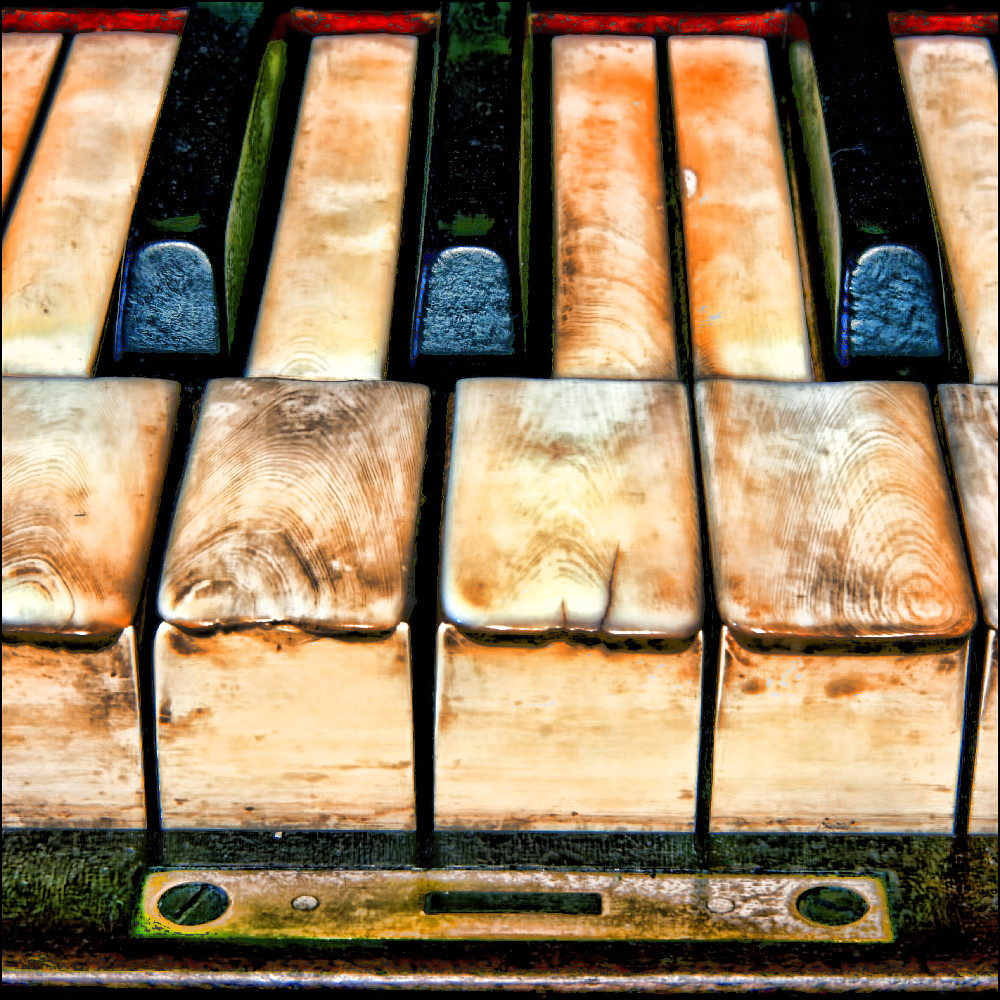
Notes left behind by strangers long since dead entranced my mother—not the squiggles, dots and lines themselves, but what musicians read from them on radio, the sounds ink spots had spelled. In quartets and in Claire de lune, her young ears heard what many can’t discern: enchanting, complex things—beyond the tune— about which she had little chance to learn. When she grew up, her voice was warm and rich as those of many singers who’d been schooled in breath control and quarter notes and pitch. She was as musical as some who’ve ruled the concert stage—but she sang in the car and kitchen; we heard her wide repertoire.
We heard her car and kitchen repertoire of opera arias, concerto themes, and deep regret she never got as far as piano lessons. Her childhood daydreams were seeded by the sagging upright housed at her Aunt Margaret’s—maybe she’d learn there?— and fed by radio: Puccini roused her love of opera, Brahms made her aware of string-sung drama. She pursued her chances to learn and listen—and also to plead for lessons, though her parents’ circumstances made that impossible. But she’d succeed in giving her kids what she’d never had— assisted in that effort by my dad.
It took substantial effort. Mom and Dad lacked wealth, but not love or imagination. Wrong turns became adventures, plans gone bad would show up later in a wry narration. Fun for us kids was low-cost, even free: a paper crown on birthdays, or a game made out of raking leaves, or a decree that it was Ice Cream Tuesday. We became as skilled as they were at composing joy: we heard another music in our days of sibling harmony, learned to deploy exuberance and laughter as one plays an instrument. And then catastrophe and cleverness brought opportunity.
Our clever dad saw opportunity when fire destroyed a nearby school, with all its contents lost—including, doubtlessly, the old piano. But Dad made a call and had the badly damaged upright brought to our garage. It was a rescue mission: the smoky wreck could be revived, he thought. He’d never played, and he had no ambition to do so, but he always had been good at fixing things. And so he scrubbed the keys, patched felts and hammers, and restored the wood of the disfigured case. And by degrees, the sooty hulk became something we prized. Untrained, unmusical, he’d improvised.
With talents of his own, he’d improvised, so we could, too. And he and Mom had planned and saved so we’d have lessons. Though advised to start us at age seven, Mom had grand ambitions for my younger hands. At six, I got to know the keys and clefs with smart, no-nonsense Mrs. Steffen, who would mix high standards and commitment to the art of making music with kid-friendly stuff. I played a little Mozart (simplified), a piece called “Crunchy Flakes” and other fluff, some basic boogie-woogie, drills that tried my patience. And my two sisters and I all played—too loudly—Brahms’s lullaby.
We all played Brahms’s famous lullaby, and argued over which of us would get to practice next; I knew the time would fly when it was my hour. Paired in a duet, two sisters often bickered just as much as we made music, but we learned to work together, synchronize tempo and touch, forget the other could be such a jerk. Years later I made music my profession, and it became both job and joy, a route to self-sufficiency and self-expression— a gift whose worth I never could compute, from parents who would never read a score, but who would give us music and much more.
They gave us music, but a great deal more than just the audible variety. Their well-tuned lives—examples set before us kids—were also music. They taught me to practice patience in both work and play; to face discord and my mistakes with poise; to transpose trouble to keys far away; to find and share the song within the noise. My mother’s dreams, my father’s diligence, and love composed a priceless education. And those gifts all enrich the resonance I hear in Bach and Brahms—in my translation of small black symbols in the scores I’ve read: notes left behind by strangers long since dead.
*****
Jean L. Kreiling writes: “I often find myself reminding readers that poems are not always autobiographical—but ‘Another Music’ is thoroughly autobiographical, and it’s meant to honor my devoted and fun-loving parents. My mother’s love of music and my father’s brilliance did shape much of my life, and my parents gave me (and my siblings) a richly happy and secure childhood. My parents’ legacy has lived on in the lives of all of their children: music has been important in all our lives, and family has been a top priority and a joy for all of us. Mom and Dad supported my work as a poet just as enthusiastically as they supported my musical endeavors, and I’m grateful that they both lived to see my first book of poems published.”
Jean L. Kreiling is the author of four collections of poetry; her work has been awarded the Able Muse Book Award, the Frost Farm Prize, the Rhina Espaillat Poetry Prize, and the Kim Bridgford Memorial Sonnet Prize, among other honors. A Professor Emeritus of Music at Bridgewater State University, she has published articles on the intersections between music and literature in numerous academic journals.
Without black tea, his mornings never start. The newspaper should be upon his bed; Not finding it will make his eyes all red. As if examining a piece of art, He reads each page. Loud oohs such as ‘My heart!’, ‘Another swindle!’, or ‘So many dead!’, Are heard as if the earth’s weight’s on his head. Harrumphing, he jumps to the Cultures part. A pensioner today, back in those days, He was a banker. Now, he saunters, plays Carom with me, or spends the noontimes planting Camellias —- a work he finds enchanting. At times, he sits before some dusty files, Puts on the glasses, thumbs through them, and smiles.
Shamik Banerjee is a poet from Assam, India. Some of his recent publications include Spelt, Ink Sweat & Tears, Modern Reformation, San Antonio Review, The Society of Classical Poets, Third Wednesday, and Amethyst Review among others.
Her ashes spread on Skirrid that she loved; and his bones buried by the Harbour bay… Why choose views for the dead? Once in earth shoved, dirt in the dark is all they’d see, not day, even if they lived. And if cremated, well… So is it for our own guilt’s absolution? Or status, that their graves our standing tell? Or rites for social change’s resolution? Those who were always here are here no more – Their alwaysness runs out when they decease, and life will now sound different from before, like insect shrills not heard until they cease. Dead ghosts sleep twittering in our heads’ domed caves, waking to fill night skies from dreams and graves.
*****
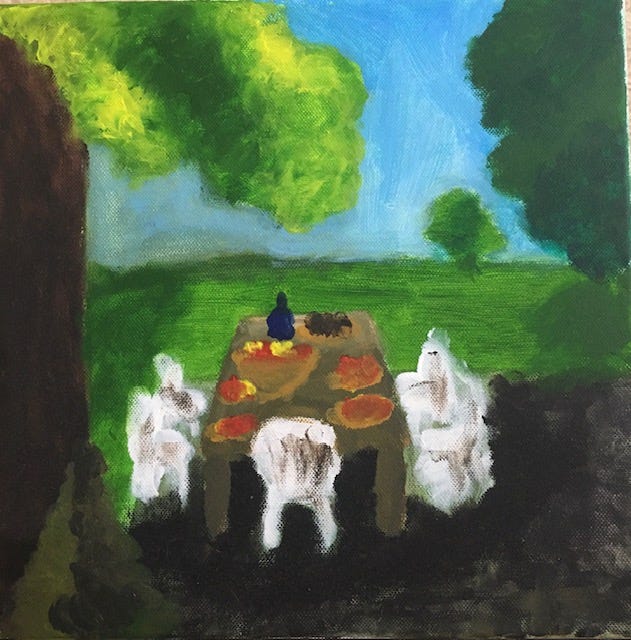
This sonnet was published by The Wee Sparrow Poetry Press as a response to their ekphrastic challenge for the illustration, a painting by Žofia Katriňáková. It was written for my parents who, although they died decades ago, are still a background to my thoughts. My father is buried by the bay of Governor’s Harbour, my mother’s ashes were scattered on Skirrid Fawr, the Welsh mountain she loved and lived within sight of in Abergavenny. And I have another short poem for them, published in the Amsterdam Quarterly:
In the night’s jam jar of my memory my long-dead parents live as fireflies. My thoughts of them worn by time’s emery, their faint light still suggests where my path lies.
Is it reasonable to hope to be a firefly for your children and grandchildren?
Inside his penthouse office he views his Inuit artwork, carvings from a culture reduced to buy-and-hold, then scans the evening city, his bar chart on the skyline where real estate has grown his stake but cost him bonds he’s had to break – he hadn’t meant to so forsake his parents. They looked old
that day outside the croft house when cowed farewells were murmured as cattle lowed in wind blasts keening from the sea. His mother and his father stood waving from the porch step; next year she’d crack her pelvic bone, when winter iced that slab of stone, and never walk again. I’ll phone, and he was history.
(…)
He downs his drink and glances again at his computer – an email from a neighbour: Your father died last night. He’d lately gotten thinner and seldom had a fire on – what little peat he had was soft. Some things of yours are in the loft so mind them when you sell the croft. The city lights are bright;
he turns again and faces his metamorphic sculptures of walruses in soapstone that never will break free from rock that locks the sea waves – past fused against the future. Another gin? That’s six. Or eight? So be it. Clarity’s too late. His real estate’s no real estate – he’s left his legacy.
*****
John Beaton writes: “This is a composite. Elements of it are taken from my life but I’ve borrowed significantly from the trajectories of others, especially some of my father’s contemporaries who left Camustianavaig physically but never in their hearts. There are also aspects of the lives of some people I’ve known in business.
I worked out the form so that each stanza would start out steadily and rhythmically for six trimeter lines then build pace for three rhymed tetrameter lines and rein to a halt with a single trimeter line that has a masculine rhyme with line four. Even though they limit word-choices, I thought feminine endings for the first three lines and lines five and six were worth it for the rhythm. And I like how they form a sort of rhyme and closure gradient with lines four and seven to ten.”
John Beaton’s metrical poetry has been widely published and has won numerous awards. He recites from memory as a spoken word performer and is author of Leaving Camustianavaig published by Word Galaxy Press, which includes this poem. Raised in the Scottish Highlands, John lives in Qualicum Beach on Vancouver Island. https://www.john-beaton.com/
It’s easy to forget they’d fought a war: his father drowned, half-brother bayoneted; her kilted sibling captured at Dunkirk, locked up for five long years. But yes they met
in uniform, lost half their friends, before the normal world re-started when they wed: mortgage; children; grinding office work – all I suppose they wanted when they set
out as a couple. We must have been a shock: busting their rulebook; scornful of sacrifice; mocking their past and their belief in ‘progress’;
too young, too smashed, too angry to unlock their silence, or to understand the price they’d paid for what they’d still call happiness.
Tom Vaughan writes: “I chose Happiness it because I hope it gets right not just my own retrospective feelings about my parents, but also something more general about the generational shift between those who went through WW2 in their youth, and their less-tested offspring.
Secondly, because it’s a sonnet (a favourite form of mine), but in what I call a ‘roller’ rhyming (not always full rhymes) pattern, which tries to pull the reader down to the final line with a lurch which I hope is also of the emotions.
It was published in Dream Catcher in 2016, but has been picked up a couple of times elsewhere since then, including in your Families and Other Fiascoes chapbook.”
Tom Vaughan is not the real name of a poet whose previous publications include a novel and two poetry pamphlets (A Sampler, 2010, and Envoy, 2013, both published by HappenStance). His poems have been published in a range of poetry magazines, including several of the Potcake Chapbooks: Careers and Other Catastrophes Familes and Other Fiascoes Strip Down Houses and Homes Forever Travels and Travails. He currently lives and works in London. https://tomvaughan.website
How cool is Heaven? Where do I begin here? The nightlife’s hipper than pre-war Berlin here, Yet wholesome as a cozy country inn here. I’m suave as Cary Grant or Errol Flynn here. I’ve got broad shoulders and a dazzling grin here, Plus perfect hair, flat abs and strong, cleft chin here. (We all look like some sexy film star’s twin here.) Nobody hates the color of your skin here. Yang enjoys perfect harmony with yin here. The food is rich, yet all of us stay thin here. Nobody has to lose for me to win here. We’re all on friendly terms with all our kin here. No politicians practice crooked spin here. I never get hung over from the gin here. None of my favorite vices is a sin here. Damned if I can tell how I got in here.
Chis O’Carroll writes: “I set out to write a matched pair of afterlife poems, assuming that the message from Hell would be inherently funnier.
The Internet’s top bloggers, your ex-lovers, Share details of how bad you were in bed. All books, despite the titles on their covers, Are Dianetics or The Fountainhead.
That sort of stuff. Eternal bliss struck me as less promising comedy material somehow. But my lack of saintliness is pretty hilarious, and one of my many sins is loving monorhyme way more than I should, so the Paradise poem worked out OK after all. I’m often indebted to my wife or to various poet friends as I polish and fine-tune a poem. In this case, it was my late father who read an early draft and helped me punch the thing up. Naturally, this blog is available in Heaven, so he knows I’m giving him a shout-out.“
Chris O’Carroll, author of The Joke’s on Me and Abracadabratude(both from Kelsay Books’ White Violet Press), is a Light magazine featured poet as well as a contributor to the Potcake Chapbooks series (Rogues and Roses, Families and Other Fiascoes, Wordplayful and Murder!) and The Great American Wise Ass Poetry Anthology. His poems appear in An Amaranthine Summer (published in memory of Kim Bridgford), Extreme Sonnets, Love Affairs at the Villa Nelle, and New York City Haiku, among other collections. Chris is a member of Actors Equity and has performed widely as a stand-up comedian. He lives in Massachusetts with his wife, historian Karen Manners Smith.
‘Postcard from the Afterlife‘ was originally published in The Spectator.
My aunt who brought her kidney function back
By eating grapefruit seeds for fifty days
Makes no impression on our local quack.
It’s anecdotal evidence, he says.
There are no reproducible results.
Another person might eat grapefruit seeds
For fifty days and cease to have a pulse.
Cause and effect’s the evidence he needs.
The evidence is all in favor of
The proposition that the dead are dead,
Despite our bitter hope and wistful love.
Yet when my mother died, my father said
That just before the chill that would not thaw,
Her face lit up with joy at what she saw.
Gail White writes: “One poem out of a lifetime’s work is hard to choose, but I find that when I think back over many years of sonnets, my mind keeps settling on this one (first published in Measure). The opening is light (and fictional), but the final sentence on my mother’s death is serious (and true). Perhaps for that reason it has stayed near my heart.”
Gail White is the resident poet and cat lady of Breaux Bridge, Louisiana. Her poems appear in several of the Potcake Chapbooks, available from Sampson Low Publishers; her books ASPERITY STREET and CATECHISM are available on Amazon. She is a contributing editor to Light Poetry Magazine. “Tourist in India” won the Howard Nemerov Sonnet Award for 2013.
In the night’s jam jar of my memory
My long-dead parents live as fireflies.
My thoughts of them worn by time’s emery,
Their faint light still suggests where my path lies.
“Jam Jar” was published last year in the September issue of Amsterdam Quarterly (as well as in the AQ 2018 Yearbook). I originally titled it “Fireflies”, but AQ editor Bryan Monte had published a piece with that name in the previous issue, and naturally requested a change. Such are the vagaries of the publishing world.
Catching fireflies in a jar is such a childlike activity. And that’s appropriate here: no matter how old you become, you will always be the child of your parents.
Technically: it’s a short, simple poem. Iambic pentameter suits the meditative mood, the ABAB rhyme scheme is a natural for four lines.