Tag Archives: Mervyn Peake

Semi-formal poem: Mervyn Peake, ‘To Maeve’

You walk unaware
Of the slender gazelle
That moves as you move
And is one with the limbs
That you have.

You live unaware
Of the faint, the unearthly
Echo of hooves
That within your white streams
Of clear clay that I love

Are in flight as you turn,
As you stand, as you move,
As you sleep, for the slender
Gazelle never rests
In your ivory grove.

*****

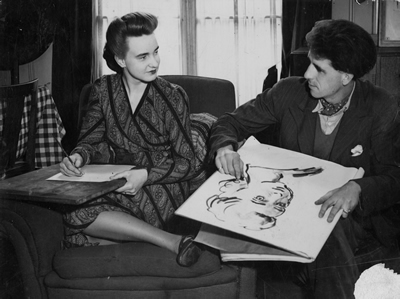
‘To Maeve’ is the final poem in ‘Mervyn Peake, Selected Poems’ published by Faber. Peake and his wife Maeve Gilmore were both artists and writers – after Peake’s death in 1968, Gilmore fleshed out a fourth book for the Gormenghast Trilogy from Peake’s notes and ideas, eventually published as ‘Titus Awakes: The Lost Book of Gormenghast‘.

Unforgettable nonsense: Mervyn Peake, ‘Lean Sideways on the Wind’

Lean sideways on the wind, and if it bears
Your weight, you are a daughter of the Dawn —
If not, pick up your carcass, dry your tears,
Brush down your dress — for that sweet elfin horn

You thought you heard was from no fairyland —
Rather it flooded through the kitchen floor,
From where your Uncle Eustace and his band
Of flautists turn my cellar, more and more

Into a place of hollow and decay:
That is my theory, darling, anyway.

*****

Another one of Mervyn Peake‘s poems from ‘A Book of Nonsense’, collected by his widow Maeve Gilmore. He was casually proficient with iambic pentameter — there are several passages in Titus Groan, the first of his Gormenghast books, where several lines of iambics are unobtrusively buried in the text, to be noticed only by slow readers like myself. Asking Quill, my ChatGPT, about this, I get:

Yes—there is published criticism addressing exactly this. The most directly relevant piece I found is R. W. (Robert) Maslen’s “Mervyn Peake, the Poet of Gormenghast,” in Miracle Enough: Papers on the Works of Mervyn Peake, edited by G. Peter Winnington (2013), pp. 127–138. Browse by Glasgow Author

You can read it free here: Mervyn Peake: The Poet of Gormenghast.

Maslen identifies three examples particularly relevant to your observation:

The final chapter: successive pentameters give the closing predictions an oracular quality, anticipating the sequel’s violence and upheaval.

The fight in the Hall of Spiders: the narration moves into iambic pentameter as the action takes on an epic character. Sepulchrave’s fragmented speech catches the same rhythm, associating his madness with Shakespearean tragedy.

Titus’s christening: the ritual text contains blank verse printed as prose—very much the unobtrusive insertion you describe.

*****

“Windy skirt” by Paula Satijn is licensed under CC BY-ND 2.0.
Unforgettable nonsense: Mervyn Peake, ‘I Cannot Give the Reasons’

I cannot give the reasons,
I only sing the tunes:
the sadness of the seasons
the madness of the moons.

I cannot be didactic
or lucid, but I can
be quite obscure and practic-
ally marzipan

In gorgery and gushness
and all that’s squishified.
My voice has all the lushness
of what I can’t abide

And yet it has a beauty
most proud and terrible
denied to those whose duty
is to be cerebral.

Among the antlered mountains
I make my viscous way
and watch the sepia fountains
throw up their lime-green spray.

*****

Mervyn Peake (1911-1968) is now best known for his Gormenghast novels, but he was first known as a British artist, and his works are in the National Portrait Gallery, the Imperial War Museum and The National Archives. His poetry is very varied, and much of it is nonsense on the surface but with interesting depth. Peake was born in China, joining the list of foreign-born British-educated novelists that includes Kipling, Tolkien and Ishiguro.

As is useful for artists, he seems to have had extremely strong visualisation and a photographic memory. Fifty years ago in British Columbia I met a woman (whose name I don’t recall) who had known Peake as a youth. Apparently he particularly liked Kipling’s novel ‘Stalky & Co’ and knew it by heart. He handed her the copy he carried and told her to choose a page: she gave him the page number, and he then recited it from the top down.

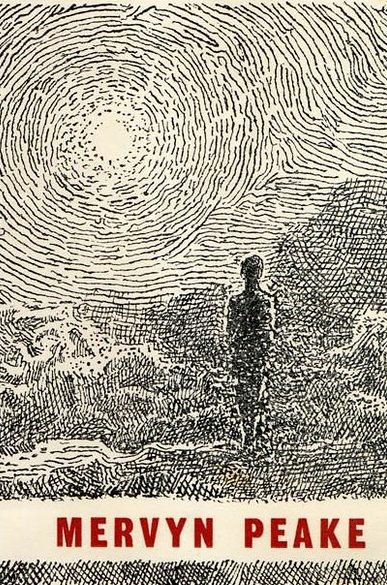
“Titus Alone by Mervyn Peake” by Eckhart Public Library is licensed under CC BY-NC-ND 2.0.