
16 February, 2024.
1.
Rough and chivvying cold winds blow
The helpless dead leaves to and fro.
Leaves have no say in where they go
But we’re alive so can say no –
Let us praise those men who show
Resistance to the easy flow.
2.
Navalny, prisoner in the snow,
In numbing twenty-eight below,
Has paid the price for saying no;
He’s gone the way we feared he’d go.
That’s Putin, making sure all know
That retribution comes in tow
For those who won’t go with the flow.
‘All dissidents will finish so,’
The message is: ‘Go with the flow,
Or you too could end on Death Row.’
I imagine his warders: Did they know
A twinge of guilt at this, or show
Regret or shame? I doubt it. No –
Why should men let a conscience grow
When they can just go with the flow?
When life is so much easier so,
When every television show,
The papers and the radio
All radiate a conformist glow
Incessantly, so all men know
Life’s comfier with the status quo.
It’s only awkward sods say no,
Go their own way, not with the flow.
Those have a dangerous row to hoe,
And who can blame the average Joe
For on the whole deciding: ‘No,
That’s not for me. I’d rather toe
The line, collect my wages, know
I’m safe and needn’t undergo
What brave men have to suffer. No,
Go with the flow, go with the flow.’
3.
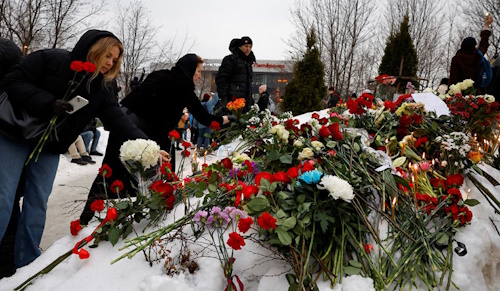
In Moscow brave girls risk a blow
By laying flowers in the snow
To honour him for saying ‘No’.
Brave girls. I admire them so.
*****
George Simmers writes: “This poem began because our local Arts Festival announced its theme as ‘Flow’. Which made me grumble a bit: was I supposed to write stuff about how nice it was that rivers flowed? Not my style. But then I thought about people who go against the flow by saying ‘No!’ and that suggested a subject and a rhyme scheme. It was only after I’d scribbled a few possible lines that I came across a photo of young women in Moscow placing flowers in the snow as tributes to the murdered Russian dissident, Alexei Navalny. In some towns, such protestors had been arrested or beaten up by the police.
“It’s thirty-odd years since I visited Russia. That was at the time of perestroika and hopefulness. We had a contact in Moscow who took us to see the sights, including the Arbat, a popular meeting- place. He said: ‘Can we stop and talk here for a few minutes? I ask because a few years ago If I had been seen here in conversation with a foreigner, I should have been arrested.’ Freedom was precious then, but repression returned.
“Navalny was a lawyer who campaigned against the corruption endemic in Russian political life. In 2020 he was poisoned with Novichok (probably by the Federal Security Service) ; after hospital treatment in Berlin that saved his life, he returned to Russia, even though he knew of the dangers. He was immediately arrested, and ended up in an Arctic Circle corrective colony. The exact circumstances of his death still remain unclear, but while in prison he had suffered from malnourishment and mistreatment.
“Writing this poem I remember Auden’s words: ‘Poetry makes nothing happen.’ Auden pointed out that political poems make the writer feel better, but have no positive effect in the real world. He was right, as usual, which is why I mostly avoid writing poems about politics. But I don’t really see this as a poem about Navalny. I could have chosen to write about Alan Bates and his twenty-five year battle for justice for postmasters, or about Kathleen Stock and others, who opposed the dangerous ideology of the Tavistock clinic. Going against the flow matters everywhere, not just Russia. The form is monorhyme, mostly because that’s how the poem started, and it wasn’t too difficult to keep going. Monorhyme is easier than it looks, so long as you choose the right rhyme word to start with. Don’t try it with ‘month’ or ‘silver’.
“Nalvalny’s death made a news splash in February, but since then more recent horrors have displaced it on the news pages. So maybe this poem will do a little good as a reminder of a brave man. Thank you for re-blogging it.”
The poem will be part of the film ‘Wordflow’ (a film by John Coombes with a soundtrack of stories and poems by Holmfirth Writers’ Group in a continuous showing from 10am-4pm), presented at the Holmfirth Arts Festival in Yorkshire on Sunday, June 16th, upstairs at the ‘Nowhere’ bistro, Norridge Bottom, Holmfirth, HD9 7BB.
George Simmers used to be a teacher; now he spends much of his time researching literature written during and after the First World War. He has edited Snakeskin since 1995. It is probably the oldest-established poetry zine on the Internet. His work appears in several Potcake Chapbooks, and his recent diverse collection is ‘Old and Bookish’.
 Form in Formless Times