Tag Archives: non-existent

Sonnet: RHL, ‘An Observation’

If particles only exist as waves,
precipitating out only when measured, seen,
till then just ghostly, nebulous, roughed-in…
If that’s the way the universe behaves,
then who’s to say the moons of Jupiter
existed before Galileo scoped
them out? Our simple world had coped,
pre-Hubbell, without needing to infer
a billion galaxies. Again, if things
newly observed are different than before,
then things that once were real are real no more,
especially nebulous, wave-form, with wings,
hence dragons, fairies, elves all now seem odd…
and angels, demons, giants, ghosts… and God.

*****

This sonnet was recently published in Bewildering Stories (thanks, Don Webb), and seems to have touched a chord with that issue’s theme of esse est percipi; so it leads off that week’s questions in the magazine:

  1. In Robin Helweg-Larsen’s An Observation:
    1. George Berkeley’s philosophy of Idealism is based upon the principle: “To be is to be perceived.” How does the theory of Quantum Physics support the principle of perception? Or does it?
    2. The poem concludes by listing a number of supernatural beings whose reality is implicitly denied as long as they have not been perceived. How does “God” differ — by definition — from the others in the list?
    3. By whom or what must something be perceived in order to exist? And how does a perception take place?

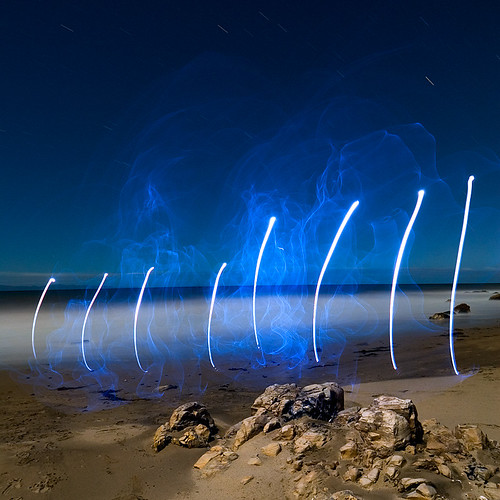
Photo: “Nebulous in Blue” by Toby Keller / Burnblue is licensed under CC BY-NC-SA 2.0.
Odd poem: ‘Sonnets for the Novachord (1.)’ by the non-existent Ern Malley

Rise from the wrist, o kestrel
Mind, to a clear expanse.
Perform your high dance
On the clouds of ancestral
Duty. Hawk at the wraith
Of remembered emotions.
Vindicate our high notions
Of a new and pitiless faith.
It is not without risk!
In a lofty attempt
The fool makes a brisk
Tumble. Rightly contempt
Rewards the cloud-foot unwary
Who falls to the prairie.

*****

This sonnet is by “Ern” Malley, a fictitious poet whose biography and body of work were created in one day in 1943 by conservative writers James McAuley and Harold Stewart in order to hoax the Angry Penguins, a modernist art and literary movement centred around a journal of the same name, co-edited by poet Max Harris and art patron John Reed, of Heide, Melbourne.

In one afternoon, McAuley and Stewart wrote Malley’s entire body of work: 17 poems, none longer than a page, and all intended to be read in sequence under the title The Darkening Ecliptic. Their writing style, as they described it, was to write down the first thing that came into their heads, lifting words and phrases from the Concise Oxford Dictionary, a Collected Shakespeare, and a Dictionary of Quotations: “We opened books at random, choosing a word or phrase haphazardly. We made lists of these and wove them in nonsensical sentences. We misquoted and made false allusions. We deliberately perpetrated bad verse, and selected awkward rhymes from a Ripman’s Rhyming Dictionary.”

They mailed sixteen poems to Harris under the guise of Ethel, Ern Malley’s surviving sister. Harris and other members of the Heide Circle fell for the hoax, and, enraptured by the poetry, devoted the next issue of Angry Penguins to Malley, hailing him as a genius. The hoax was revealed soon after, resulting in a cause célèbre and the humiliation of Harris, who was put on trial, convicted and fined for publishing the poems on the grounds that they contained obscene content. Angry Penguins folded in 1946.

In the decades that followed, the hoax proved to be a significant setback for modernist poetry in Australia. Since the 1970s, however, the Ern Malley poems, though known to be a hoax, became celebrated as a successful example of surrealist poetry in their own right, lauded by poets and critics such as John Ashbery.

The above is copied and tweaked from https://en.wikipedia.org/wiki/Ern_Malley_hoax

and the BBC covers his story here: https://www.bbc.com/reel/video/p0f3h03g/ern-malley-the-influential-australian-poet-who-never-lived

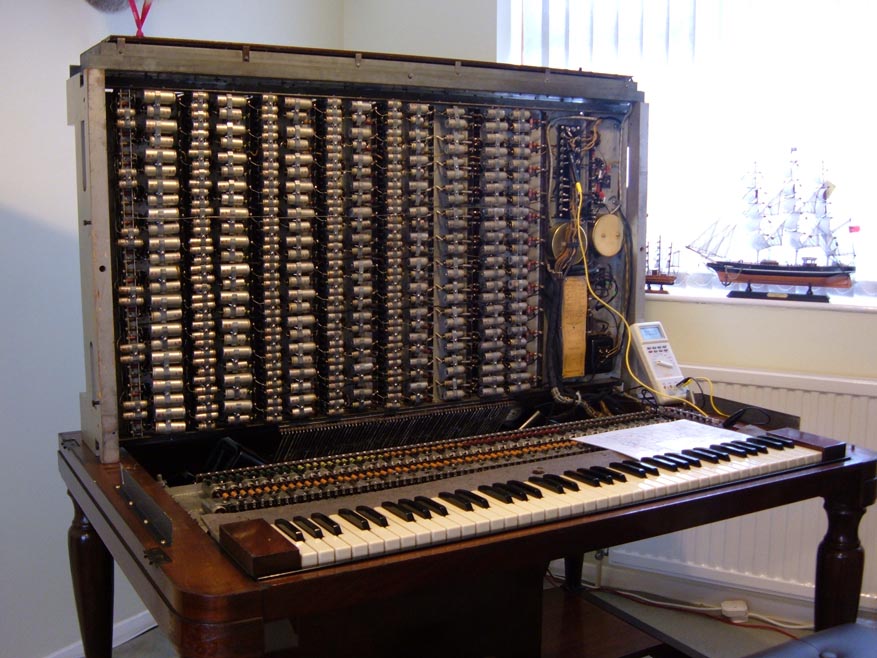
CC BY 3.0, File:Novachord insides3.jpg, Created: 29 December 2009 Attribution: Hollow Sun at English Wikipedia