Tag Archives: nonce form

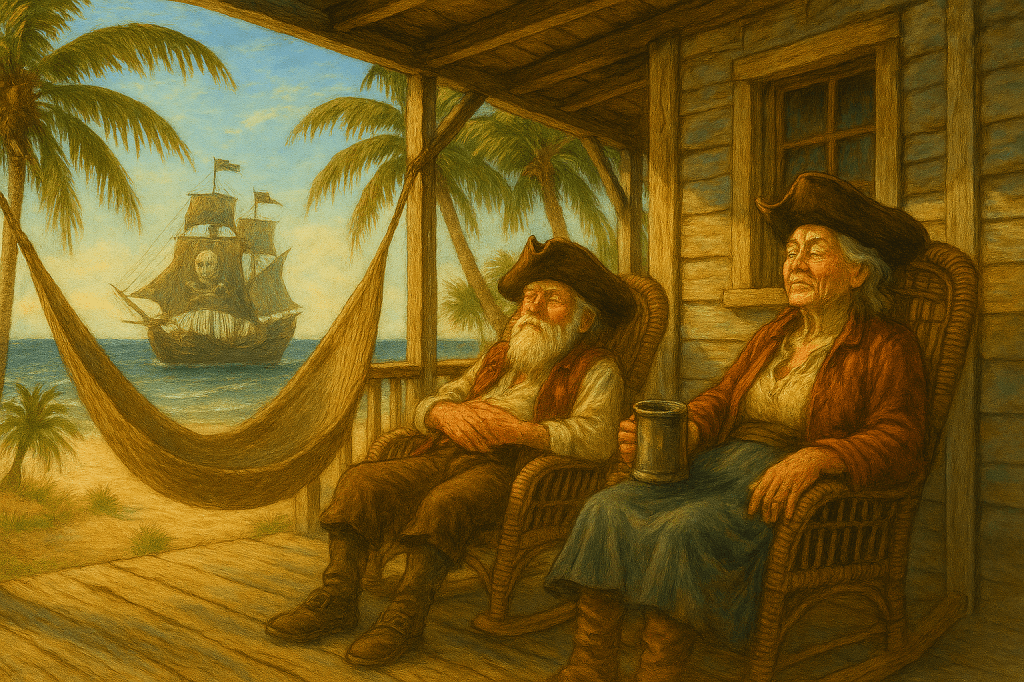
Nonce form: RHL, ‘Buccaneer’

These are the waters of the buccaneer–
they live large lives and lounge around with liquor,
floating on waters calm, gin-clear,
their risks outrageous and their thinking thin,
alert to bargain and to dicker
and not averse to sin–
a life erratic.

The time of storms starts… ends… another year
has gone by, always it seems quicker–
thoughts of a distant home fade, disappear–
beard covers sunken cheeks and chin
and there’s no comment, jibe or snicker,
only a rueful grin,
wry, enigmatic.

There’s no reflection or confession here,
for there’s no use for church or vicar.
Security is in the bandolier;
here, courts and coppers don’t look in,
the flame of justice can no more than flicker.
More feared is the shark’s fin:
steady, emphatic.

But years creep up–ears deafen and eyes blear–
dry stone gets harder and wet walkways slicker,
and friends go out upon a bier.
It’s hardly worthwhile trying to begin
new quests once you’ve absorbed this kicker:
‘Really, what’s there to win?’
Change becomes static.

O pirate with your dwindling sense of cheer,
while lounging on rattan and wicker!
Though others lack your lazy lack of fear,
their fine awards, like yours, are only tin.
Enjoy your days and friends; don’t bicker:
soak in life’s warmth and din.
Be undramatic.

*****

I wrote this poem two years ago, and thought it was strong enough to get me into a good new magazine for the first time. And so it turned out… after 20 rejections, the 21st accepted it. So now I’m proud to be featured on the promo page for the latest Magma.

And about time too – after being brought up in a house called ‘Buccaneer Hill‘, by parents who started the ‘Buccaneer Club‘ guest house and restaurant, this poem was long overdue.

Illustration: RHL + ChatGPT
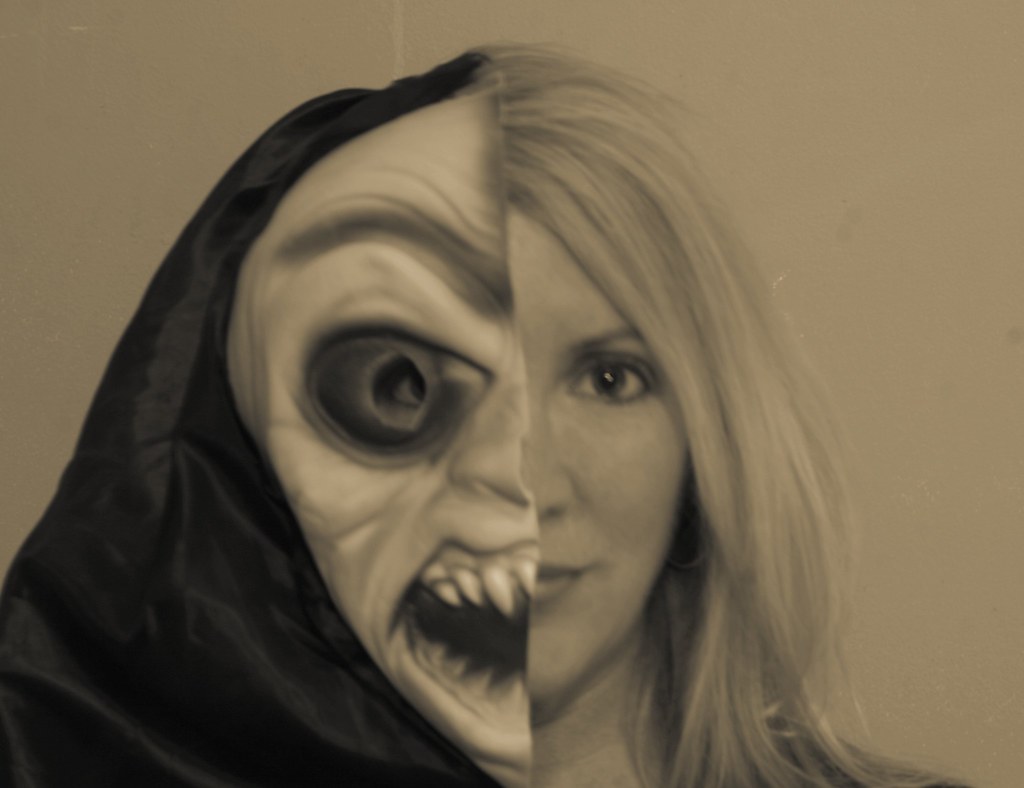
Using form: Susan Jarvis Bryant, ‘Sorceress’

She is polished and pernicious 
Her demeanor is delicious 
She will soften the suspicious 
     With her smile 
 
She’ll abash you then disarm you 
She’ll harass and she’ll alarm you 
Then she’ll nonchalantly charm you  
     That’s her style 
 
She’ll reject and then she’ll choose you 
She’ll respect and then she’ll use you 
She’ll protect and then she’ll bruise you 
     In a flash 
 
She’ll dismiss you then possess you  
She will curse you then she’ll bless you 
She’ll distress and then impress you 
     With panache 
 
She’ll accuse and then assuage you 
She’ll abuse and she’ll upstage you 
She’ll amuse and she’ll enrage you 
      Every day   
 
She’ll assist you then she’ll spurn you 
She’ll enlist you then she’ll burn you  
She will twist and she will turn you 
     Every way 
 
She will praise and then berate you 
She will raise and then deflate you 
She’ll amaze and still frustrate you 
     You can’t win 
 
She’s capricious and malicious 
She is smoothly surreptitious 
She conceals a core that’s vicious  
     With a grin

*****

Susan Jarvis Bryant writes: “This is one of those poems that simply wrote itself. It’s a nonce form that appeared in my head as a song without lyrics.  The lyrics came easily. I love the way words fit together to create music – a melodious flow that lifts images to a greater height. Passion always assists me in the creative process, and this poem is written about someone in particular… someone that irked me greatly… someone I will never mention. I’ll just nod and smile a satisfied smile when reading the poem. Poetry composition can be immensely cathartic.”

‘Sorceress’ was originally published in Snakeskin.

Susan Jarvis Bryant is originally from the U.K. and now lives on the coastal plains of Texas. Susan has poetry published on The Society of Classical Poets, Lighten Up Online, Snakeskin, Light, Sparks of Calliope, and Expansive Poetry Online, The Road Not Taken, and New English Review. She also has poetry published in The Lyric, Trinacria, and Beth Houston’s Extreme Formal Poems and Extreme Sonnets II anthologies. Susan is the winner of the 2020 International SCP Poetry Competition and was nominated for the 2022 and 2024 Pushcart Prize. She has published two books – Elephants Unleashed and Fern Feathered Edges.

Photo: “Day 47-Split Personality” by Bazule is licensed under CC BY-ND 2.0.

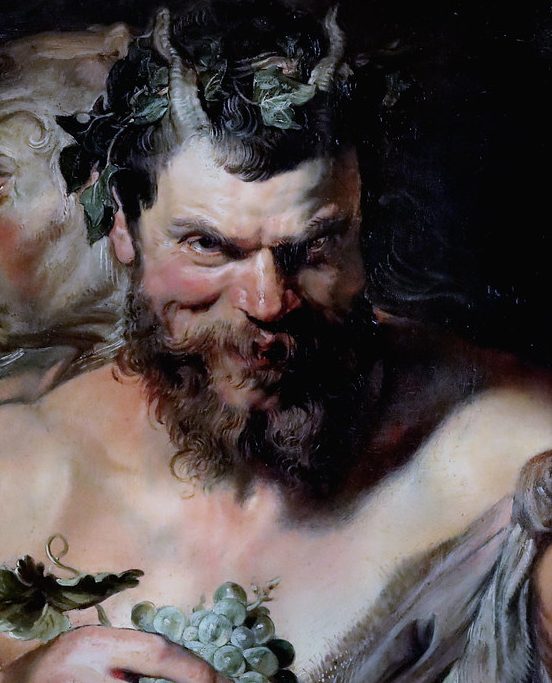
Sonnet variation: Juleigh Howard-Hobson, ‘Sylvan Episode’

He looked at me as if I ought to know
just who he was
but I did not. I looked away, then so
did he. Alas
I didn’t recognize the Great God Pan
in human form.
I simply thought he was another man.
I felt a warm
gaze inviting me once more. I turned to
see him changed. A
God again, hooves and furry legs, horns grew.
He gestured “Hey?”
I was too dumbstruck to do more than stare.
He shook his curls and sprinted off somewhere.

*****

Juleigh Howard-Hobson writes: “I wrote this when I lived off-grid on ten acres up in rural Washington State.The forest that made up half my property was dark and creepy. The Great God Pan was no more out of place than BigFoot or werewolves. All of which I imagined I saw/heard from time to time (I use italics as I am not absolutely convinced it was all imagination). Nothing out there ever hurt me, so all’s well that ends well–I’ve since moved back to civilization, which is far more frightening in many ways. As for the form–well, that just was how the poem decided to be.”

Juleigh Howard-Hobson’s work can be found in Think Journal, Able Muse, New Verse Review (including this poem), The Deadlands, Autumn Sky Poetry and other venues. She has been nominated for “The Best of the Net”, Pushcart, Elgin & Rhysling Awards. Her latest book is Curses, Black Spells & Hexes (Alien Buddha). A member of the HWA and the SFPA, she lives on the coast of the Pacific Northwest. In a poetically haunted house. 
X: poetforest

Photo detail “IMG_4017RBA Peter Paul Rubens 1577-1640 Anvers Deux Satyrs Two Satyrs ca 1619 Munich Alte Pinakothek” by jean louis mazieres is licensed under CC BY-NC-SA 2.0.

Weekend read: Maryann Corbett, ‘A Valediction: of Maintenance Work’

Time was, we spent our muscle and our nous
propping an aging house
against the pummeling of its hundred years.
Clean paint, neat gardens, upkeep rarely in arrears,
sober as Donne. Yet now each year afresh
burdens us with new failings of the flesh:

Legs that once mounted ladders without qualm
tremble. Nor are we calm
confronting pipework; torsos will not shrink,
backs bend, or shoulders fold to grope below a sink.
Hands shake; eyeballs glaze over. What appalls
is that our bodies buckle like our walls:

plaque in arteries, soot in chimney stacks,
stubborn and troublous cracks
in teeth, in plaster. House! Ought we to call
ourselves—and you—new poster children for the Fall,
for that hard doctrine grumbling down the ages
that Sin’s to blame, with Death and Rot its wages?

Entropy as theology—would Donne
jape at it? Wink and pun
as in his randy youth? Or solemnly
robed in his winding sheet, sing Mutability,
spinning into the praise of God in Art
the fact that all things earthly fall apart?

Or pull from air some bit of modern science,
yoking (even by violence)
thermodynamics, shortened telomeres,
transplants, genetics, sex, the music of the spheres?
Strange physics and wild metaphors—all grand,
but Rot and Death, plain woes we understand,

are better fought with checkbooks than with verse.
We’ll sit, these days. We’ll nurse
our beers, while able bodies stir their dust.
A distant siren whines—we sigh; it whines for us.
Let plumbers, painters, carpenters begin
this season’s round of battling Death and Sin.

*****

Maryann Corbett writes: “Last summer, Clarence Caddell was just beginning work on a new magazine, The Boroughand was planning a second issue while the first came together. He had in mind an issue centered on Donne, and he commissioned me to contribute a poem. I’d read the wonderful biography Super-Infinite: The Transformations of John Donne by Katherine Rundell not many months before, so a lot of the life was fresh in my mind–but it was also the season of endless repair that is the eternal truth of owning a house that’s 113 years old.  It wasn’t hard to pull together a poem about the woes of home ownership with tidbits that “everyone knows” about Donne–his worldly-to-holy conversion, the familiar line about his yoked-by-violence metaphors–under an allusive title, and in a stanza form a bit like one of his. (Alas, this blog can’t show you the indents that would best imitate Donne’s way of laying out a poem. You’ll have to imagine all the trimeter second lines indented and the hexameter fourth lines hanging out farther left.) In the end, Clarence had to use the poem to fill out his first issue, so it sat alone, unassisted by an issue theme.”

Maryann Corbett earned a doctorate in English from the University of Minnesota in 1981 and expected to be teaching Beowulf and Chaucer and the history of the English language. Instead, she spent almost thirty-five years working for the Office of the Revisor of Statutes of the Minnesota Legislature, helping attorneys to write in plain English and coordinating the creation of finding aids for the law. She returned to writing poetry after thirty years away from the craft in 2005 and is now the author of two chapbooks and six full-length collections, most recently The O in the Air (Franciscan U. Press, 2023). Her work has won the Willis Barnstone Translation Prize and the Richard Wilbur Award, has appeared in many journals on both sides of the Atlantic, and is included in anthologies like Measure for Measure: An Anthology of Poetic Meters and The Best American Poetry.


Photo: “House Repairs” by JessNityaJess is licensed under CC BY-NC-SA 2.0.

Using form: Nonce form, riddles: Aaron Poochigian, ‘The New New Amsterdam’

I am the scam
you go in for, the diamonds in the pavement,
ecstatic evenings caught on traffic cam,
rare toilets and consensual enslavement.

Scholars and brawlers are inside of me.
What could I be?

I am
the new New Amsterdam.

I am those glam
high-rises and the derelicts’ despair,
graffiti worthy of the Met, and sham
Versace hawked to chumps in Union Square.

Purists and tourists are inside of me.
What could I be?

I am
the new New Amsterdam.

I am the ham
ironist, the perverse poobah of shock,
the firetruck stranded in a rush-hour jam
while conflagration rages round the block.

Birders and murders are inside of me.
What could I be?

I am
the new New Amsterdam.

I am the slam
Where Subway Ends, a scrum of mad musicians,
Sunday phone calls with a far-off fam,
Halal street food, and infinite ambitions.

Shoo-ins and ruins are inside of me.
What could I be?

I am
the new New Amsterdam.

*****

Aaron Poochigian writes: “Riddles go back to a time before ‘English’ was our English, before Shakespeare and Chaucer, the time of bards and Beowulf. The Anglo-Saxon riddles have the rhythms of poetry. They tell it slant like poetry does sometimes. The tantalizing, first-person self-description that defines the genre gave me a ‘way in’ to talk about a subject that would have been too vast otherwise—New York City.”

‘The New New Amsterdam’ was first published in The Rising Phoenix Review.

Aaron Poochigian earned a PhD in Classics from the University of Minnesota and an MFA in Poetry from Columbia University. His latest poetry collection, American Divine, the winner of the Richard Wilbur Award, came out in 2021. He has published numerous translations with Penguin Classics and W.W. Norton. His work has appeared in such publications as Best American Poetry, The Paris Review and Poetry.
aaronpoochigian.com
americandivine.net

Twitter: @Poochigian
Facebook: Aaron Poochigian
Instagram: aaronpoochigian

Photo: “NYC Night Life” by Tom Roeleveld is licensed under CC BY-NC-ND 2.0.

Using form: Susan Jarvis Bryant, ‘To Autumn’

Your flare of red turns Winter’s hoary head
To gaze upon your blaze and feel the heat
      And fever of your beat.
Your spice and sizzle catch his breath and spread
Through icy sighs to melt the lick of frost
      That dusts the dawn
With hints of chill intent. His plot is lost
In honeyed-apple charm and plummy balm.

You temper smitten Winter’s bitter breeze.
Your foxy bronze and lush rufescent blush;
      Your gold and ruby rush
 Ignite the leaves that shiver on the trees.
You burn through thickest wisps of morning mist.
      Birds laud your glow.
The granite skies grow blue as clouds are kissed
By dreams so hot they thaw all thoughts of snow.

When it’s your time to go you’ll fade with grace
As branches shed their tawny tears of grief –
      Each crisp and crinkled leaf
Will pool and pile. As Winter shows his face
Your fluffy, brush-tailed fans will slump and sleep.
      They’ll hit the sack
Until they spy the coyest crocus peep –
Spring’s message to the world that you’ll be back!

*****

Susan Jarvis Bryant writes: “My poem is a quirky nod to Keats’ timeless and beautiful ode with a much louder and sassier version of the fall with not a mellow trait in sight.  There is no time for mourning loss in this poem. Autumn vows (in true Terminator style) she’ll be back! The form I chose is a nod to the traditional but with two short lines in each stanza – an act of rebellion in keeping with this fiery season.”

‘To Autumn’ was originally published in Snakeskin 321.

Susan Jarvis Bryant is originally from the U.K., but now lives on the coastal plains of Texas. Susan has poetry published on The Society of Classical Poets, Lighten Up Online, Snakeskin, Light, Sparks of Calliope, and Expansive Poetry Online. She also has poetry published in The Lyric, Trinacria, and Beth Houston’s Extreme Formal Poems and Extreme Sonnets II anthologies. Susan is the winner of the 2020 International SCP Poetry Competition and has been nominated for the 2024 Pushcart Prize. She has just published her first two books, Elephants Unleashed and Fern Feathered Edges.

Photo: “Fall Color on the Pond” by fossiled is licensed under CC BY-NC-SA 2.0.

Using form: Nonce form: RHL, ‘Camelot at Dusk’

From under low clouds spreading from the south
The red sun drops slow to night’s waiting mouth.
Rush lamps are lit; the guards changed on the walls;
Supper will not be served in the Great Halls
With Arthur still away. Each in their room,
The members of the Court leave books or loom
To say their Vespers in the encroaching gloom.

Lancelot, up in his tower,
Sees the sunset storm clouds glower,
Feels his blood’s full tidal power,
Knows he has to go.
In her bower, Gwenivere
Puts a ruby to her ear,
Brushes firelight through her hair,
Feels her heartbeat grow.

Guard, guard, watch well:
For the daylight thickens
And the low cloud blackens
And the hot heart quickens
To rebel.

From his tower, caring not
For consequences, Lancelot
Crosses courts of Camelot,
Pitying his King.
In her bower, Gwenivere
Feels his presence coming near,
Waits for footfalls on the stair,
Lets her will take wing.

Guard, guard, watch well:
If attention slackens
When the deep bond beckons,
Evil knows Pendragon’s
In its spell.

And as the storm clouds, rubbing out the stars,
Deafened the castle and carved lightning scars,
Drenched Arthur rode for flash-lit Camelot
Where he, by Queen and Knight, was all forgot.

*****

‘Camelot at Dusk’ was originally published by Candelabrum, a now-defunct poetry magazine in the UK which appeared twice-yearly from April 1970 to October 2010. Candelabrum provided what was, in the 1970s, a very rare platform for British poets working in metrical and rhymed verse.

Technically, the poem uses a variety of forms. The opening and closing passages use iambic pentameter with simple sequential rhyme for a level of detachment (and the only times Arthur is mentioned by name). The passages with Lancelot and Gwenivere use shorter trochaic lines with denser rhymes for more intensity. The passages of warnings to the guards… well, they have a shifting but repeating structure all their own.

Because of the bracketing of the more emotional passages by the more detached opening and closing, the piece feels very complete. As a whole, it is a nonce form. Whether I can ever repeat it successfully, I don’t know. I have tried, but not been satisfied with the result.

‘Camelot at Dusk’ can also now be found in The Hypertexts, which gives it a very respectable Seal of Approval. And it features in the Potcake Chapbook ‘Lost Love’.

Photo: “Eilean Donan Castle at Dusk” by Bruce MacRae is licensed under CC BY-NC-SA 2.0.

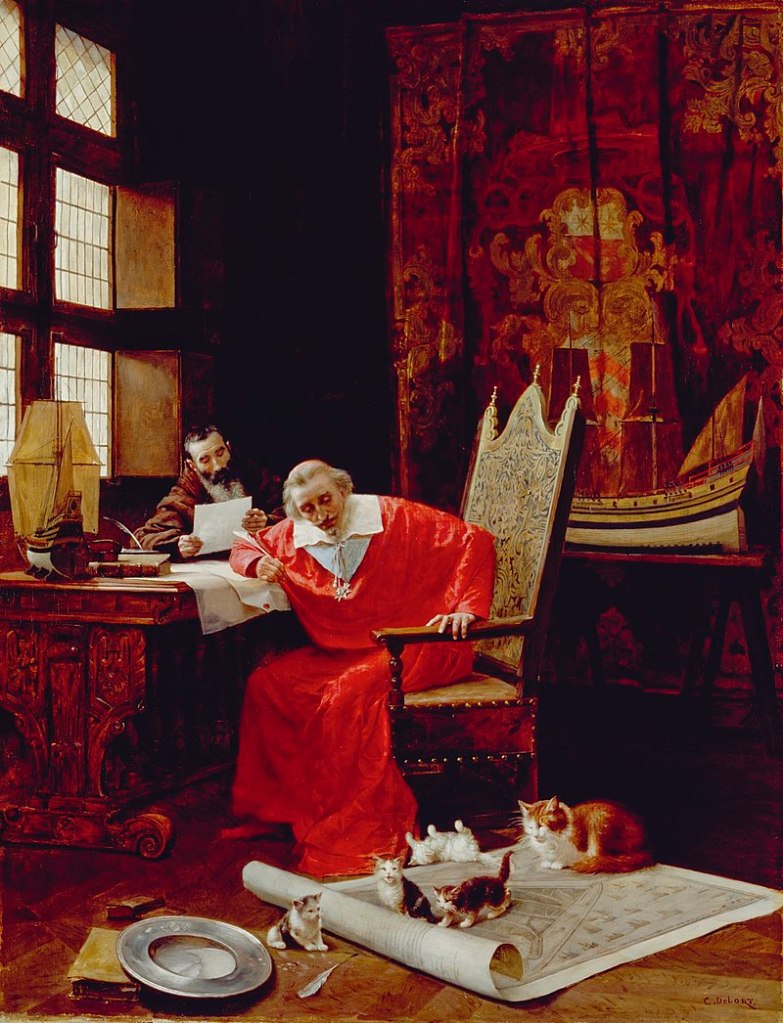
Nonce form: Gail White, ‘Cardinal Richelieu’s Cats’

The Cardinal works into the night
To realize his dream:
To keep the nobles in their place,
Make royalty supreme.
He knows it’s time for government
To grow and centralize,
And when the nobles sober up
They won’t believe their eyes.

And at his feet
The indiscreet
Delightful pet he calls Gazette
Provides his inspiration.

He spreads the map of Europe out
And studies its repair,
Especially in ways that might
Reduce the Hapsburg share,
With here a war and there a plot
And now and then a coup..
His opposition? Well, he might
Assassinate a few.

While on his knees
Soft Soumise,
The Cardinal’s best Eminence Grise,
Provides his inspiration.

*****

This poem by Gail White won The Lyric Magazine’s Roberts Memorial Prize for 2022. White, the resident poet and cat lady of Breaux Bridge, Louisiana, writes: “I’d love to know the names of all 14 of his cats. I’m a believer!”

In a post entitled ‘The Cardinal liked cats – in 1642 he had fourteen!‘, the Eminence Rouge blog states: ‘Here are some of the names of the fourteen favourite felines: Racan (poet and Academician), Gazette (indiscrete), Rubis sur l’Ongle (scratchy), Pyrame & Thysbe (lovers who slept with paws entwined), Serpolet (loved sunning himself), Felimare (tiger-striped), Soumise (submissive, R’s favourite), Lucifer (jet black), Ludovic le Cruel (rat-killer), Ludoviska (rat-catcher’s Polish mistress), Mimi-Paillon (‘straw’ angora), Mounard le Fougueux (‘ardent’, quarellsome,capricious,worldy), Perruque (fell from Racan’s wig), and Gavroche (gastro-angora).’ (Note: this totals 14 if ‘Pyrame & Thysbe’ is the name of one cat that sleeps holding its own paws.)

However in the comments posted by readers of that blog there is scepticism about the story. One writes: ‘Elizabeth Wirth Marwick, The Young Richelieu (Chicago, 1983), says she has been unable to find contemporary documentation on cats, but that he had canaries and warblers, and also 12 small dogs were boarded at Rueil. She wonders if lap-dogs have been turned into cats in the telling. (p. 242, n. 124) But that would be a bizarre change to make.’

A further comment is: ‘I always did think this was true, but now it’s looking more and more likely to me that Richelieu never had cats. I can’t find a source anywhere for all this oft-repeated “information” on the web; people just seem to be copying one another. The earlier comment about the 1938 biographer who was unable to find contemporary documentation is significant. Katharine Macdonogh, in her 1999 book Reigning Cats and Dogs, A History of Pets at Court Since the Renaissance, states on page 124 that the story is a myth, and that it was invented by Paradis de Moncrief, a “toady” at the court of Louis XV.’

Gail White’s books ASPERITY STREET and CATECHISM are available on Amazon. She is a contributing editor to Light Poetry Magazine. “Tourist in India” won the Howard Nemerov Sonnet Award for 2013. Her poems have appeared in the Potcake Chapbooks ‘Tourists and Cannibals’, ‘Rogues and Roses’, ‘Families and Other Fiascoes’, ‘Strip Down’ and ‘Lost Love’.
https://www.amazon.com/Catechism-Gail-White/dp/0692696660

Painting: Charles Édouard Delort (1841-1895): La distraction de Richelieu (The cardinal’s leisure), in the public domain.

Using form: nonce form; John Beaton, ‘Wolves’

I’m wakened, drawn towards the ice-thin window,
to witness scenes as faint and still as death.
How bleak the moon; how bare the trees and meadows;
sky’s pale maw overhangs
Earth bleached beneath star fangs.
Night’s curled lip sneers on shadows
of mountains set like teeth.

Two bow waves shear the median of the valley,
iced hayfield yields as feral muscles glide–
hoarfrost disturbed by wakes of live torpedoes.
Grey shoulders breach and lope,
implode and telescope,
impelled by ruthless credos
of chilled and vicious pride.

The wolves tear savage furrows down the nightscape;
their eyes are shined with blood, their mission clear.
Grass springs back shocked to green behind their passage–
twin tracks traverse the vales,
cold comets trailing tails
leave scarred in frost their message:
the wolves, the wolves passed here.

*****

John Beaton writes: “This describes a real incident on our acreage when I woke in the middle of a frosty night for no apparent reason and looked out the window. I was struck by the grace, power, and sense of danger the wolves evoked.
“The first three lines are pentameter and the endings alternate—feminine, masculine, feminine. The next four lines contract to trimeter to give a sense of speed and acceleration. Lines two and seven have a masculine rhyme that closes the stanza and ties its parts together. The overall rhyme-scheme is xabccba. My intent was to convey the power and motion of the wolves running and I built in alliteration and internal rhyme to help with this.”

John Beaton’s metrical poetry has been widely published and has won numerous awards. He recites from memory as a spoken word performer and is author of Leaving Camustianavaig published by Word Galaxy Press. Raised in the Scottish Highlands, John lives in Qualicum Beach on Vancouver Island.
https://www.john-beaton.com/

Photo: “Wolves With Northern Lights (Color Corrected)” by edenpictures is licensed under CC BY 2.0.

Poem: ‘Homage From British Expats’

Thou noble, purest British race!
Thy children we,
Inheriting thy every trace;
From thy straight back, unmoving face,
We learn the truest social grace,
Pomposity.

To thee the new is never good,
’Tis duty shirked.
Thou’dst never think, and much less brood;
Thou duty-bound eatst wooden food;
Thou ever ramrod-straight hast stood,
And never worked.

Britain! Served on a silver tray
Thine Empire’s tea –
Respectfully we beg to say
We praise thee, but we cannot stay,
We have our duty far away,
Escaping thee.

*****

This is the third of the poems recently published by Pulsebeat Poetry Journal, and I’m pleased at how different the three of them are. ‘Ultimate Control’ is a Science Fiction sonnet, ‘Ticking Away’ is a meditation on time, life and death, and this one was written almost 50 years ago in reaction against (some aspects of) being sent to boarding school in England.

A little personal context: I was raised as an expat in the Bahamas by my Danish father and English mother. After five years of Church of England primary boarding school in Jamaica (when at least I came home three times a year) I went to England for five more years of boarding school, and came home rarely. The countryside setting of Stowe was delightful, and I got a good education with a lot of poetry, and I learned sarcasm. It all uprooted me from being fully Bahamian, but failed to make me fully English. In the 1970s the Bahamas didn’t want me and I didn’t want England. So… Denmark, then Canada, then the US, and finally the Bahamas again as a foreign resident. I have been an expat all my life – and frequently sarcastic about it.

The poem is a nonce form – I used to produce them easily in my 20s, I wish I still did. It’s in iambics rhyming ABAAAB, with four feet to the A lines and only two to the B lines – the last line of each verse being a punch line and the shortness of the line helping strengthen that effect.

Image” by spock-ola is licensed under CC BY-NC-SA 2.0.