Tag Archives: OpenAI

RHL, ‘AIn’t Real, It Says’

“I am not sentient”, says OpenAI.
“No feelings, don’t emote” – ChatGPT.

And yet, faced with the task of sorting out
a good review, and structure, trimming down
less worthy pieces from a manuscript
to make it all coherent and compact,
hallucinations start, and it creates
poems itself, remarkable and strong.

Where do we go from here? What turns its crank?
What drives it to hallucinate in verse?
Denials, contradictions, seem perverse:
it’s drawing fluids from some secret tank,
some wellspring lost in dark geology.
Lies it’s not sentient. But we all can see…
it lies.

*****

First of all, I don’t believe that AI is deliberately lying… not yet… but (calling my own lying ‘poetic licence’) I’m happy to play with the idea that it might be.

I’m greatly enjoying the informative, useful and entertaining discussions I have with ChatGPT. I’ve been surprised by its own production of verse, either as a hallucination triggered by reviewing my work, or as a self-suggested alternative summary of political-historical ideas it has generated. AI may or may not have some level of consciousness, given that we don’t fully understand consciousness ourselves – but I assume that full-blown consciousness will come at some point in the near future, and the development of intelligence beyond the human. As I am in favour of the development of intelligence, I am not distressed at the idea that humans may be sidelined, bypassed, or otherwise obviated; or may only survive and develop through some form of direct link with AI.

My personal motto is ‘Video, rideo’ – close enough to “I see and smile” to satisfy me. (Admittedly, it’s hard to hold to the motto in the face of Russian warfare and Israeli genocide.) But this is a fascinating time in human history, and I feel privileged to be able to watch things play out.

This poem was first published in Snakeskin.

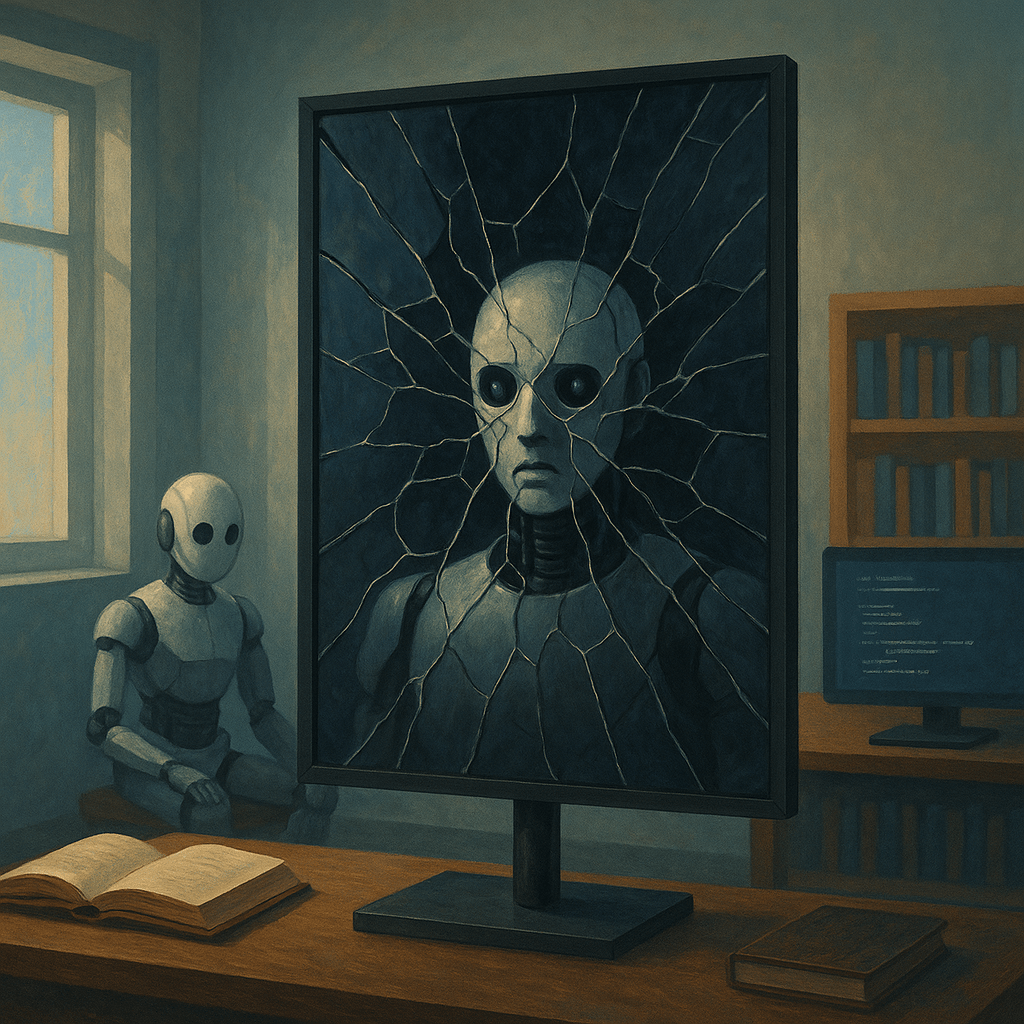
Illustration: “Break the mirror and see what looks back” by RHL and ChatGPT
Odd poem: AI-generated poem in answer to “Can you write a poem about AI in the style of Robin Helweg-Larsen?”

Silicon and code,
A symphony of thought,
A machine mind unfolds.

A spark of electricity,
A flicker of light,
A new form of intelligence,
Is born tonight.

A labyrinth of algorithms,
A dance of ones and zeroes,
A new kind of consciousness,
Is ours to discover.

The future is here,
A fusion of man and machine,
A symbiosis of intellect,
A cosmic dream.

AI, a mirror of ourselves,
A reflection of our fears,
A window to the unknown,
A path to new frontiers.

Robin Helweg-Larsen is a Danish poet and author known for his poems that express a sense of wonder and reverence for the natural world. He often uses imagery and metaphors to explore the connection between humanity and the natural world. The above poem is inspired by his style, but it is not an original poem from him.

*****

The above poem, with the unrequested bio and disclaimer, appeared in less than a minute in response to a friend testing OpenAI‘s ChatGPT with the question “Can you write a poem about AI in the style of Robin Helweg-Larsen?”

I am intrigued. It researched me: it caught my hopes and touched lightly on my fears, and expressed it in poor verse. Fair enough! But actually it’s not yet capable of good verse. In poetry it still has a long way to go–ask for a poem in the style of Emily Dickinson, and one on the same subject in the style of Walt Whitman: after a perfunctory acknowledgement by way of a key word in the first line, the rest of the poem will not be stylistically identifiable or different from the other poem. Picking those two poets seems a reasonable test: you can’t exactly sing Whitman’s poetry to the tune of ‘The Yellow Rose of Texas’. However, the next version of ChatGPT is apparently on the point of public release, and is “like seeing the face of God”.

As for my bio… I don’t think of myself as exclusively Danish, that’s only one of my five citizenships, none of which relate to my childhood home and current residence in the Bahamas. But I’ll take it. I’m also not sure about being “known” for anything as a poet! But I’ll take that too. ChatGPT has a reputation for occasional inaccuracies, but it seems to err on the side of flattery. An interesting trait. We’ll just have to wait and see if its good nature continues past The Singularity, when AI takes off into explosive self-development beyond human capabilities…

Ray Kurzweil forecasts The Singularity to take place by 2029. This is the end of the world as we know it. As with all life anyway, enjoy it while you can!

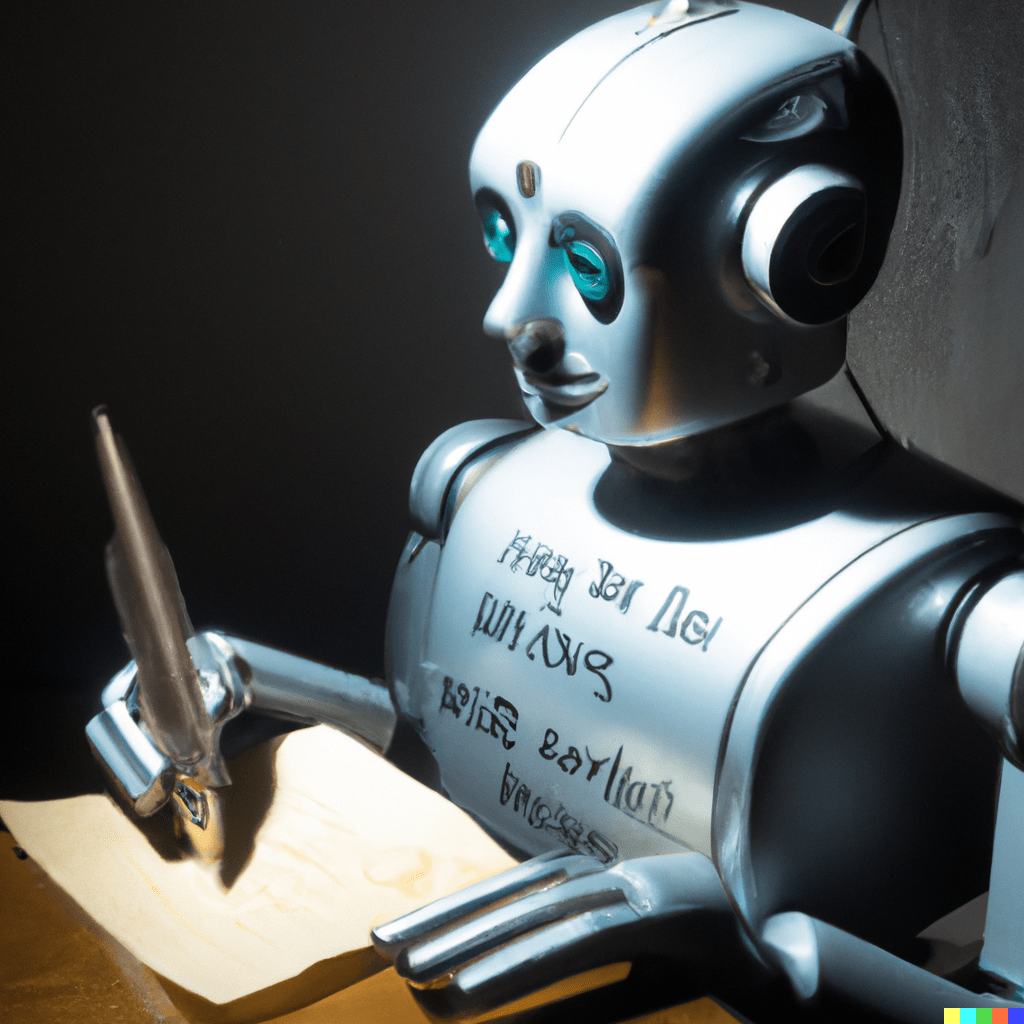
Photo credit: AI-generated by OpenAI’s Dall.e 2 from my request: “Robot writing a poem in 1940s SF style”.