Tag Archives: pretentiousness

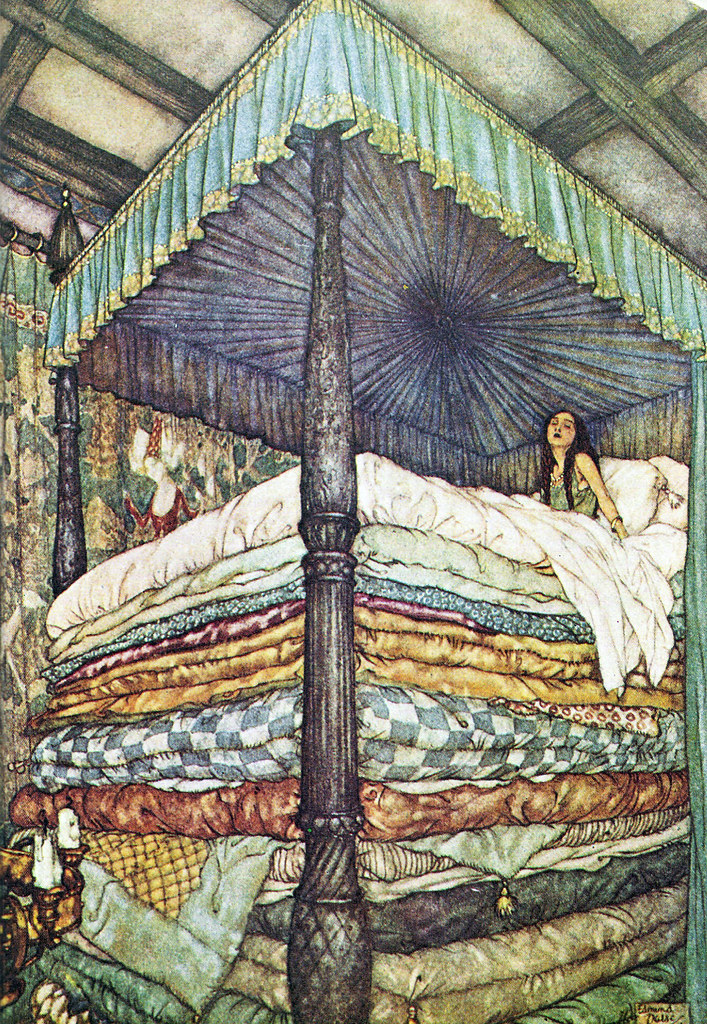
Max Gutmann, ‘The Princess and the Pea’

Once a devious queen lodged just one tiny pea
Under twenty soft mattresses, wanting to see
Out of many young princesses which was the one
Who deserved to be matched with the prince, her fine son.

For she knew a true princess was dainty and fine,
And that little legume underneath the frail spine
Would prevent her enjoying the tiniest rest,
And by this all would know she had passed the queen’s test.

But you see, a true princess is also polite,
So when, bleary-eyed after a long, sleepless night,
Each was asked how she’d slept by the queen the next day,
She replied, “Very well,” and was sent on her way,

Till one morning a girl hollered, “What is this lump?
Do you call this a bed? Who can sleep in this dump?”
So the queen said okay. The prince married her straight.
And the moral is: don’t let your mom choose your mate.

*****

Max Gutmann writes: “It always frustrated me that the fairy tale couldn’t seem to see the flaw in the queen’s thinking.”

This poem was first published in Snakeskin.

Max Gutmann has contributed to New StatesmanAble MuseCricket, and other publications. His plays have appeared throughout the U.S. (see maxgutmann.com). His book There Was a Young Girl from Verona sold several copies.

Illustration: ‘The Princess and the Pea’ by Edmund Dulac. Dulac illustrated several of H.C. Andersen’s fairy tales, many of which include sarcastic social commentary on pretentiousness.


Marcus Bales, ‘Air Guitar’

Bit by bit they deconstruct the thing:
no frets, no pegs, no bridge, removing its
harmonic parts until at last each string
is slack, and lacking resonating bits.
They put the rest, the body, neck, and head,
aside as too much like a prop for those
whose earnestness is all they need instead
of craft and art to fake that they can sing.
So there they are, on either stage or page:
The foremost poets of the modern age,
Who, writing their relineated prose,
Will swagger as they grimace, strut, and pose
Pretending they are better than they are
While playing nothing but an air guitar.

*****

Marcus Bales writes: “Back in the day I spent more time than I should have arguing that freeverse was prose, and that freeversers are prose writers, not poets at all. Of course, when you strike at the core of a belief-system those who believe it feel you are attacking them personally, and respond with insults. They cannot address the reasoning of the arguments, so they resort to ad hominem. I was searching for a metaphor to substitute for argument, something that would reveal the fundamental paucity of the entire freeverser credo that prose is poetry if only they say it is. What I was looking for was something to demonstrate the posers as mere posers. What, besides writing prose and then arbitrarily or whimsically relineating it to resemble the ragged-right look of poetry on the page and calling it poetry, was an even more ridiculous example of that pose? Here it is.”

Not much is known about Marcus Bales except that he lives and works in Cleveland, Ohio, and that his work has not been published in Poetry or The New Yorker. However his ’51 Poems’ is available from Amazon. He has been published in several of the Potcake Chapbooks (‘Form in Formless Times’).

Photo: “Airnadette: Air Bass Guitar” by DocChewbacca is licensed under CC BY-NC-SA 2.0..

Anomalous First Lines: Eliot’s ‘Prufrock’

Let us go then, you and I,
When the evening is spread out against the sky
Like a patient etherized upon a table;

There are two points of interest in the first line of T.S. Eliot’s first professionally published poem, ‘The Love Song of J. Alfred Prufrock’. The first is the identity of Prufrock’s companion – never specified, it is normally assumed to be the reader of the poem, but it could equally be another person, or creature, or good luck charm, or hat, or umbrella, or even the Muse of Poetry herself. It plays no further part in the story and yet, well, it’s there for reasons of rhetoric or invocation.

The second point is grammatical. The line is so embedded in English poetry that it seems sacrosanct, but periodically someone will point out that it should be “you and me”. Consider these sentences: “Let me go to the store for you.” “Let us go to the store.” “Let’s you and me go to the store.” In all examples, “me” and “us” are the objects of the verb “let”; there is no occasion for “you and I” any more than there is for writing “we” instead of “us”. You wouldn’t say “Let we go to the store.”

Caveat: perhaps a Jamaican would. So Prufrock in patois could begin, “Mek we go den, you an I” or in deference to my Rastafarian brethren, “Mek we go den, you an I an I.” But other than in patois? No, it should be “you and me”.

So why did Eliot write “you and I”? It makes a useful rhyme as part of the startling image that follows. Those who debate this issue often come up with alternative opening lines with a rhyme for either “me” or “you”. Thomas Middleton in the L.A. Times suggests:

Let us go, then, you and me,
When the evening is suspended from a tree
Like a horse thief or a swing put up for children.

while Peter De Vries has offered:

Leave us go then, me and you,
When the evening is dropped like an old shoe,
The first of what must inevitably be two.

Eliot’s version seems better, even if grammatically dubious. However it still grates. And it has the feeling of a class issue. Against the lower-class “you and me” used as a subject–“You and me gonna fight about this”–the upper-class reaction is to use “you and I” pretentiously on all possible occasions, even as an object. But that would suggest that Eliot was a snob… or J. Alfred Prufrock is, at the very least… and I think the voices are the same.