Tag Archives: riddle

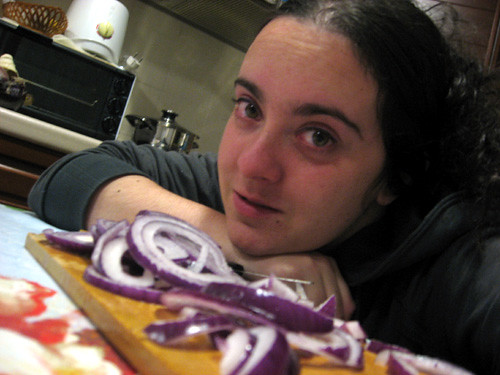
Translation from the Exeter Book: Maryann Corbett, ‘Riddle 25’

A wonder, that’s me, · what the women wait for
with hope, and a handy · help to their near ones.
I won’t hurt a soul · but the one who slays me.
I’ve a stem that sticks · up straight in the bed
and shaggy hairiness · hidden below.
The farmer’s girl– · she’s a forward thing,
and good to look at– · gets me in a grip
and reaches right · for my ruddy self,
handles my head · and holds me close
clasping me firmly. · She’ll feel my force,
the toss-curled tease. · There’ll be tears in her eyes.

*****

Maryann Corbett writes: “Riddle 25: Onion–This poem is a fairly faithful translation of one of the Old English riddles of the Exeter Book. Readers new to the riddles are sometimes surprised that a book preserved in a cathedral library includes such bits of naughty double-entendre.”

Maryann Corbett’s translation is collected in ‘Mid Evil’ (which won the 2014 Richard Wilbur Award). The original reads:
Ic eom wunderlicu wiht · wifum on hyhte
neahbuendum nyt; · nægum sceþþe
burgsittendra nymthe · bonan anum.
Staþol min is steapheah · stonde ic on bedde
neoðan ruh nathwær. · Neþeð hwilum
ful cyrtenu · ceorles dohtor
modwlonc meowle · þæt heo on mec gripe
ræseð mec on reodne · reafath min heafod
fegeð mec on fæsten. · Feleþ sona
mines gemotes · seo þe mec nearwað
wif wundenlocc. · Wæt bið þæt eage.

Maryann Corbett earned a doctorate in English from the University of Minnesota in 1981 and expected to be teaching Beowulf and Chaucer and the history of the English language. Instead, she spent almost thirty-five years working for the Office of the Revisor of Statutes of the Minnesota Legislature, helping attorneys to write in plain English and coordinating the creation of finding aids for the law. She returned to writing poetry after thirty years away from the craft in 2005 and is now the author of two chapbooks and six full-length collections, most recently The O in the Air (Franciscan U. Press, 2023). Her work has won the Willis Barnstone Translation Prize and the Richard Wilbur Award, has appeared in many journals on both sides of the Atlantic, and is included in anthologies like Measure for Measure: An Anthology of Poetic Meters and The Best American Poetry.

Photo: “Onion’s effect” by the Italian voice is licensed under CC BY 2.0.

Using form: Nonce form, riddles: Aaron Poochigian, ‘The New New Amsterdam’

I am the scam
you go in for, the diamonds in the pavement,
ecstatic evenings caught on traffic cam,
rare toilets and consensual enslavement.

Scholars and brawlers are inside of me.
What could I be?

I am
the new New Amsterdam.

I am those glam
high-rises and the derelicts’ despair,
graffiti worthy of the Met, and sham
Versace hawked to chumps in Union Square.

Purists and tourists are inside of me.
What could I be?

I am
the new New Amsterdam.

I am the ham
ironist, the perverse poobah of shock,
the firetruck stranded in a rush-hour jam
while conflagration rages round the block.

Birders and murders are inside of me.
What could I be?

I am
the new New Amsterdam.

I am the slam
Where Subway Ends, a scrum of mad musicians,
Sunday phone calls with a far-off fam,
Halal street food, and infinite ambitions.

Shoo-ins and ruins are inside of me.
What could I be?

I am
the new New Amsterdam.

*****

Aaron Poochigian writes: “Riddles go back to a time before ‘English’ was our English, before Shakespeare and Chaucer, the time of bards and Beowulf. The Anglo-Saxon riddles have the rhythms of poetry. They tell it slant like poetry does sometimes. The tantalizing, first-person self-description that defines the genre gave me a ‘way in’ to talk about a subject that would have been too vast otherwise—New York City.”

‘The New New Amsterdam’ was first published in The Rising Phoenix Review.

Aaron Poochigian earned a PhD in Classics from the University of Minnesota and an MFA in Poetry from Columbia University. His latest poetry collection, American Divine, the winner of the Richard Wilbur Award, came out in 2021. He has published numerous translations with Penguin Classics and W.W. Norton. His work has appeared in such publications as Best American Poetry, The Paris Review and Poetry.
aaronpoochigian.com
americandivine.net

Twitter: @Poochigian
Facebook: Aaron Poochigian
Instagram: aaronpoochigian

Photo: “NYC Night Life” by Tom Roeleveld is licensed under CC BY-NC-ND 2.0.

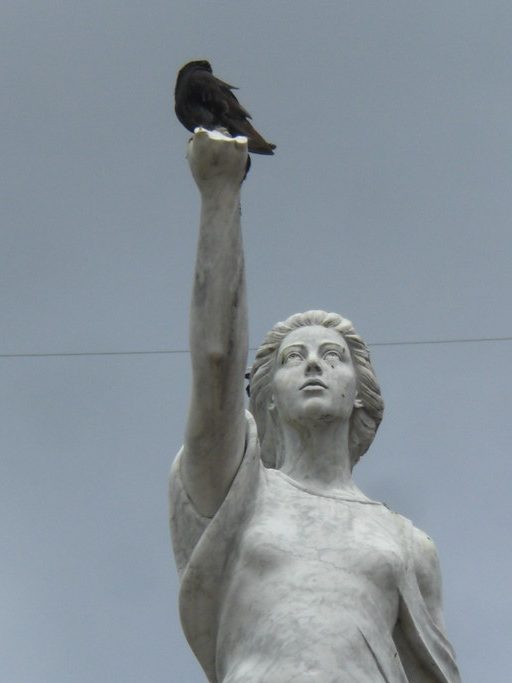
Melissa Balmain, ‘Bird in the Hand’

It doesn’t caw or hunt or fly.
It can’t peck anybody’s eye,
or even grow a single lousy feather.
One-clawed, no match for any tom,
it’s stranded on a leafless palm,
regardless of the season, time or weather.

Yet what’s the bird that, all alone,
sticks up for you when gibes have flown
and you don’t care to verbalize or linger;
when someone’s mocked you to your face
or cut you off or swiped your space –
what bird? The one that moonlights as a finger.

*****

Melissa Balmain writes: “I’m pretty sure this would have been the Sphinx’s riddle if she had guarded the Brooklyn Bridge.”

‘Bird in the Hand’ was first published in The Rotary Dial and is collected in Walking in on People © Melissa Balmain, 2014. Used by permission of Able Muse Press.

Melissa Balmain’s third poetry collection, Satan Talks to His Therapist, is available from Paul Dry Books (and from all the usual retail empires). Balmain is the editor-in-chief of Light, America’s longest-running journal of light verse, and has been a member of the University of Rochester’s English Department since 2010. She will teach a three-day workshop on comic poetry at the Poetry by the Sea conference in Madison, CT, in May 2024.

Photo: “A bird in hand” by Whatsername? is licensed under CC BY-SA 2.0.