I.
The day I left for Canada my mother
and father quelled their tears. We held and hugged.
He said, “We three may never see each other
alive again.” That leaving
hooked my gut and tugged.
We never did. He died and left her widowed
so next time we three met was at his tomb.
Our parting afterwards had been foreshadowed–
the breakage of the cord
that fed me from her womb.
We rode on gondolas to summits she
had never dreamed of. Mountains could not buy
her heart from where they’d raised the family–
we shared reunions linked
by contrails in the sky.
II.
Hi, Mum. It’s me, from Canada, your John.
Och, John! You’ve caught me in an awful state!
I know. I’m sad to hear that Henry’s gone.
The one that was my brother?
My memory’s not great.
He’s back now, from the War. Oh dear, they’re here.
Who? They’re all against me. Who? The clique.
They’ve done such nasty things. They think I’m queer.
I think I’ll kill myself.
So how’s the house this week?
Och this one’s grand. I moved two days ago.
And Johnny helped. I think he’s at the door.
I’ll have to run now, Henry. Cheerio.
Don’t go. The phone is dead.
The cord exists no more.
III.
A winter storm comes sweeping down the hills
and, gusting, blasts umbrellas inside-out.
They ring the grave like blighted daffodils
and rain-black mourners hold,
like buffeted peat-burn trout.
I take the tasselled pall rope, let it slide,
and with my brothers ease the coffin down;
it slips across the lip of a great divide
and sinks what was my mother–
a shuck, a wrinkled gown.
Gales carry off the prayer as it is spoken.
I cast the rope adrift. The rains of Skye
slap my back. Again, a cord has broken–
this time my lungs won’t fill.
I try but cannot cry.
*****
John Beaton writes: ” This one is autobiographical. Using the metaphor of an umbilical cord, it tells how emigration stretches and breaks family connections. The title refers to the old practice alluded to in the last stanza of holding the newborn upside down and slapping it on the back till a cry indicates its lungs have started to work and it is breathing on its own. At the end of the poem, grief prevents such a cry.
The dementia dialog is taken pretty much verbatim from an international phone call to my mother. That’s the part that crystallized the abacb rhyme scheme and 55533 meter. The dialog fell into place with that pattern and I felt it worked for the rest of the poem too. I think the last two lines of each stanza, with the first being unrhymed and the second linking through masculine rhyme with line two, act like an alexandrine and combine to give a closure effect.
The three-part structure represents three stages of escalating disconnection.”
John Beaton’s metrical poetry has been widely published and has won numerous awards. He recites from memory as a spoken word performer and is author of Leaving Camustianavaig published by Word Galaxy Press, which includes this poem. Raised in the Scottish Highlands, John lives in Qualicum Beach on Vancouver Island.
https://www.john-beaton.com/
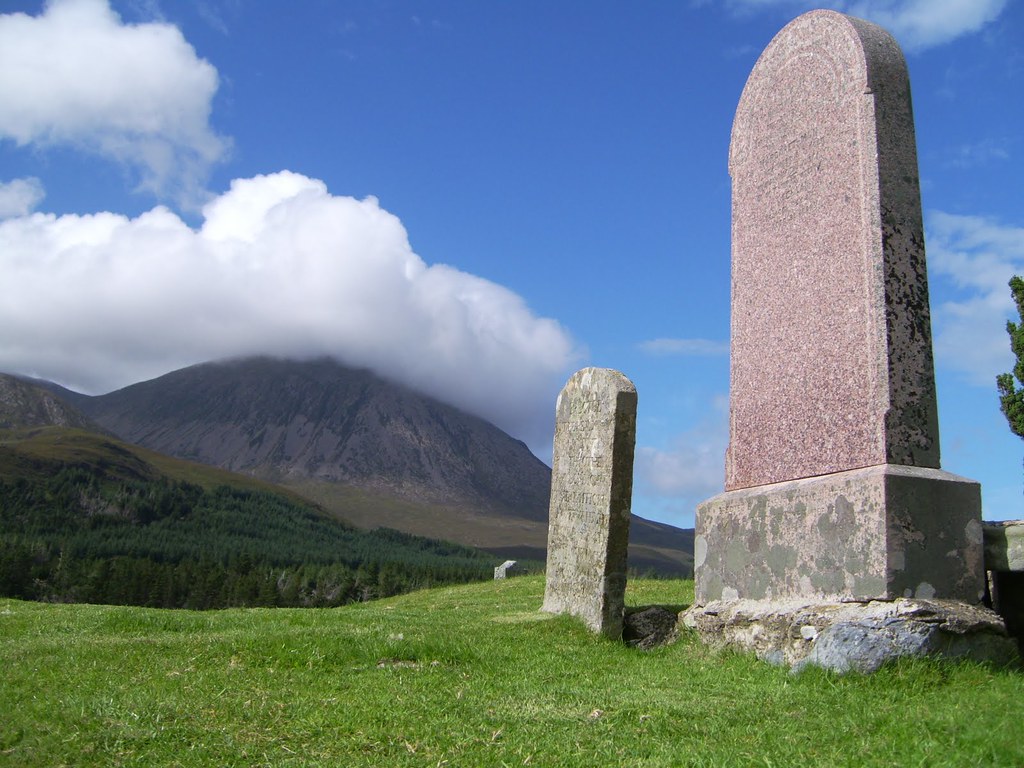
“Cill Chriosd Graveyard Isle of Skye Scotland” by Tour Scotland Photographs is licensed under CC BY-NC-ND 2.0.

 Form in Formless Times