Tag Archives: shipwreck

Dialect verse: William Henry Drummond, ‘The Wreck of the Julie Plante’

On wan dark night on Lac St. Pierre,
      De win’ she blow, blow, blow,
  An’ de crew of de wood scow “Julie Plante”
      Got scar’t an’ run below—
  For de win’ she blow lak hurricane,
      Bimeby she blow some more,
  An’ de scow bus’ up on Lac St. Pierre
      Wan arpent from de shore.

  De captinne walk on de fronte deck,
      An’ walk de hin’ deck too—
  He call de crew from up de hole,
      He call de cook also.
  De cook she ‘s name was Rosie,
      She come from Montreal,
  Was chambre maid on lumber barge,
      On de Grande Lachine Canal.

  De win’ she blow from nor’ -eas’ -wes’,—
      De sout’ win’ she blow too,
  W’en Rosie cry, “Mon cher captinne,
      Mon cher, w’at I shall do ?”
  Den de captinne t’row de beeg ankerre,
      But still de scow she dreef,
  De crew he can’t pass on de shore,
      Becos’ he los’ hees skeef.

  De night was dark lak wan black cat,
      De wave run high an’ fas’,
  W’en de captinne tak’ de Rosie girl
      An’ tie her to de mas’.
  Den he also tak’ de life preserve,
      An’ jomp off on de lak’,
  An’ say, “Good-bye, ma Rosie dear,
      I go drown for your sak’.”

  Nex’ morning very early
      ‘Bout ha’f-pas’ two—t’ree—four—
  De captinne—scow—an’ de poor Rosie
      Was corpses on de shore,
  For de win’ she blow lak hurricane,
      Bimeby she blow some more,
  An’ de scow bus’ up on Lac St. Pierre,
      Wan arpent from de shore.

MORAL
  Now all good wood scow sailor man
      Tak’ warning by dat storm
  An’ go an’ marry some nice French girl
      An’ leev on wan beeg farm.
  De win’ can blow lak’ hurricane
      An’ s’pose she blow some more,
  You can’t get drown on Lac St. Pierre
      So long you stay on shore.

*****

William Henry Drummond (1854 – 1907) was born in Ireland shortly after the end of the Great Famine, and came to Canada as a boy with his parents. He became a doctor, but gained fame as the ‘Poet of the Habitant’, celebrating the rural communities of Quebec with humour and goodwill.

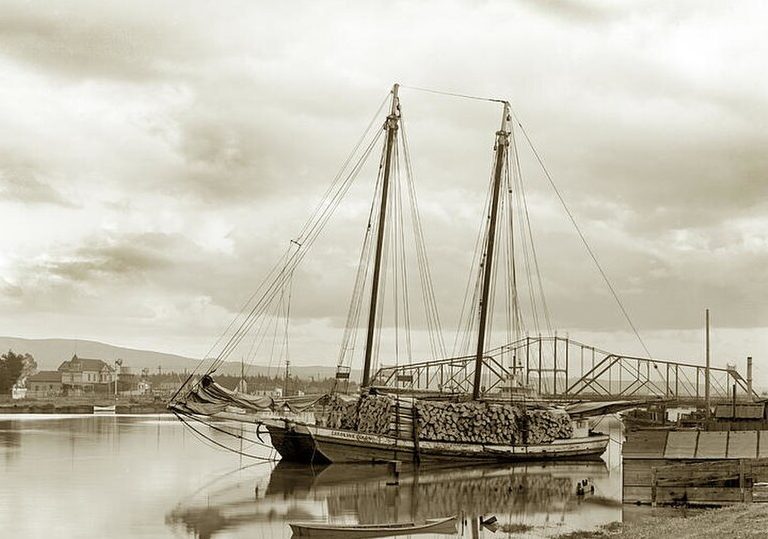
Photo: The scow schooner Caroline Dixon with a load of wood for the match factory.
Poem: Sonnet?: “The Antikythera Mechanism”

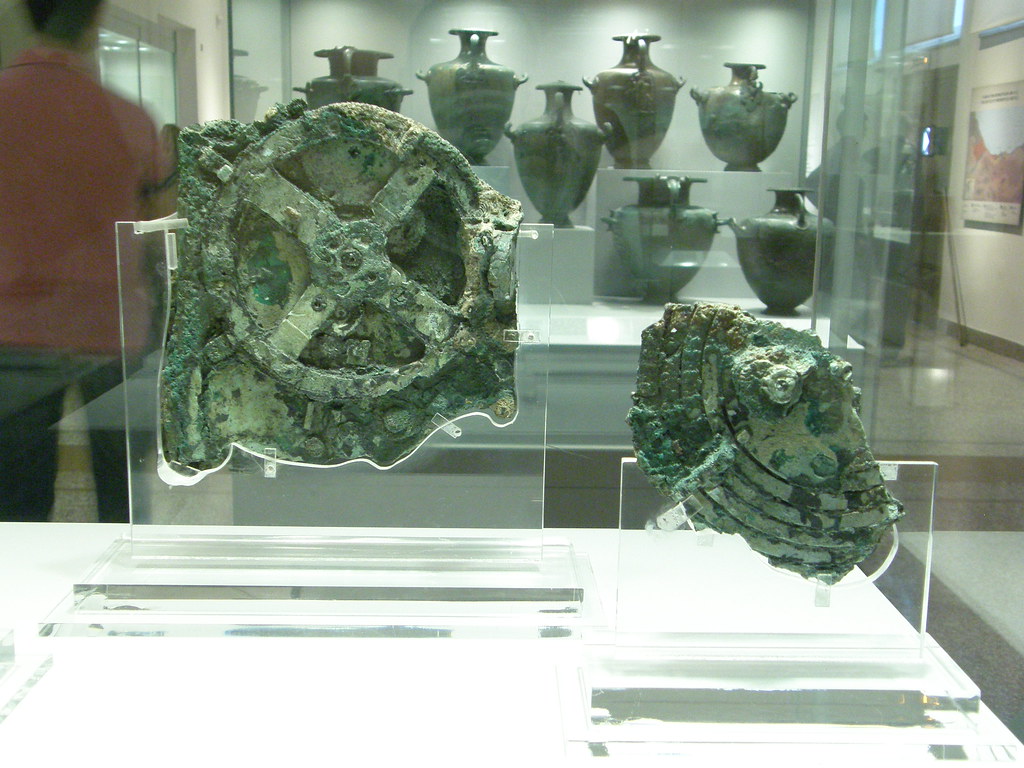
In 1900, sponge divers found a shipwreck in 150 feet (45 m) of sea off the Greek island of Antikythera. It proved to be a Roman cargo ship from the first century BC. Among the objects subsequently retrieved was a mechanism for calculating astronomical positions and eclipses centuries in advance of its time, generally considered to be the world’s earliest known analogue computer.

This poem was originally published in Snakeskin in June 2017

ANTIKYTHERA MECHANISM

The Antikythera Mechanism fits
Comfortably in no category I know;
A thing of Metal, from the Earth below,
For studying the heavens (Fire or Air)
While trapped in Water for two thousand years.
This ancient artefact from cultures past,
Designed to calculate future events,
Has a contemporary feel at last –
Making allowance for its steampunk look.
Not a computer, less whole than distressed,
It sits anomalously, missing bits,
But speaks loud of that loss much more intense
When the religious dogmas of The Book
Destroyed the nascent scientific quest.

This is a Sunday blog post, so I put a bit of religion in it. I recognise pros and cons to religion. (“All religions united with government are more or less inimical to liberty. All, separated from government, are compatible with liberty.”) It’s nice for people to use religions to explore their relationship with the universe, but I hold the inherent intolerance of monotheism responsible for setting civilisation back a thousand years.

On the use of form: well, the poem has aspects of form – it’s in iambic pentameter, like a regular sonnet; it has 14 lines, ditto; it rhymes… but there’s no structure to the rhyme. The combination of structure and chaos suits the mood of the poem, the odd position in history of this mechanism, and its odd state of semi-survival. Reconstructions of the Antikythera Mechanism have been made confidently, and put on display next to its fragments in the National Archaeological Museum in Athens