Tag Archives: age

Semi-formal sonnet: Red Hawk, ‘Old Age Requires the Greatest Courage’

The greatest courage is not needed for war,
but for ordinary people growing old.
Like soldiers, the aged are never very far
from death: many are called,
all are chosen. A soldier faces danger
then retreats, but for the old, going back
is not possible; they may hunger
for youth but pray for the luck
of a quick death. When one by one
the body’s systems fail, they must be brave
and face annihilation of the flesh and bone,
the Soul clinging like a shipwrecked sailor, to love;
finally, love is all we are given
to navigate between exhaustion and heaven.

*****

Red Hawk writes: “What inspired this poem is the School of Hard Knocks, surviving on Earth for 83 years, observing the chaos and madness of the human species, 45 years of self observation to see my own inner chaos & madness, and the Objectively Clear understanding that we all die, we all pay for our emanations, our lives, and finally there is the revelation that all & everything is the Love of Our Creator (whatever that is) & we are how that Love manifests in human form; the Love of Our Creator manifests disguised as our life. Following that, the chaos & madness which that Love takes in human beings is the result of it passing through the human mind & being corrupted and perverted by that screening process. Absent the interference of the ego structure, that Love manifests cleanly, clearly, and without judgment.

“The sonnet form is one of my favorite poetry disciplines & owes much to Shakespeare, Keats, & Edna St. V. Millay! Being one given to speaking too much & too often, this discipline has been a tremendous ally in taming that compulsion & mastering the tongue. Rhyme, though not in favor just now, is another tremendous discipline: it opens the gateway to the unknown—I may begin with a plan or an idea, but the demands of the rhyme send me at once into unknown territory: I don’t know what or how will come next to satisfy the demand of the rhyme and now I am subject to intuition & inspiration, the opening to the Divine.

“Red Hawk (aka Robert Moore) is not an Indian name, nor was it ever intended to be one or pretend to be one; it is an Earth name, given by Mother Earth many years ago after a 4-day water fast at the Buffalo River in an effort to save my life in one of the darkest periods of my life. Given to me during one of the worst ice storms in recent Arkansas history, it was given as an answer to prayer. It came about through conscious labor, prayer and wish, and was paid for by intentional suffering and remorse. It indicates a deep love & reverence for the Earth and how it has shaped my life. It is an honoring of Conscience and of the source which named me: our Mother Earth. To not acknowledge Her gift would be to disrespect Her and Her power to name and direct the course of my life; I am Her legitimate son. As the illegitimate son of unknown parents, Robert Moore is my adopted name given to me by 2 people who died of alcoholism; I honor it and them by the way I live my life.
You can google many of my books at Amazon, or find many of them at www.hohmpress.com. The book on self observation is now in 14 languages.”

‘Old Age Requires the Greatest Courage’ was first published in Rattle.

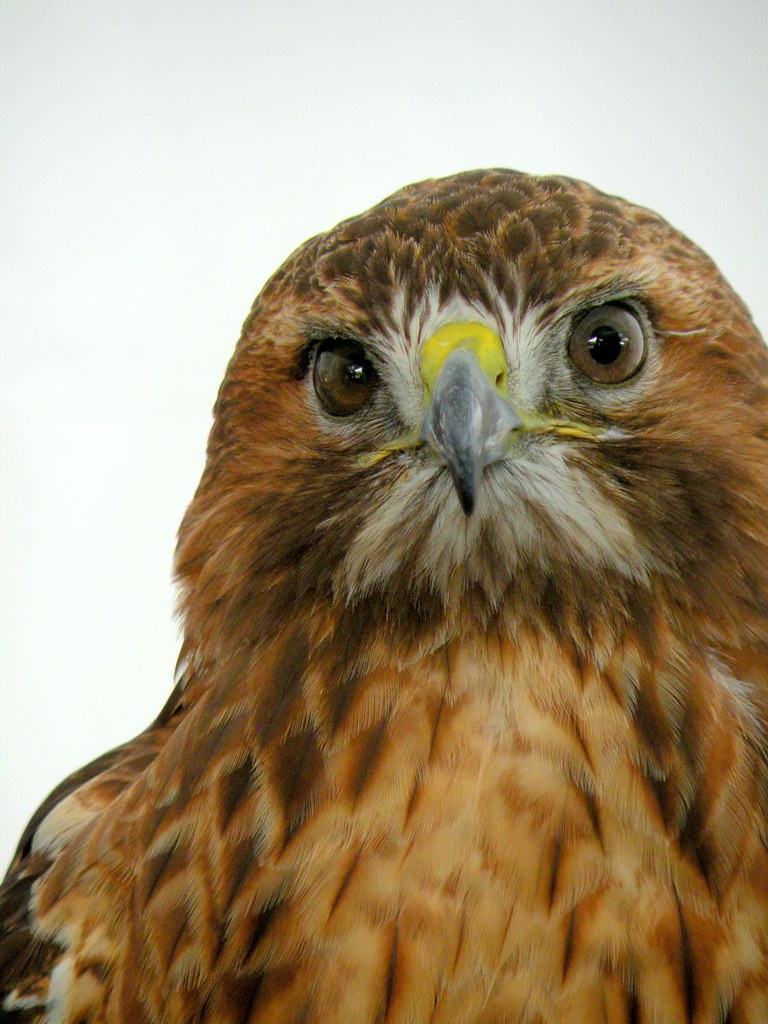
Photo: “Red Hawk” by Kiesha Jean is licensed under CC BY-NC-ND 2.0.

Joe Crocker, ‘A one-way visit’

to the vet with our decrepit cat:
snaggle-toothed, arthritic, ectoparasitic.
His kick-ass piebald coat is now a mat
for fleas to wipe their feet on.

His legs are lame. His dignity is flat.
He used to know his name was Tipperary.
Today it could be Tom or even Jerry.
Enough. He’s had enough.
And that is that.

*****

Joe Crocker writes: “Tipper” was my youngest daughter’s cat. He had white socks and a white tip to his black tail. “Tipperary” seemed like a fitting formalisation for his vaccination record. (And somewhere in my head was TS Eliot’s “The Naming of Cats”.) I don’t suppose Tipper ever really knew our name for him. In his final weeks he looked utterly bewildered and certainly unable to “keep up his tail perpendicular, spread out his whiskers or cherish his pride.”

‘A One-way Visit’ was originally published in Snakeskin.

Brief biography of Joe Crocker (masculine/feminine/neutered)

He writes his stuff and slides it under doors.
His age and sex, his fantasies, are no concern of yours.

The rhymes reflect his humour — down to earth.
A pamphlet is forthcoming but refuses to come fearth.

Winner of the Awkward Prize, ham-fisted.
Never short- or long- but  sometimes black- or shopping-listed.

Nominated (pusher) for the pushcart.
Squawking from the slush pile, self-regarding little upstart.

Google says he’s one of Sheffield’s legends
— a rock star who gets by with little help from friends, well… ex-friends.

*****

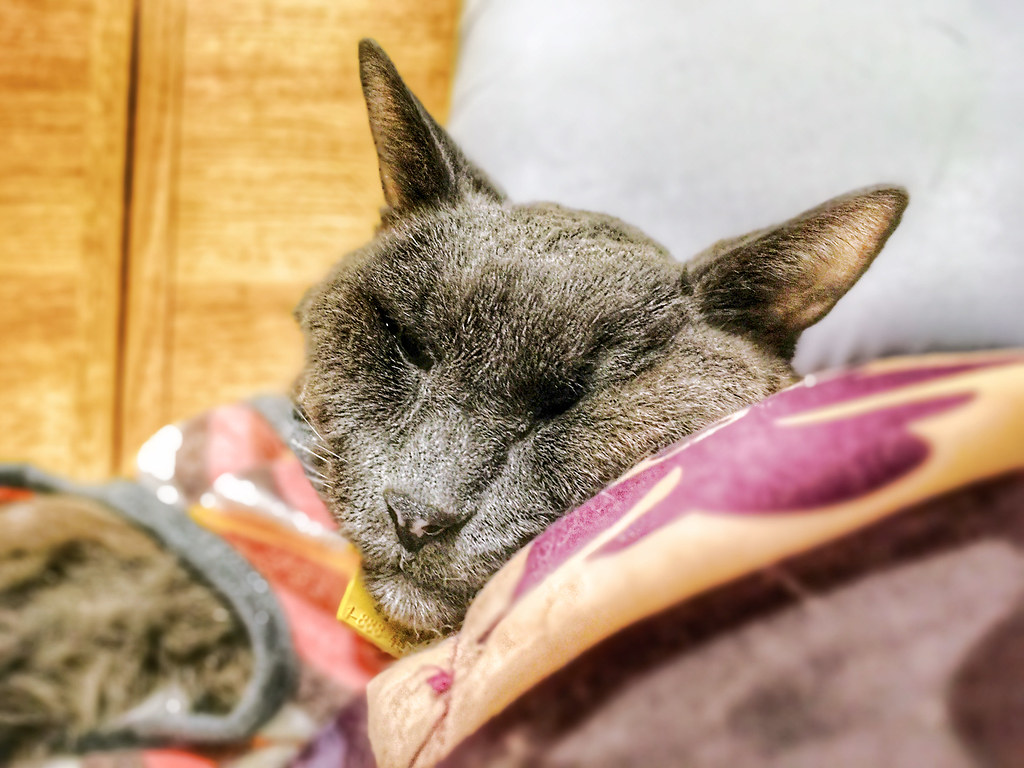
Photo: “Portrait of a Very Old Cat” by sjrankin is licensed under CC BY-NC 2.0.

RHL, ‘Fifty Year Argument: Old Fool, Young Twit’

1. To Myself in Fifty Years Time

Old fool!  You really think yourself the same
As I who write to you, aged 22?
Ha!  All we’ve got in common is my name:
I’ll wear it out, throw it away,
You’ll pick it up some other day….
        But who are you?

My life’s before me; can you say the same?
I choose its how and why and when and who.
I’ll choose the rules by which we play the game;
I may choose wrong, it’s not denied,
But by my choice you must abide….
        What choice have you?

If, bored, I think one day to see the world
I pack that day and fly out on the next.
My choice to wander, or to sit home-curled;
Each place has friends, good fun, good food,
But you sit toothless, silent, rude….
        And undersexed!

Cares and regrets of loss can go to hell:
You sort them out with Reason’s time-worn tool.
Today’s superb; tomorrow looks as well:
The word “tomorrow” is a thrill,
I’ll make of mine just what I will….
        What’s yours, old fool?

2. Reply to Myself – Fifty Years Later

Young twit! You really think we’re not the same?
That means you’re too young to extrapolate.
You’re the mere seed of what I since became:
    a husband, father, game creator,
    global skills facilitator…
        well paid; thought great!

You claimed to thrive, renting some garbage heap;
you travelled: hitchhiked, froze, thought life’s a bitch,
and ate whatever you could find that’s cheap;
    I travel too, and I eat well,
    and choose to sleep in a hotel…
        not in a ditch!

Your search for happiness was excellent;
you lived with several countries, faiths and girls,
though little lasted from those years you spent;
    for when you can’t tell love from lust
    and never work out who to trust…
        of course life whirls!

Your limited perspective proved a sham.
Your rude invective, though a load of shit,
helped fertilise my growth to what I am.
        My resumé –kids raised, loves gained,
        a business built –shows much attained…
            what’s yours, young twit?

*****

I was proud of the form I created when I wrote the first bratty poem, with both the rhyme scheme (abaccb) and the lines getting shorter (3 pentameter, 2 tetrameter, and a dimeter) contributing to the effect of each stanza ending with a punchline. But after I wrote that first poem to my future self at age 22, I was nagged by the need to respond as I got older; and I was never able to produce anything I liked. Finally, a full 50 years later, I produced the 72-year-old’s point by point rebuttal in the same form as the original. The original took a couple of hours over two days to write; the response was done in a couple of hours in one day.

The argument was first published in Snakeskin.

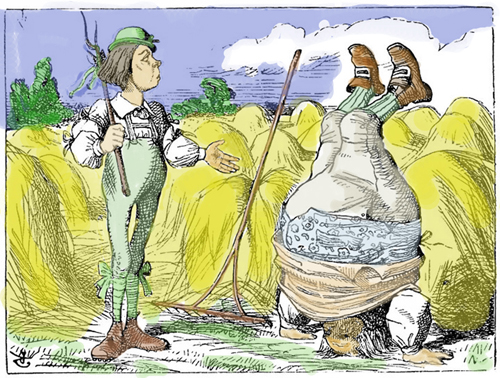
The illustration is one of Tenniel’s for Lewis Carroll’s “You are old, Father William“. And, yes, I still do headstands.

Aaron Poochigian, ‘The Old Man’

The old man wakens to a mute caregiver
pushing his chair past gulls along a railing.
This is the morning when he gets the river.
Surrendering to wind and a prevailing

saline tang kicked up from the Atlantic,
he lets whatever strikes him resonate.
A taut rod wrangling with a snagged and frantic
flounder whisks him to a lake upstate

where he, a wee one, tumbled off the dock,
his virgin perch still flapping in his grip.
A ferry, then, so very on the clock,
transports him to the boxy convoy ship

he steered through moonlit breakers toward Pyongyang
with perfect timing: his approach kissed land
at dawn. He dropped the ramp, and roughnecks sprang
out of the gangway onto commie sand.

Joggers, though, tug him back home from the war.
Whole herds of them keep gallivanting by
as thunder like they own the slate-paved shore.
He has to sit there coveting their high.

Sneakered and young as far as he can see,
they just keep leaving him behind to long
for liberty and the serene esprit
he got to savor when his legs were strong.

*****

Aaron Poochigian writes: “About the poem, all I want to say is that I think of it as flash fiction. I’ve started doing more studies of fictional characters in verse.”

‘The Old Man’ was first published in Portico Quarterly.

Aaron Poochigian earned a PhD in Classics from the University of Minnesota and an MFA in Poetry from Columbia University. His latest poetry collection, American Divine, the winner of the Richard Wilbur Award, came out in 2021. He has published numerous translations with Penguin Classics and W.W. Norton. His work has appeared in such publications as Best American Poetry, The Paris Review and Poetry.
aaronpoochigian.com
americandivine.net

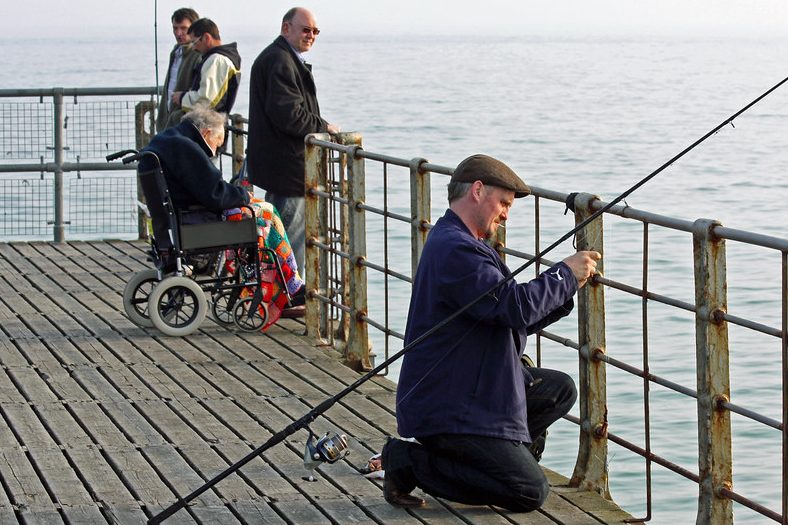
Photo: “Bognor Regis Pier – Mar 2011 – Portrait of a Working Man at Play” by Gareth1953 All Right Now is licensed under CC BY 2.0.

Claudia Gary, ‘The Body’

It catches up–sore teeth,
cramped neck or growing belly–
demanding our attention
once and for all. Beneath

a well-established brain,
above submissive toes,
the rest of it rebels
at our neglect, to gain

maybe not sympathy
but serious concern–
whatever is required
for us to stop and see

its loyalty. A steed
deserving of a gallop,
water and oats, in want
of love, it must be freed.

*****

Claudia Gary’s new book, Time and Other Solvents, will be available soon from Sligo Creek Publishing (See https://www.sligocreekpublishing.com/time-and-other-solvents). 

She lives near Washington DC and teaches workshops on Sonnets, Villanelles, Natural Meter, Persona Poems, Poetry vs. Trauma, etc., at The Writer’s Center (writer.org) and privately, currently via Zoom. Also the author of Humor Me (2006) and several chapbooks, most recently Genetic Revisionism, Claudia is an advisory editor for New Verse Review, as well as a science writer, visual artist, and composer of tonal art songs and chamber music. Her article about setting poems to music can be found online at  https://straightlabyrinth.info/conference.html. See also pw.org/content/claudia_gary.

‘The Body’ was first published in Amsterdam Quarterly

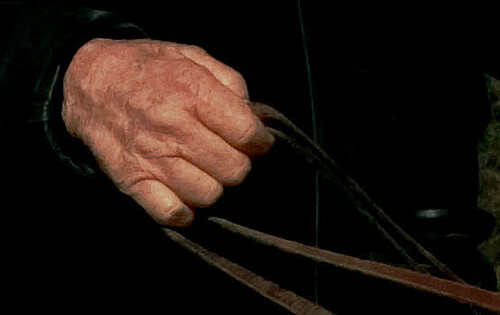
Photo: “The Old Cowboy” by Big Grey Mare is licensed under CC BY-NC-ND 2.0.

Sonnet: Richard Fleming, ‘Curtains’

He draws back curtains on a winter’s day.
It’s eight a.m. A charcoal sketch of trees
confronts him. All the world is grey
and unappealing. Nothing guarantees
a lowering of spirits as do scenes
like these. He peers outside. The thuggish sky
scowls back at him. Of all his small routines
this is the worst: he knows that, with a sigh,
he’ll draw these selfsame curtains yet again
in no more than a few hours’ time, when night
comes slouching from its prehistoric den
and all the birds of fortitude take flight.
He is a detainee, his heart in chains.
Love is a star long dead whose light remains.

*****

Richard Fleming writes: “Titles are often an afterthought in poetry, with first lines pressed into service as titles. For this writer, titles matter, and Curtains is a case in point. For those who grew up in the 1950s, curtains implied an ending, often death,
a sense reinforced by noir cinema. The poem Curtains treats the word both literally and symbolically: the daily opening and closing of curtains in winter becomes a measure of time passing and of life nearing its end.”

‘Curtains’ was first published in The High Window.

Richard Fleming is an Irish-born poet and humorist based in Guernsey, a Channel Island between Britain and France. Widely regarded as one of the island’s foremost literary voices, his versatile work blends lyricism, sharp wit, emotional depth, and a strong sense of place. Drawing from his Northern Irish roots and adopted home, his poetry and prose explore love, loss, nostalgia, identity, and modern life. Collections include Strange Journey (2012), held in the National Poetry Library, and Stone Witness (Blue Ormer) featuring the BBC-commissioned title poem. His work can be found on Facebook https://www.facebook.com richard.fleming.92102564/
or Bard at Bay www.redhandwriter.blogspot.com

Photo: “Good Morning, Sunshine.” by caiteesmith photography. is licensed under CC BY-ND 2.0.

Richard Fleming, ‘The Prayer’


I remember the cold, high-ceilinged room
where they had laid him, the smell of incense,
brass coffin handles shining in the gloom,
an aspidistra, dusty and immense.

To this small boy dressed in a mourning suit,
he seemed reduced, much less than he once was:
his scalp, without his cap, bald as a coot,
his fingers criss-crossed on his chest like claws.

I thought back to the day we watched geese rise
high over wetlands blurred with morning haze,
the laughter always dancing in his eyes,
his warm, familiar smell, his turn of phrase.

Life is so short while memories are long.
We the bereaved are left with words unsaid.
At the day’s end, he’d sing a lulling song
as I rode his strong shoulders home to bed.

A prayer unbidden reached me on a whim:
Preserve in me the things I loved in him.

*****

Richard Fleming writes: “This is a shortened, rhyming version of a lengthy free verse poem that I wrote over thirty years ago when I relocated to Guernsey from Northern Ireland. Like many love poems, the original version, The Hidden Traveller, has stood the test of time. This version stands as a homage to its source.”

Richard Fleming is an Irish-born poet and humorist based in Guernsey, a Channel Island between Britain and France. Widely regarded as one of the island’s foremost literary voices, his versatile work blends lyricism, sharp wit, emotional depth, and a strong sense of place. Drawing from his Northern Irish roots and adopted home, his poetry and prose explore love, loss, nostalgia, identity, and modern life. Collections include Strange Journey (2012), held in the National Poetry Library, and Stone Witness (Blue Ormer) featuring the BBC-commissioned title poem. His work can be found on
Facebook https://www.facebook.com/richard.fleming.92102564/
or Bard at Bay www.redhandwriter.blogspot.com


Barbara Loots, ‘A Note to my Old Age’

By now you shall have counted out my fears
on many fingers, and I count them, too,
because I know I am already you
remembering myself from your old years.

How loved you were: your hands, your heavy breasts,
your laughter, and the secret talk of eyes,
the vivid mouth, the spreading lap of thighs
(beloved woman, warm and fully blessed

whose laughter lined our face with troughs for tears!)
I write this down in order to prepare
a kind of perfume for your sallow hair,
a kiss, a love song for your wrinkled ears.

*****

Barbara Loots writes: “Following a form of Yeats (“When you are old and gray and full of sleep…”) I wrote this note to myself in my 30s. Now closing in on my 80s, I feel not in the least wistful or decrepit, still waiting for that imagined “old age”. With the perspective of some fifty years, I can say that old age is not at all as dismal as this poem would suggest. For one thing, my hair turned a rather dazzling white. And love faileth not.”

After decades of publishing her poems, Barbara Loots has laurels to rest on, but keeps climbing.  The recent gathering at Poetry by the Sea in Connecticut inspired fresh enthusiasm. Residing in Kansas City, Missouri, Barbara and her husband Bill Dickinson are pleased to welcome into the household a charming tuxedo kitty named Miss Jane Austen, in honor of the 250th birthday year of that immortal. She has new work coming in The Lyric, in the anthology The Shining Years II, and elsewhere. She serves as the Review editor for Light Poetry Magazine (see the Guidelines at  lightpoetrymagazine.com)

Dorothy Parker, ‘The Veteran’

When I was young and bold and strong,
Oh, right was right, and wrong was wrong!
My plume on high, my flag unfurled,
I rode away to right the world.
“Come out, you dogs, and fight!” said I,
And wept there was but once to die.

But I am old; and good and bad
Are woven in a crazy plaid.
I sit and say, “The world is so;
And he is wise who lets it go.
A battle lost, a battle won–
The difference is small, my son.”

Inertia rides and riddles me;
The which is called Philosophy.

*****

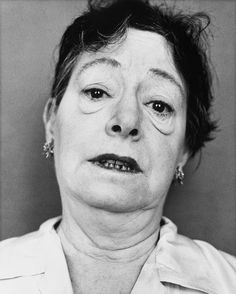
Dorothy Parker (August 22, 1893 – June 7, 1967). The source of innumerable witty, caustic poems and quotable squibs. Her philosophical stance is one of Cynicism and Idealism; Socialism, Feminism and Civil Rights; and Literary American Modernism. She was wonderful.

Image: Dorothy Parker

Michael R. Burch, ‘How It Goes, or Doesn’t’

My face is getting craggier.
My pants are getting saggier.
My ear-hair’s getting shaggier.
My wife is getting naggier.
I’m getting old!

My memory’s plumb awful.
My eyesight is unlawful.
I eschew a tofu waffle.
My wife’s an Eiffel eyeful.
I’m getting old!

My temperature is colder.
My molars need more solder.
Soon I’ll need a boulder-holder.
My wife seized up. Unfold her!
I’m getting old!

*****

Michael R. Burch adds the disclaimer “that the poem is pure comedy and my wife Beth is an absolute jewel. I’m lucky to have her. (Rodney Dangerfield put me up to it!)”

Michael R. Burch’s poems have been published by hundreds of literary journals, taught in high schools and colleges, translated into 23 languages, incorporated into three plays and four operas, and set to music, from swamp blues to classical, 75 times by 34 composers. He is also the founder and editor-in-chief of The HyperTexts.

OLD old Man” by bixentro is licensed under CC BY 2.0.