Tag Archives: students

Weekend read: Maryann Corbett, ‘An Orientation’

If, in the midst of this elated day,
someone took him aside with the stern warning,
Most of your life will not be like this morning,
he’d never hear it. How–while fountains play
beside clipped lawns and walkways arched with green
maples that move to stipple white and gold
on paths he and his harried parents have strolled
laden for move-in–how could he hear? He’s seen
Arcadia now, where classical facades
put a straight face on tanglements of thought,
and edgy spears of light and color, wrought
in steel and glass, look daggers at the gods.

The whole week’s strewn with glittering temptations
and parti-colored parties for the eyes:
gown-sleeves aflap like tropical butterflies,
professors float along in convocations.
Some one of them, someday, and over a drink,
will show him grittier visions: Rumor. Snark.
Administrative bloat. Nowhere to park.
How only summers bless you with time to think.
How even the mind’s beauties fester, vexed
by deadlines, balky software, budget hassle.
How research builds its turreted air-castle,
gorgeous for one day, rubble on the next.

But here, today, does anybody give
a bleep for realness? Let us cleave to form,
leaving him to his roommate and his dorm
and whispering, Here’s the poison. Drink and live.

*****

Maryann Corbett writes: “A few years ago, I happened to be on the campus of a nearby university on move-in day during freshman orientation week. It was an experience that gave me poem-provoking nostalgia.
“Orientation week is an institution I know well; I’ve lived my own college orientation and each of my children’s, and I’ve worked as a university staffer conducting such events. Freshman orientations usually take place in the week before classes begin in the fall and before other students return to campus. They’re meant to give new students everything they need to settle in and become part of the university community.
“But in addition to practicalities like moving young people into their dormitories — and dealing with parents’ emotional goodbyes — orientations will always involve hype and hoopla. Beautiful campuses are part of that hoopla, part of the seduction of academe. There will also be welcoming events that overpraise what students have achieved just by being admitted, tours that overpraise the campus’s buildings and amenities, and academic convocations with professors in full regalia delivering speeches that overpraise everything about the academic world.
“How true is all this as a picture of the scholarly life? I’ve been close enough to the facts of that life to know that the picture needs some correcting pessimism. The poem offers that but says it can wait. Let’s let the students fall in love with the vision before we tell them the truth.”

Maryann Corbett earned a doctorate in English from the University of Minnesota in 1981 and expected to be teaching Beowulf and Chaucer and the history of the English language. Instead, she spent almost thirty-five years working for the Office of the Revisor of Statutes of the Minnesota Legislature, helping attorneys to write in plain English and coordinating the creation of finding aids for the law. She returned to writing poetry after thirty years away from the craft in 2005 and is now the author of two chapbooks and six full-length collections, most recently The O in the Air (Franciscan U. Press, 2023). Her work has won the Willis Barnstone Translation Prize and the Richard Wilbur Award, has appeared in many journals on both sides of the Atlantic, and is included in anthologies like Measure for Measure: An Anthology of Poetic Meters and The Best American Poetry. ‘An Orientation’ is from her collection In Code.

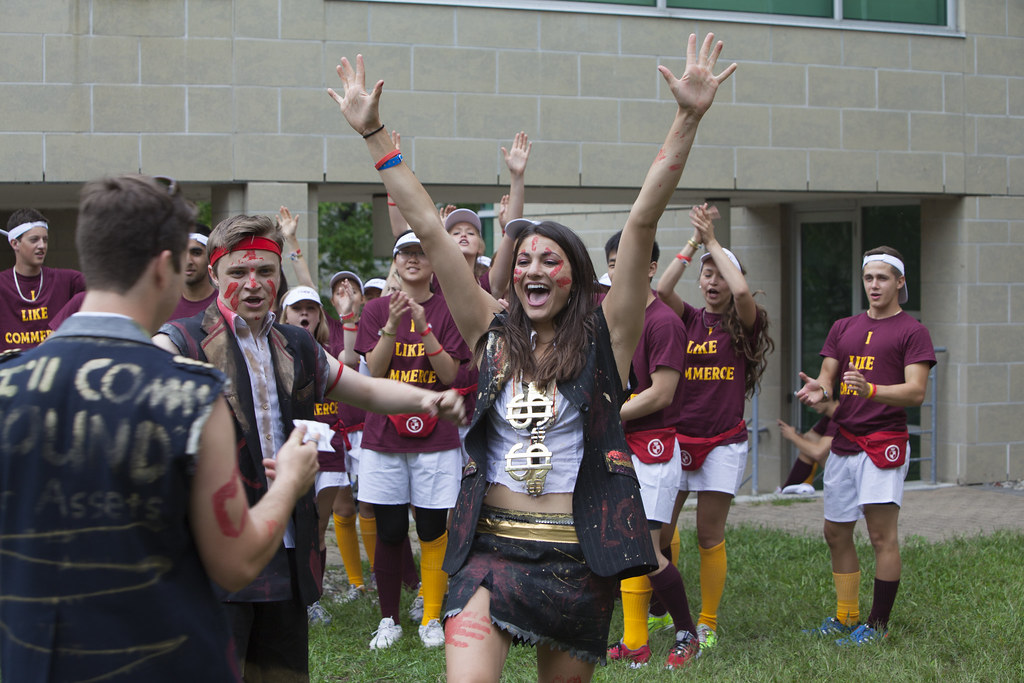
Photo: “Orientation week” by queensu is licensed under CC BY-NC-ND 2.0.
Edmund Conti, ‘Class Action’

Forty farty arty asses
Taking “Art and Humor” classes.
We can easily dispense of
Ten of those who have no sense of
Why they’re spending time in class.
Perhaps they hope the time will pass.

Thirty dirty-thinking students
Driving cars with one or two dents
All with New York license plates
(no one comes from other states).
None of them are Trappist Monks.
Three of them are from the Bronx.

Twenty seven, several standing
All of them aloud demanding
Knowledge and some satisfaction
Looking for a little action.
Which brings in play some other factors:
Like, the class has fourteen actors.

Thirteen thirsty knowledge seekers
Most of them in hi-tech sneakers
Fast-lane Yuppies causing sparks
Passing Jeffs and passing Marks,
Easily outclassing Freds
Four of them are wearing Keds.

Nine no-nonsense neophytes
New to Art and its delights
Also new to thoughts of Humor
Each of them a Baby Boomer.
Mostly what they make is money.
Eight don’t think that humor’s funny.

One remaining arty ass
Thirty nine aren’t in his class.
He has a strong artistic bent
A witty and amusing gent
But he (who is the poet) copped out,
Fell between the cracks and dropped out.

*****

Edmund Conti writes: “I think was inspired by a reference somewhere to an “Art and Humor” class. And naturally I had to have students dropping out, one by one, or two by two or more. The poem immediately became a lab for rhymes and puns and whatever could go under the banner of art and humor. Just riffing mostly.”

Edmund Conti has recent poems published in Light, Lighten-Up Online, The Lyric, The Asses of Parnassus, newversenews, Verse-Virtual and Open Arts Forum. His book of poems, Just So You Know, is published by Kelsay Books,
https://www.amazon.com/Just-You-Know-Edmund-Conti/dp/1947465899/
and was followed by That Shakespeherian Rag, also from Kelsay
https://kelsaybooks.com/products/that-shakespeherian-rag

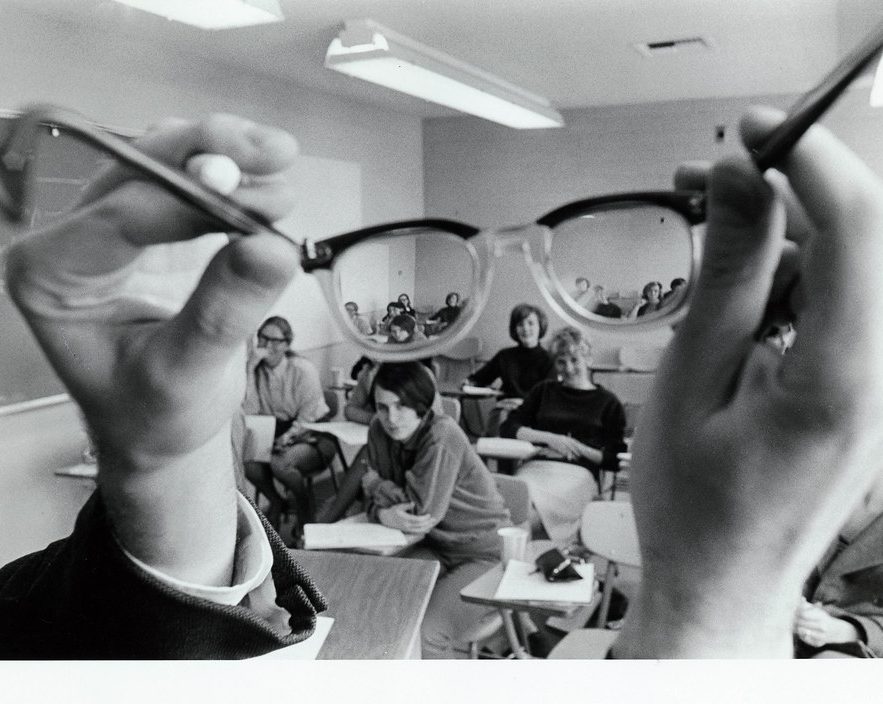
Students in class, Pitzer College” by Claremont Colleges Digital Library is licensed under CC BY-NC 2.0.

Max Gutmann, ‘A Letter Home’

One flat fall evening, as an undergrad,
I left the library to mail a letter
and at the mailbox had
a stirring–-I don’t know what else to call it,
but I felt certain, drifting back
on brittle leaves, surrounded by the gray,
this was my life–-a feeling new,
whole, deeply and vibratingly unstrange.

Back at the carrel, where my books still lay,
I sat some time immersed there in that moment:
me, having walked away
from books for some slight, distant human contact,
returning through the coming winter
to my small space. It struck me as both sad
and right; young as I was, I knew
it wasn’t something I would ever change.

*****

Max Gutmann writes: “Though it takes the perspective of an older man looking back, ‘A Letter Home‘ was written shortly after the experience it shares, years before I wrote any other verse (aside from some limericks); the drive to record the experience as a poem had nothing to do with habit. I couldn’t have anticipated that the “distant human contact” in my life would come to include a community of writers with whom I’ve only ever exchanged words on a screen (a community you do a lot to nourish, Robin. Thank you.)”

A Letter Home‘ was first published in the Pulsebeat Poetry Journal.

Max Gutmann has worked as, among other things, a stage manager, a journalist, a teacher, an editor, a clerk, a factory worker, a community service officer, the business manager of an improv troupe, and a performer in a Daffy Duck costume. Occasionally, he has even earned money writing plays and poems.

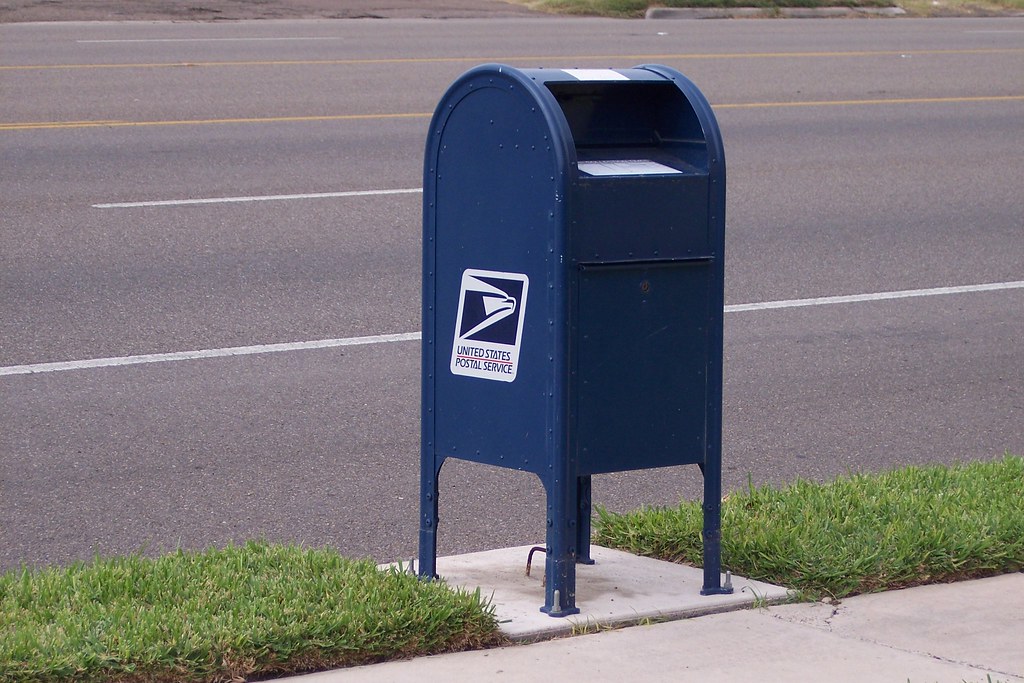
Photo: “McAllen mailbox” by Drpoulette is licensed under CC BY-NC-SA 2.0.

Poem: ‘Fellow Student’

I went round to Sarah’s flat one night:
“Hi man,” she said, “Yeah, you can come in, sure,”
apologising as she shut the door –
“but not for too long, you know how it is –
I’ve got two essays still to write
and then exams start – I’m in quite a tizz.”
She yawned and laughed, said “I’ve just changed Sam’s nappy,
and now he’s fast asleep – at last!” she smiled –
“Wow, but he keeps me busy!” “Also happy,”
I put in. “Yes, but not all the while –
he’s got a weak chest, coughs, cries with the pain,
I get so uptight we both end in tears…
his dad got sentenced, over drugs, eight years…
that’s long: I guess we won’t get back again;
I’ve got my Finals coming up, and then,
after, who knows? I’ve hardly time for dreams:
with Sam and studying, sometimes, it seems
my life’s nappies and essays, nothing more.”
She changed the record, sat to roll a joint,
and said “First thing I do, even before
I take Sam to that Nursery up the road –
he’s bigger every day! He’s quite a load!
But anyway, that’s not the point –
first of all, I get stoned, and stay that way,
or else I’d never make it through the day.”

A new cloud added to her soft rich room
a further depth of blue, a silent pause.

She spoke again, her thoughts already gone
back to her work: “And then, they seem such fools,
dividing all Philosophy in schools.
You know my option is the Indian course;
I know so much of what the old books mean:
things of which lecturers can’t conceive, think guff,
I understand, they’re places where I’ve been…
I’m always trying to turn the lecturers on:
if they’d drop acid, or just smoke some stuff,
they’d see so much… but they’re not brave enough.
So Transcendental just remains
a trendy course which their students can take
if other courses can’t keep them awake.
But still they try their worst,” she said, nonplussed,
and read “The Bhaghavad Gita retains
relevance for our century. Discuss.

Christ, aren’t they boring!” she said, biro poised.
I let myself out, while she found her page,
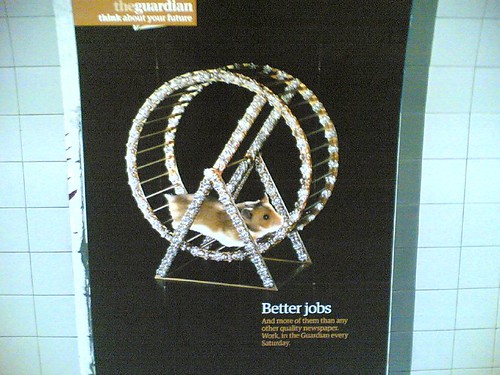
and Briggs, her hamster, woken by the noise,
went streaming up the rat-race in his cage.

*****

This poem dates to the time after I had dropped out of the University of Dundee, but still came back to it in the years that saw most of my 25,000 miles of hitchhiking. I feel I learned more by wandering in and out of jobs, countries, languages and religions than I would have if I’d stayed on Sarah’s path. But then, I have no idea how life worked out for her, so who knows.

The poem is semi-formal – rhymed but without a rhyme scheme, in iambic pentameter with some occasional liberties taken with metre… but those liberties are comparatively acceptable, even beneficial, in a longish poem as they break up the metrical monotony. That’s my excuse anyway, and I’m sticking with it. The poem was published decades later in Snakeskin – thanks, George Simmers!

Hamster Race” by Naked Faris is licensed under CC BY-NC-ND 2.0.

Sonnet: ‘Mythic Memories’

From all the mythic memories we make
Of childhood’s forests, gardens, beaches, seas,
Disturbed by adults’ eccentricities,
Come all the world’s religions – Tree and Snake,
Hero and Mother, Martyr, Saint and Fake.
Then let us make our mythic memories
(Implying endless possibilities)
From all that follows in the island’s wake:

Climbing up banyans, palms and tamarinds –
Firelight and starlight – total black of caves –
Spearing a lionfish – running on pink sand –
And unknown flowers scented on sea winds –
And jagged cliff heights where the ocean raves –
And views of huge horizons past all land.

I think it is important for children to experience the diversity of the world in different ways: when very small they need to feel the rhythms of day and night, winter and summer, and celebrate them with memorable festivals. When they are a little older, say six to eight, it is useful to experience the diversity of the world: if they live in cities, to go to farms and mountains and forests and beaches; if they grow up in a rural area as I did, it is a huge experience to spend a few days in a city. In either of those cases, the experiences make school learning much more relevant, something that can understood and believed in, because of the personal memories. I was fortunate to experience cities and countryside, jungles and deserts, before I started school. History, geography and languages were always very interesting as a result.

For even older children our family advocates a further step: in grade 10–i.e. at age 15–each of our kids got to choose where they were going for a year of schooling overseas. The only restriction was: Not an English-speaking country! They went away for Grade 11 and returned to finish high school with their friends for Grade 12. They went through competent organizations (YFU–Youth For Understanding, and AFS… though one went to the family of a boy we had hosted the previous year). The normal structure was that they went to a family (best if there are other children in the family) in which one parent spoke English; they had a week or two of prep time with the organization in the new country before the school year started; in school, initially they sat at the back of the class and didn’t know what was being said except in English classes and maybe Maths; by Christmas they understood everything; by Easter they spoke fluently; by the end of the year they had acquired the regional accent. The five kids each chose different countries: Denmark, Costa Rica, Italy, Japan and France.

They came back several years more mature than when they left. Instead of dreaming of owning a car, they none of them wanted a car particularly: they had learned to get around a strange city by bus and metro, which is cheap and flexible. Instead of believing that there is only one appropriate style of clothing and only one good type of music for their generation, they realized that even if all teens think that, those clothes and music are different in different countries, and it is a matter of choice. Instead of fighting with us, their parents, over teenage complaints of lack of freedom, they came home delighted to return to the rules and life they had known, with a year of living differently under their belt. And they had seen a lot of the world in a very deep way, the childhood and school experience, the local family experience, all the seasonal foods and songs and rituals, something that is very hard for an adult to ever experience in a foreign country.

And as it is from our childhood experiences that we derive our understanding of the world, and make the myths we live by and the goals we strive for, it is beneficial for us to have as wide and deep a range of childhood experiences as possible. So I believe, anyway.

This poem was originally published in Snakeskin. It may feel like an unfortunate post for a time of Covid and lockdowns in various parts of the world, but the days of good travel should return soon, and we can start planning…

Photo: “Pink Sand Beach” by Cédric Z is licensed under CC BY-NC-ND 2.0