You will find me drinking rum, Like a sailor in a slum, You will find me drinking beer like a Bavarian. You will find me drinking gin In the lowest kind of inn, Because I am a rigid Vegetarian.
So I cleared the inn of wine, And I tried to climb the sign, And I tried to hail the constable as “Marion.” But he said I couldn’t speak, And he bowled me to the Beak Because I was a Happy Vegetarian.
(…)
No more the milk of cows Shall pollute my private house Than the milk of the wild mares of the Barbarian; I will stick to port and sherry, For they are so very, very, So very, very, very, Vegetarian.
*****
G.K. Chesterton was an English author with a good sense of humour and a good turn of phrase. He was a loudly committed Roman Catholic, and combined a selective love of the Old Testament with a strong antisemitic streak – illogical perhaps, but not unknown among Christians; and therefore I have omitted part of the poem because of content that detracts from the joy of the piece.
‘The Logical Vegetarian’ appeared first in The Flying Inn (1914), a satirical novel in which Chesterton railed against what he saw as dreary and oppressive modernity; and it was reprinted in Wine, Water, and Song.
Illustration: G.K. Chesterton by RHL and GPT-6 Astra Light
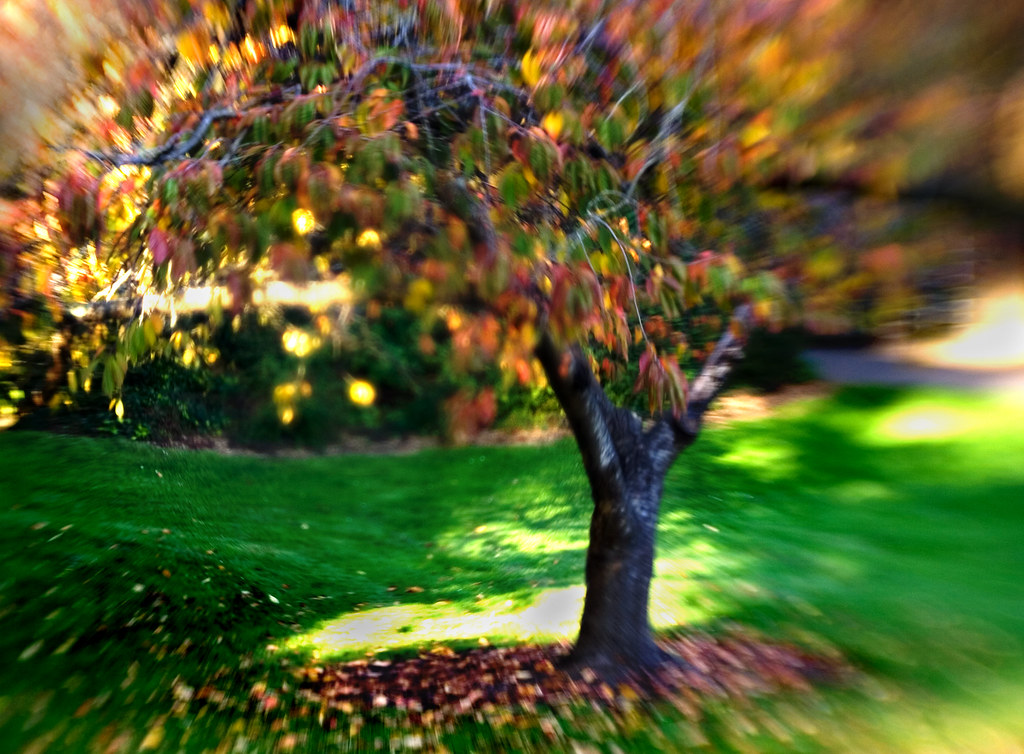
Márgarét, are you gríeving Over Goldengrove unleaving? Leáves, líke the things of man, you With your fresh thoughts care for, can you? Ah! ás the heart grows older It will come to such sights colder By and by, nor spare a sigh Though worlds of wanwood leafmeal lie; And yet you wíll weep and know why. Now no matter, child, the name: Sórrow’s spríngs áre the same. Nor mouth had, no nor mind, expressed What heart heard of, ghost guessed: It ís the blight man was born for, It is Margaret you mourn for.
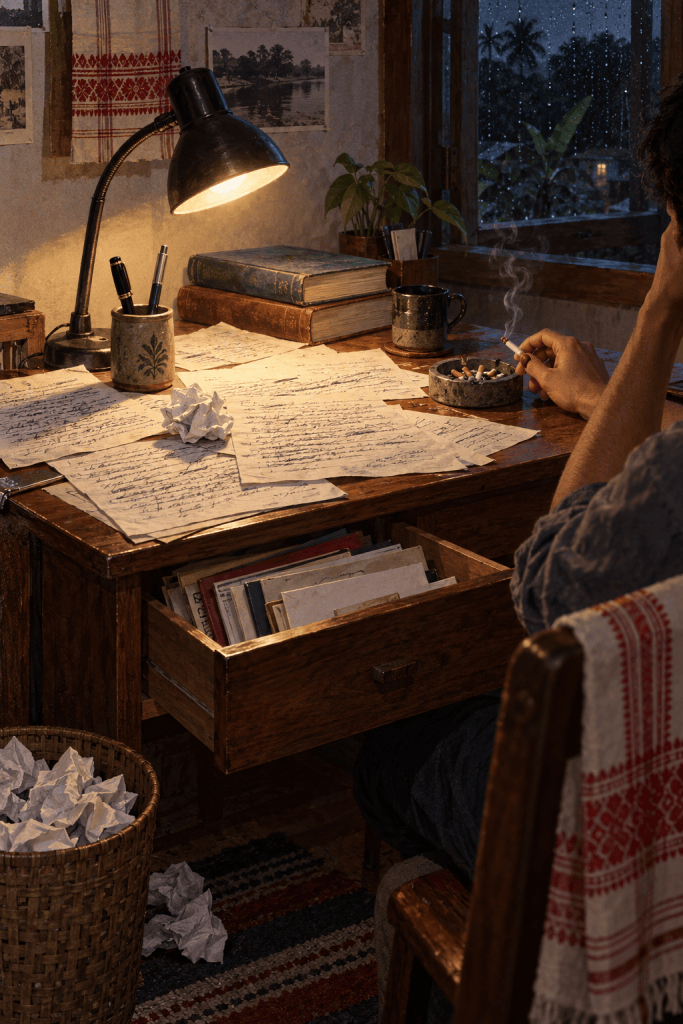
A rollerback and ballpoint, smartly standing inside the holder, flash their dignity. Illegible and lengthy roughwork, scrawled on sheets, hint at a poem still expanding or old stuff being polished thoroughly. Upon this cropland, labour’s never stalled.
Two well-stacked books of minstrels from the past refill this poet’s mental inventory when it’s devoid of stock. Some letters, furled and kept inside his drawer tell: he’s amassed a tonne of publications and the glory extended by the literary world.
Some white scrunched pages in the waste bin say discontent looms at times. The gooseneck lamp confesses how it stayed up with him through the nights bereft of words. What takes away such great distress? What remedy revamps his mind? Perhaps the ashtray gives a clue.
*****
‘A Poet’s Desk’ was originally published in Orbis.
Shamik Banerjee is a poet from Assam, India. He currently resides in Gurgaon, Haryana. Some of his recent publications include Spelt, Ink Sweat & Tears, St. Austin, San Antonio Review, Sheepshead Review, The Trinity Review, Third Wednesday, and Amethyst Review among others. He secured second position in the Southern Shakespeare Company Sonnet Contest, 2024, and was nominated for the Best of the Net by Flapper Press.
“Jansen, you gotta wear gloves when you work on the grinder. You want hurt yourself?” And then Kaczmarek looked down at Frank’s left hand. He saw the scar before the boy could jerk his arm away. “It’s nothing. An accident is all, ya know?” He’d done it Sunday night. Sometimes the burning made you feel alright when you were getting lonely. He had meant to do it somewhere hidden, but it felt good, the old man noticing like he had. That’s probably how it was to have a dad— he’d hit your backside with a leather belt when you were a little shit, but he’d care if you were hurt. He’d even stroke your hair.
*****
Alex Rettie writes: “Protection” was first published in the Summer 2026 issue of Nimrod International, edited by Boris Dralyuk. It’s part of an as-yet unpublished manuscript called “The Triangles,” which follows the lives of two gay men (including Frank, the speaker of the poem) and a nun (the former teacher of one of the men).”
Alex Rettie is a Calgary poet who has been published in print and online journals in Canada, Australia, the UK and the US. He co-edits the online poetry journal Poems for Persons of Interest (https://pfpoi.blogspot.com/). You can find more of his work on Substack at https://poemsforpoi.substack.com/.
At six o’clock, I wake, And plod down to the kitchen table In time to greet the sun, And hear the news on cable But focus on my sugar flakes; I don’t watch it none.
At eight, I hit the tees— I’m done faster without a foursome— And watch the wheeling hawks— At times, the game is boresome— And leave the club at ten oh three, In time for business talks.
At three, I call my mom, Who asks keenly about my meetings; I don’t have much to say. She wants to know I’m eating; I tell her yes to keep her calm. We do this every day.
At six I disconnect And meet friends at my favorite diner And drink a single glass. At eight, in my recliner, I grab my clicker to select The way the time will pass.
By nine, I’m back in bed, My teeth brushed and my body showered. The bed is soft and deep, My screens unplugged, unpowered. The pillow yields beneath my head. At four, I fall asleep.
*****
Narcisse Tardif writes: “I watch some crime documentaries here and there, and I’m struck whenever the murderer or would-be murderer just seems like a normal person. I wanted to use my poem to explore what life could be like for a “normal-person” murderer who got away with it. OJ was a big inspiration, but the poem is not meant to just be a retelling of the OJ story.
“The form is an ad hoc invention. I liked the double stress of “plod down” because of its evocative nature, so I built the second line around that, using a trochaic substitution in the second foot of each second line. The rest of the form is meant to be somewhat conversational, mimicking the ebb and flow of daily life, with some variation here and there, but the repetition of the exact form in every stanza still leaves enough sameness to evoke routine. I don’t know whether you have a policy regarding overexplaining poems on your blog, but the line about drinking a single glass is supposed to be a hint, as well as the more obvious sleepless night. On a more subtle note, the complete absence of a romantic partner is a bit of subtext throughout the whole poem.”
Narcisse Tardif self-describes as “Poet grappling with the ironies and incongruities of heartbreak, religion, meditation, and mortality. I write mostly in English, but also in French and sometimes other languages. First person ≠ autobiographical.”
What hovers above condenses below And the vagus nerve has wonders to show: Mill of the belly, invisible grind Slick convolutions sculpt all they find Smooth muscle contracts around traveling scat As sensual as the yawn of a cat. An abdominal chorus—how it gurgles! Saturn’s own voice, corruptly fertile. Cells split and shimmy, chromosomes boil Identity settles, signed with a coil,
Written in meat’s salty alphabet. Pulsing skin shimmers, scented and wet. Eyeballs disguised writhe over a dream. Our rubbery hearts, the genitals’ steam Carbon dioxide’s vegetable tang Ancient green song all vertebrates sang Wet from the lick of valence’s tongue. Leaping or lurching down star light’s descent Trailing our dreams and our excrement. From acids and stink the soul forges land: Thoughts in our heads, and work in the hand.
*****
Elizabeth Hurst writes: “Below” was inspired by the concentration of nerves in our guts that functions as a second brain, the alchemical axiom “As above, so below” & “Love has pitched his mansion in the place of excrement” from Yeats’s Crazy Jane poem.”
Elizabeth Hurst is originally from Los Angeles and moved up to San Francisco many years ago. She lives out by the beach with her husband, Gerald Stack.
“The strong survive, and all of that,” he’d tell the limply dangling cloth between his beak, a former moth, but doesn’t sense the lunging cat,
who doesn’t think the wheels that run consider cats their proper prey. Yet, now he’s just a dead display beneath the slowly dying sun.
Who knows if later down the road that truck won’t strike a rotting tree and bring to bear on top of me its paralyzing wooden load?
Though like a reel of comic scenes, it’s also how our stories go: the endings are the same, we know, but brought about by varied means.
*****
Paul Burgess writes: “Earlier in the summer, a bird appeared in front of me casually holding a dying moth and looking almost cheerful. The encounter got me thinking about deaths that come suddenly, without malice, and without much meaning to the creatures or things that have caused them. I can’t say exactly why, but some combination of my mood and the circumstances made the sight more vivid and significant to me than it might have been on another day.”
‘Another Old, Familiar Story’ was first published in Snakeskin.
Paul Burgess is the sole proprietor of a business in Lexington, Kentucky that offers ESL classes in addition to English, Japanese, and Spanish-language translation and interpretation services. He has recently contributed work to The Road Not Taken, Blue Unicorn, Light, The Orchards, Pulsebeat, Snakeskin, Lighten Up Online, and several other publications. https://paulburgesswritingandlanguage.blog/
From forefathers’ farmstead hunger me hounded With woman and bairns and some wretched remains: Leaping alone on the deep, our boat bounded Away from the homeland of Angles and Danes.
For days the deck dandled on wastes of grey water, And shivered and shook in the growl of a gale While sea monsters daunted my wife and my daughters And I drew deep draughts from an ox-horn of ale.
The strong ones – the heroes – they breasted and braved Those terrible fathoms of fearfullest depth, And steadily steered us through wind and through wave While cursing all cowards, disdainful of death.
But Njord sent a silver-winged gannet to guide us. Impatient for cornlands by weal or by war, We raced with the wind and the sunrise behind us, And sure was our way to a grey wooded shore.
On the flood, up a watercourse muddily canting Through marshes where mist devils wreathed among reeds, Where pastures awaited our ploughing and planting We oared ourselves bravely, emboldened by need.
But furtive eyes followed our struggle upstream As we ventured our vessel in menacing silence. The landscape seemed empty, yet sometimes the gleam Of a blade in the coverts of blackthorn spoke violence.
Whoever they were, they were ready for raiders; And we, to contest our new home to the last. Still no-one molested, still no-one waylaid us. At length we approached apprehensive, and passed,
As we warily, wearily rieved up the river, A barrack abandoned, a half-ruined hall. Within arrow’s reach but wavering never While Britons looked on from those broken-down walls
Some long-vanished Legion had left there, and stared From their crumbling defences of rubble and stones. We were outnumbered, but though we prepared For foray or ambush, they left us alone.
Where the shallows gave out and we grounded the keel At a bend in the vale, shipped oars and dropped sail, An auspicious white egret wheeled over the field Where we sit by this hearth where I tell you this tale.
So here we sowed barley, roots, rye and wheat; Brewed strong Saxon beer, baked good Saxon bread; Our sheep grazed and grew, gave us wool, milk and meat. Brides were my daughters for Britons – both wed
Sons of the tribe we had troubled when first Setting foot on their dale in that dangerous dawn. Then you came along, with lungs fit to burst, Your grandfather’s joy from the day you were born.
Well, we followed the fashion for Cross and for Christ, Acknowledged His kingship to keep a calm life, Forswore the old gods, and got us baptised. I bowed to His will when He took my young wife….
Your grandmother’s happy in heaven, they say, Spinning and weaving a wool of pure gold Where angels sit feasting and drinking all day. Another turf on the fire, boy, these evenings are cold.
Yes, I, a dull peasant, she thought me so grand, Me, shy of adventure and frightened of pain…. But these fields were fertile, four cows bore my brand, And I, a true Saxon, lived up to my name
Of Earth-Brother. They’ll tell you in our mother tongue That heroes are warlike, wield swords, win more land, Yet I was content among swine and their dung. The ploughshare I chose; but, boy, understand:
All-Fatherly fortune has favoured my choice. You wonder, wide-eyed, would I do it again? The ocean, the fear? Hear an old voice: The heart in the breast of my broodiest hen
Beats brave as the heart of a hero – but then, No courage is needed to counter the new. Heroes are merely a notion of men. The future must happen; will happen to you.
*****
Martin Briggs writes: “Saxon” began as an experiment. I wanted to think myself into the frame of mind of men forced by circumstances to seek out and colonise new lands – a situation being re-enacted tragically today in response to environmental and other pressures. The heavy alliteration reflects the Anglo-Saxon predilection for the same, and the persistent rhythm is intended to convey a sense of bardic tradition.”
“Saxon” was first published in Pulsebeat Poetry Journal. This version has been subject to very minor revision.
Martin Briggs only began writing in earnest after retiring from a career in public administration, since when his work has appeared in a variety of periodicals and formats on both sides of the Atlantic. He regards form, rhyme and metre as a liberating force rather than a constraint, and as a means of perpetuating a tradition which is as old as poetry itself. He lives in Suffolk, a part of England where Anglo-Saxons settled quite densely.
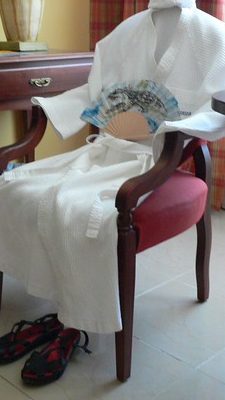
The inside of the collar’s badly frayed; the pink and sky-blue stripes began to fade a while ago. I’ve worn it for twelve years, she wore it for a few, and it appears it might not last much longer. I’ll be sad to lose it, and to lose the sense I’ve had, each time I slip it on, that she would grin to see it on me. She was short and thin, I’m not, so when I wear it, I expose a bit of leg, while it reached to her toes. And she’d wear slippers with it, taking care they matched the robe; my bigger feet are bare. I put this robe on and I put on all the ways we differed—though I don’t recall we argued much. She listened to Garth Brooks, I favor Brahms; she was the best of cooks — those famous meatballs, cookies of all kinds — while takeout is my strength. Sometimes what binds two sisters may be each one’s readiness to be amused by her antithesis when it’s wrapped up in measureless affection — as I still feel wrapped up in our connection, and not just when I wear her robe. Although I’ll let it go soon, with regret, I know I won’t let go of her until the day the world lets go of me. Some things don’t fray.
*****
Jean L. Kreiling writes: “This poem is entirely autobiographical; my sister Susan’s premature death to brain cancer broke my family’s heart. Wearing her robe has been therapeutic—as was writing this poem—but I’ll miss her every day for the rest of my life.”
Jean L. Kreiling is the author of four collections of poetry, most recently Home and Away (2025). Her work has been awarded the Able Muse Book Award, the Frost Farm Prize, the Rhina Espaillat Poetry Prize, and the Kim Bridgford Memorial Sonnet Prize, among other honors.
What spurs me, in this breathing grave of coffee mouths and cheeks unshaved, to stand upon my chair and shout, “I’m out! I’m out
of this forever-widening coop where glumness, going on a loop, entraps, within its strangling mesh, the mind and flesh?”
I should be sitting by my table immersed in some sweet ancient fable or search, within some lyric verse, joy’s universe.
But here I am—jailed in a row of coffee mouths and heads that bow to despots (dressed in cotton coats) who grab our throats.
*****
Shamik Banerjee writes: “Written in a Cubicle took root in the very cubicle where I spend nine hours a day typing incessantly and passively listening to the heavy buzz of my colleagues. I know that this poem doesn’t carry an optimistic tone, but it is also true that this very cubicle helps me clear my bills. It was just one of those days when I felt like writing it. It was cathartic, I admit.”
Shamik Banerjee is a poet from Assam, India. He currently resides in Gurgaon, Haryana. Some of his recent publications include Spelt, Ink Sweat & Tears, St. Austin, San Antonio Review, Sheepshead Review, The Trinity Review, Third Wednesday, and Amethyst Review among others. He secured second position in the Southern Shakespeare Company Sonnet Contest, 2024, and was nominated for the Best of the Net by Flapper Press.