Tag Archives: tramps

Sonnet: ‘Wanderer, or Odin/Merlin in the 21st Century’

It isn’t money, power, or (really) sex;
it’s wisdom, knowledge, understanding, truth,
the motivation from my earliest youth.
So now I watch as all our dreams turn wrecks,
as statesmen bluster, muscles bulge and flex,
economists forecast but can’t say sooth,
and life extension folks are thought uncouth–
they hoard possessions, but can’t save their necks.
I wandered, ragged, with a missing eye,
patched so none knew my implant’s extra sight,
seeking her who’d save from oblivion
the things I’ve found; for I see I must die,
and I’m now summoning the acolyte
who’ll carry knowledge on. Come, Vivien.

*****

The child wandering, the youth hitchhiking, the middle-aged tramp, the old hobo… in my view, they all have the spirit of Odin, Merlin, Hermes, Papa Legba, searching for knowledge, intermediary between the human and the divine/posthuman.

This sonnet was recently published in The Road Not Taken – a Journal of Formal Poetry. Thanks, Dr. Kathryn Jacobs!

Illustration: DALL-E
Review: “The Autobiography of a Super-Tramp” by W.H. Davies

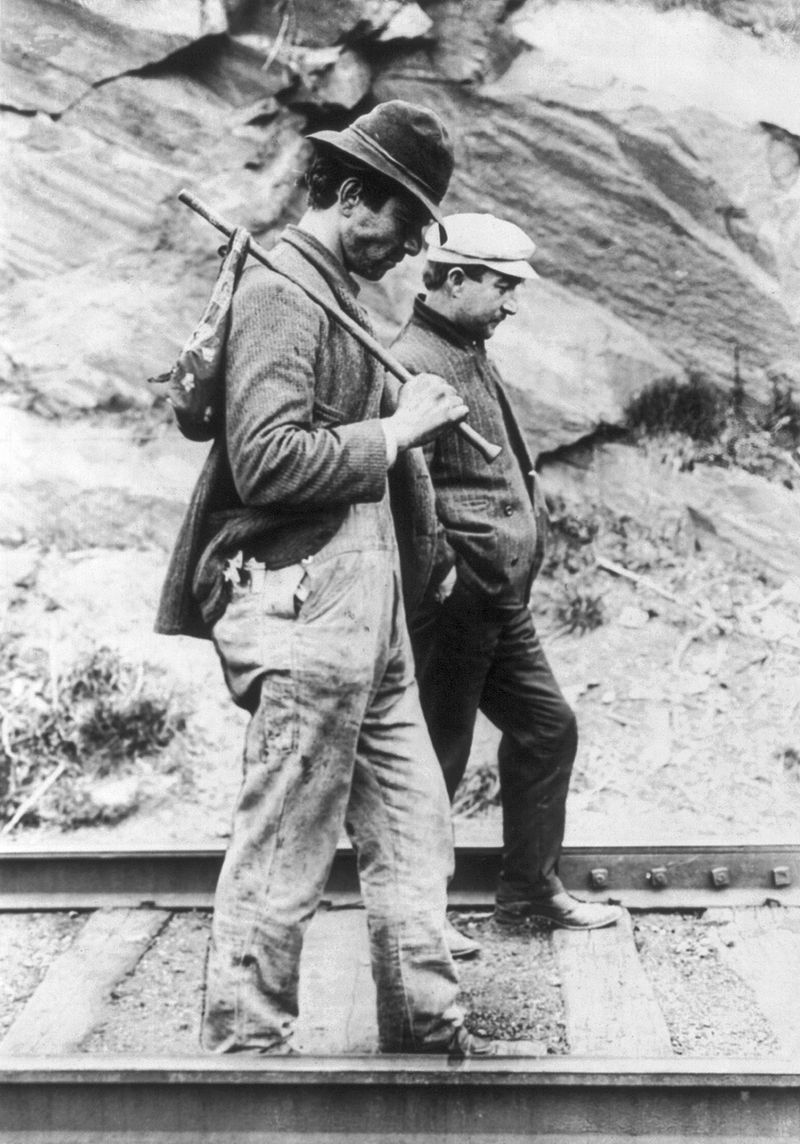
Hobos

Hobos, US Library of Congress. Unknown date. Likely 1880s – 1930s

W.H. Davies was a poet whose best-known piece begins

What is this life if, full of care,
We have no time to stand and stare.

Born in Newport, Wales, in 1871, he was raised by his grandparents. As a boy he fought a lot, and at 13 was the leader of gang, was arrested for stealing handbags, and got twelve strokes of the birch. He read enthusiastically, disliked being apprenticed to a maker of picture frames, and at 21 took passage to America. His years of wandering provide a fascinating view of the US over 100 years ago, with chapters on jails, thieves, cattlemen, race issues in the Mississippi area, and so on. He worked his way back and forth over the Atlantic, lost a leg hopping a train in Canada and thereafter limited himself to England where he began writing his poetry and memoirs in doss houses in between bouts of tramping and begging. Eventually he was noticed, published for his poetry first and then for his autobiography–with a preface by George Bernard Shaw–and became famous.

His autobiography is frank, amusing, informative, insightful and naive all at the same time. A unique book, and a good accompaniment to his poetry (the link is to an 11-slide deck) which is also insightful and naive and oriented to observing life outside, whether in city or countryside. This is from “The Sleepers”:

As I walked down the waterside
This silent morning, wet and dark;
Before the cocks in farmyards crowed,
Before the dogs began to bark;
Before the hour of five was struck
By old Westminster’s mighty clock:

As I walked down the waterside
This morning, in the cold damp air,
I saw a hundred women and men
Huddled in rags and sleeping there:
These people have no work, thought I,
And long before their time they die.