Tag Archives: writing

Rachel Hadas, ‘Rag Rug’

It has arrived—the long rag rug
multiply folded. On top, one alien hair.
I put my face to the folds and smell despair
palpable as salt air
in all those rooms and houses, small and smug—
enclosures I passed through on my way where?

Whoever did the weaving appears old
in my mind’s eye. I can’t make out her face,
can only conjure up the faintest trace
of an abstracted grace,
clack of the loom. Does she know they’ll be sold
these precious things, in some unheard-of place?

I perch her on a hill, precariously
beyond the reach of waves’ daily boom.
Sun blazes overhead, but her dim room
(no bigger than the loom)
is proof against the violence of the sky
From it I further spin what I once called my home:

Endless horizons fading into haze,
the mornings dawn came up so rosy clear;
snails in the garden, sheep bells everywhere,
the brightness of the air,
terraces, valleys organizing space
and time’s cessation. So this package here

I’m now unwrapping, in New York, today
(rugs like rainbows, woven with a grace
my strands of language barely can express;
dishrags of dailiness
dispersed and recombined and freshly gay)
comes to me imbued with images,

slowly and faithfully across the water,
across the world. It represents a time
I myself snipped and recombined as rhyme
as soon as I went home,
if that is where I am. These rugs recover
the sense of stepping twice into a single river.

*****

Rachel Hadas writes: “Rag Rug, written probably around 1980 or sometime in the early Eighties, describes my experience opening packages of rag rugs handwoven by a woman or women in Samos, the Greek island where I’d lived between 1971 and 1974. The rags in question were blue jeans, pajamas, tablecloths, you name it – I’d cut these into narrow strips which I sewed together and rolled into a ball, and when I had enough such balls I mailed them to my former mother-in-law in Samos; she eventually sent me the finished project, long rag rugs perhaps eighteen inches wide, colorful, washable, which eventually faded and blended as madras does. The evocative smell of the cloth; the memories of the island and my life there; the fact that poetry, like the making  of these rugs, like quilting, is a piecing together, recombining and recycling of fragments – reading the poem now brings all this back.”

Rachel Hadas’s recent books include Love and Dread, Pandemic Almanac, and Ghost Guest. Her translations include Euripides’s Iphigenia plays and a portion of Nonnus’s Tales of Dionysus. Professor Emerita at Rutgers-Newark, where she taught for many years, she now teaches at 92Y in New York City and serves as poetry editor of Classical Outlook. Her honors include a Guggenheim fellowship and an award from the American Academy-Institute of Arts and Letters.

Photo: “Colourful rag rug” by theihno is licensed under CC BY-ND 2.0.

Villanelle variation: James B. Nicola, ‘My MFA’

I thought I’d go and get my MFA
since college never taught me how to write.
It’s not that I had anything to say;
 
I needed somehow, though, to spend the day
and, existentially I guess, the night
as well. So I went for an MFA
 
in Creative Writing. I did OK,
creatively. My grammar was a fright,
and there was nothing that I had to say,
 
but you got extra points for this. The way
you said squat was what mattered. Outasite, 
I thought, which, when I got my MFA,
 
I didn’t know was not a word. But stay,
they’d said, you can’t create if you’re uptight.
There is no wrong or right. And who’s to say
 
that parts of speech, or lie in lieu of lay,
or topic sentences, are not a blight
on Creativity? What could I say?
I’d paid a lot to get my MFA.

*****

James B. Nicola writes: “Purists take note. ‘My MFA‘ is not quite a villanelle, since the repeated lines vary so much. I suppose Elizabeth Bishop started the ball rolling with ‘(Write it!)’ in the last line of her now-famous villanelle (or is it?) ‘One Art.’ Like her, I am originally from Worcester, Massachusetts; perhaps that explains our consaguinity.”

James B. Nicola’s poetry has appeared internationally in Acumen, erbacce, Cannon’s  Mouth, RecusantSnakeskinThe South, Orbis, and Poetry Wales (UK);  Innisfree and  Interpreter’s House (Ireland); Poetry Salzburg (Austria), mgversion2>datura (France);  Gradiva (Italy); EgoPHobia (Romania); the Istanbul Review (Turkey); Sand and The Transnational (Germany), in the latter of which his work appears in German translation;  Harvests of the New Millennium (India); Kathmandu Tribune (Nepal); and Samjoko (Korea). His eight full-length collections (2014-2023) include most recently Fires of Heaven: Poems of Faith and Sense, Turns & Twists, and Natural Tendencies. His nonfiction book Playing the Audience won a Choice magazine award.

‘My MFA’ was originally published in the current Lighten Up Online

Photo: “creative-writing-ideas Atlanta GA” by agilemktg1 is licensed under CC BY 2.0.

Poem on poetry: Sonnet: Marcus Bales, ‘White Water’

A poem is so obdurate and small
Compared to what you wanted it to say
And sometimes isn’t even close at all.
For instance, this. I’ve worked on it all day,
A metaphor for all of love’s affairs.
I failed to ride the energy it gave,
My form and balance gone. Nothing prepares
You for the wildness of the standing wave.
Possessing and possessed and then propelled
Abruptly past the point of no control
To merely peril, having once beheld
The moving stillness of it all, all whole.
Your head’s what every poem wants to split,
While you stroke hard to stay ahead of it.

*****

Marcus Bales writes: “My online pal, the poet Liam Guilar, was a kayak adventurer, sneaking across borders to paddle the most dangerous rivers in the world. I went white water rafting once. You’re stuck in cold, wet, awkward positions that often turn suddenly painful. Why people do it over and over seems not just unreasonable but cold, wet, and painful. There are exhilarating moments, but you’re still cold, wet, and out of control. I could feel in my one experience that the out of controlness might be the point. Still, it was wet and cold. Very wet. Very cold. 

“The confluence of Liam’s many tales, my paltry experience, and he and I both struggling to write poems is the impetus for this poem. I’ve often thought that maybe what it needs is a bucket of ice water suspended over the reader like a, well, like a bucket of Damocles, that sloshes over the head and down the back of the neck in order to make it work.”

Not much is known about Marcus Bales except that he lives and works in Cleveland, Ohio, and that his work has not been published in Poetry or The New Yorker. However his ‘51 Poems‘ is available from Amazon. He has been published in several of the Potcake Chapbooks (‘Form in Formless Times’).

Photo: “Kayaking through the white waters of the Gorge” by Grand River Conservation Authority is licensed under CC BY-NC-ND 2.0.
RHL, ‘Fighting with Language’

Trap and entangle it,
wrangle it, strangle it,
wrinkle it, rankle it,
manacle, mangle it!

Wrap it, unstrap it,
and rip it and strip it,
then pollard it, top it
and limb it and lop it,
and lift it and drop it
and turn it and flop it.

Then roll it out, slice it thin,
weave about, build it in,
spatter with sparkles and
sprinkle with glitter: you win!

*****

I started this poem in 2008 and abandoned it. Running across it a couple of months ago, I worked on it and sent it in to George Simmers who has just published it in this month’s Snakeskin. Keep your scraps – you may find a use for them in the future!

And by the way: December Snakeskin will be a book fair. Any poets who have published a book or pamphlet of verse over the past year are invited to contact George Simmers: editor@snakeskin.org.uk and if he thinks your book is suitable, he will ask you to send a sample poem, a short introduction and a link to where the book can be bought – and these will go online on December 1st – in time for Christmas shoppers.

Photo: from Snakeskin 322.

Sonnet: RHL, ‘Zombies and Wolves’

Women I’ve failed or wronged or left behind
approach my thoughts like zombies for the kill;
I’ve literary walled defences – still
given the chance, they’ll eat my brains, my mind.

Through forest, orchard, farmyard in decay,
a shadow of a wolf slips greyly in,
my thoughts of death, grim, wasted, ill, rib-thin,
tracking my weak resolve, hungry to slay.

Mountaintops blown apart, forests clear-cut,
where’s there to hide? Nature doesn’t exist;
her landscapes crushed in patriarchal fist.
This former farmland hides my ruined hut.

Impotent, I still write, thus giving birth
to future wolves and zombies of the earth.

*****

This sonnet was originally published in Candelabrum (a twice-yearly print magazine of formal verse that ran bravely from 1970 to 2010… now sadly defunct, eaten by wolves or zombies or whatever snacks on print poetry magazines), and republished in Bewildering Stories #1039, a decades-old online magazine of primarily speculative fiction.

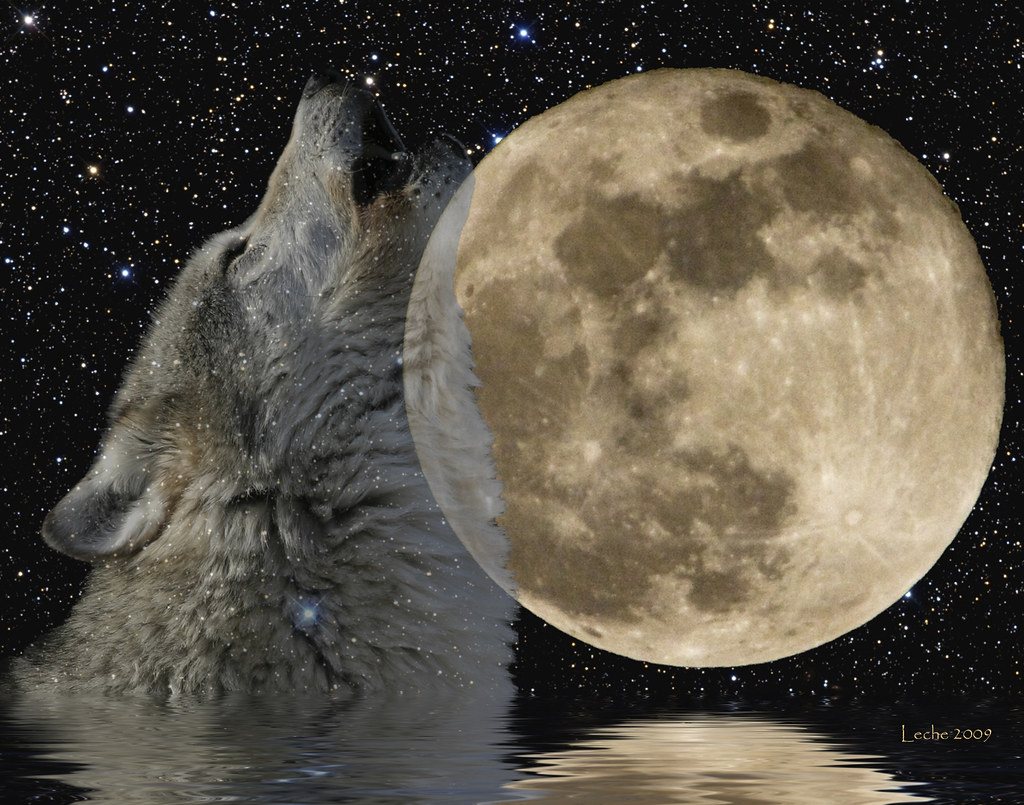
Photo: “Full ‘Wolf’ Moon – January 22, 2008” by Rick Leche is licensed under CC BY-NC-ND 2.0.
Melissa Balmain, ‘No Ifs, Ands, Or Bots’

Tradwife? No, thanks. I’m not the type you’ll find
exclaiming “Yippee!” “Yesiree!” or “YOLO!”
at thoughts of chores I might be doing solo –
especially the old-school kitchen kind.
Churn butter? Grow a sill of herbs? You’re kidding.
Give me boxed broth and Hellman’s mayonnaise
and sourdough I didn’t have to raise.
Give me technology that does my bidding.

Yet how I love to cook up verse from scratch:
to handpick thoughts I planted as a kernel
within the fertile pages of a journal,
add rhymes (a meaty or a salty batch),
then whip them into something that – although it
may stink at times – tastes vastly fresher than
the glop inside an algorithmic can
because you know it comes from me, Tradpoet.

*****

This poem was the lead poem in the latest Lighten Up Online (“LUPO”). Melissa Balmain writes: “Ironically, in the weeks since I wrote this poem, a health condition has forced me to do a lot more tradwifely stuff in the kitchen–making low-acid salad dressing, say. But I still refuse to churn butter.”

Melissa Balmain’s third poetry collection, Satan Talks to His Therapist, is available from Paul Dry Books (and from all the usual retail empires). Balmain is the editor-in-chief of Light, America’s longest-running journal of light verse, and has been a member of the University of Rochester’s English Department since 2010. She is a recovering mime.

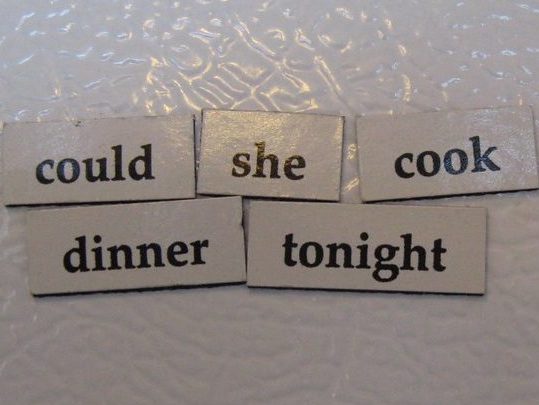
Photo: “could she cook” by aprilskiver is licensed under CC BY 2.0.

Sonnet: Sue Parman, ‘Kaizen: How to Build a Poem’

Ignore your hand and focus on the pen,
which writes without your knowledge of the whole.
Do not insert the personal. Avoid translation.
The changes made are small and gradual.

Commas herd their letters toward a distant
goal of rhymes and metaphors but do not
specify a conscious “I” or soul,
a bold new vision or a school of thought.

Write like a dancer making small mistakes.
What is wrong to you fulfills your friend’s desire.
Cuttings and shit are what it takes
to grow a garden from a funeral pyre.

A poet will die unless she learns to laugh.
Do not hit DELETE. Save everything as DRAFT.

*****

Sue Parman writes: “When I was four years old, my father asked me, ‘When is a door not a door?’ His answer, ‘when it’s ajar,’ infuriated and then intrigued me. I began to keep a journal in which I wrote down sentences such as, ‘If the Devil is evil, God is odd.’ Puns were my intro-duction to poetry, a form of verbal play that taught me that words, rather than being a lifeline to truth, could be slippery and contain many truths at the same time. One of my favorite poets is Kay Ryan, the queen of poetic puns (see her ‘Bestiary’). As an anthropologist, I consider them a vital contributor to mental health, since they satisfy the needs of large-brained mammals to avoid epilepsy by indulging in surprise.”

Sue Parman is an anthropologist and award-winning essayist, short story writer, poet, and playwright. She is the author of two poetry books, “The Thin Monster House” and “Carnivorous Gaze,” and her poems have been published in a variety of journals and anthologies, including the above poem in Rattle. She writes in a number of other genres as well, including anthropological travel memoirs and mysteries. Her most recent publications include a short story, “Gannets and Ghouls,” which appeared in the September/October 2024 issues of Ellery Queen Mystery Magazine; and a nonfiction essay, “You Can’t Get There from Here,” that was awarded the Travelers’ Tales Grand Prize for Best Travel Story of 2024. After teaching anthropology in California for thirty-five years, she moved to Oregon in search of water, and travels frequently in hopes of getting lost. https://www.sueparman.com

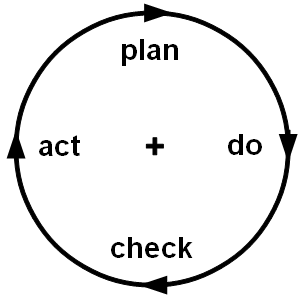
Photo: “PDCA-Cycle-Kaizen” by Tagimaguitar is licensed under CC BY-SA 3.0.

Non-traditional sonnet: Marcus Bales, ‘The Durable Rain’

The durable rain was conducting its drumming descent
Without any decent regard for the dawning of day
As if a dim evening was all of the morning it meant
To allow from a sun that was doing a landscape in grey.
Never begin with the weather the boffins have said.
If nature’s as stormy and dark as a novelist’s mind
The reader will sneer at the metaphor. Offer instead
A prose that’s so difficult readers are left far behind.
But back to my tale. Is it cozy inside, or does rain
Express what discursive description would talk past in vain?
Does a cry break a heart when the kettle releases its steam
Or, piping, awaken a lover up out of their dream?
What it will mean will depend on your context and age.
A poem exists in the reader and not on the page.

*****

Marcus Bales writes: “The first four lines rolled out without much trouble. I had let the dogs out after they’d woken me at what they thought was the right time but which to me was five in the a.m. It was cold and grey but not rainy at all. Who can figure how the brain works. I did worry briefly about the alliteration but finally put it off, hoping it would sound like rain on the roof. Sort of. And it seemed portentous and poetry-like, but where to go from that?

“I don’t know where I first heard that you’re not supposed to open with the weather. It sounds like one of those pieces of advice the internet kicks up from time to time purportedly by Elmore Leonard, along the lines of “You know those parts that readers skip over? Don’t write those.” Or “You got to know when to hold ‘em and know when to fold ‘em.” Advice that is absolutely both spot-on and worthless at one and the same time. If you know you don’t need any advice; if you need advice, it’s because you don’t know. It makes sense in that maddening way of all advice, but it is untakeable. However much you may agree that the reader doesn’t care what the weather is, they care what happens and who it happens to, there I still was without anyone there to have something happen to, except the damn rain.

“Sitting at breakfast reading my usual dollop of Wodehouse, I noticed that when things are going well for his characters the weather gets some generous play, and when not, not. Then I reflected that really I don’t have a large supply of written descriptions of the weather from anywhere. There’s ‘Neutral Tones’, of course, where the weather is a metaphor for the breaking relationship, and “Nothing that is not there and the nothing that is.” And ‘Stopping By Woods’ where the weather is the reason for the stopping, or the first lines of ‘Journey of the Magi’. There’s Auden’s ‘In Memory of Yeats’, Housman’s cherries hung like snow, if that even works, though who Snow was and how Housman knew is a mystery. And after that it’s vague references to this or that month or season generally in Keats, Poe, Byron, or Shelley, and the inference that all of Yeats happens in the summer what with swans and people fighting the horses of the sea, and all. And finally, again, all those descriptions of the morning in the Blandings and the golf stories. After that my memory starts to flail about. This isn’t the sort of thing where research is indicated at five in the ack emma. Perhaps you remember more examples of how the weather is used in prose and poetry, but it’s too late now, isn’t it.

“I wasn’t sure how to go on. It seemed as if nearly the whole practice of poetry in English was against me, aside from the sub-genre of song with all those deep and crisp and evens, and sleigh rides that began to echo in the back of my head, along with all those singers who seem to be perpetually crying or dancing or walking in the rain. Then I thought well, why not use that? I might get three or four lines out of it, and then maybe something else would occur to me. Well, I got my four lines and arrived at the volta of the sonnet, if sonnet it turned out to be. What now?

“Turning at the question that had stopped me I trod upon that patch for a few lines, and then I had got to the couplet. Well, I really had nothing, did I, among all this meta- bit, and what I had seemed to call for some digging into the whats and whys of how literature worked. Well, of course no one knows. I worried some about having failed to provide any context for the reader to see me through, and put it aside to eat breakfast.

“After that, and a shower, and a bit of humor watching the dogs return to the scene of the five o’clock crime outside to chase a squirrel in the yard, somehow the notion of context reasserted itself, and I remembered a sort of juicy quote from a professor 50 years ago who was gassing on about how a poem isn’t the sounds or the words or the meanings as the poet meant them, but rather the unpredicatable ways that the people misread poems. I recall he had half a dozen examples right to hand, as scholars so annoyingly seem to do, but I couldn’t bring a single one to mind. Fortunately, I’m a poet, not a scholar, so I don’t have to be able to give good – or any – examples, so I decided to steal his assertion and let it go at that.

“And there it is. A complete mishmash of false starts, interrupted middles, and squishy endings. Enjoy!”

Not much is known about Marcus Bales except that he lives and works in Cleveland, Ohio, and that his work has not been published in Poetry or The New Yorker. However his ‘51 Poems‘ is available from Amazon. He has been published in several of the Potcake Chapbooks (‘Form in Formless Times’).

Photo: “Rainy Day” by SammCox is licensed under CC BY-NC-ND 2.0.