Our mother was a mousetrap under the stairs. She used as bait the things she never said. We’d hear a snap and find three silver hairs in an old passport, pinned like something dead.
Our father was an occupying force in a town of collaborators. Good behavior meant not signaling in morse enemy troops camped in a distant wood.
Our parents paced—her mind a radio playing the classic dirges until dawn, his heart a spider web spun in the snow catching the dusk sun before it was gone.
For supper, they would feed us each a crumb of moonlight. Our house was a moving train. Evenings they danced in a delirium of silence, drunk on a thimbleful of rain.
*****
Morri Creech writes: “I don’t really have comments for this poem. The first line came to me, and the rest of the poem found its way as I continued to search for context to support that sentence. I didn’t know what I was going to say until I was saying it.”
Morri Creech is the author of five collections of poetry: Paper Cathedrals (Kent State U P, 2001), which received the Stan and Tom Wick Poetry Prize; Field Knowledge (Waywiser, 2006), which received the Anthony Hecht Poetry prize and was nominated for both the Los Angeles Times Book Prize and the Poet’s Prize; The Sleep of Reason (Waywiser, March 2013), a finalist for the 2014 Pulitzer Prize; Blue Rooms (Waywiser, October 2018); and, most recently, The Sentence (LSUP, September 2023). A recipient of NEA and Ruth Lilly Fellowships, as well as grants from the North Carolina and Louisiana Arts councils, he is the Writer in Residence at Queens University of Charlotte, where he teaches courses in both the undergraduate creative writing program and in the low residency M.F.A. program. He lives in Charlotte, North Carolina with the novelist Sarah Creech.
One limped a little, and another had a stammer, one was cross-eyed, swarthy, and employed atrocious grammar; so we beat them with a pipe, and then a club, and then a plier, bending them like pretzels after binding them with wire, sending trite condolences with tappings of a hammer.
One was far too clever, another drolly thick, one was hyper, one disfigured by a nervous tic; so we beat them with a tire iron, then aimed a rolling pin at tender ribs, boxed their ears, and kicked them in the shin, pretending we were sorry while we plied the heavy stick.
A fear of heights gripped one; one lived in mother’s cellar; one, depressed, developed gout and had a pasty pallor; so we beat them in a mixing bowl till minds were scrambled eggs, safe and snug at home because we’d manacled their legs, and lent our ears but didn’t hear their squalls amid the squalor.
One ignored the hoi polloi as they were mouthing curses, one kept her nose in books and mumbled antiquated verses; so we beat them with the crucifix, an ankh, and shepherd’s crooks, painted them like prison walls and hoisted them on hooks, and pent them on their merry way in gilded, garish hearses:
and when they got to heaven with its lovely rolling beaches, their uniforms restarched and blanched to white with holy bleaches, we beat them with a lightning rod, the hand of God, and thunder, for only strikes against the flint can spark a soul to wonder. There is no balm in Gilead but serpent oil and leeches.
*****
Ed Shacklee writes: “Trying to write poetry comes from reading the poems of others aloud, I think. It doesn’t seem to matter if you’re smart or eloquent, or not. I started mumbling to myself sometime after coming across William Meredith’s The Wreck of the Thresher, in which a poem ends, ‘There’s flowering, there’s a dark question answered yes.’ I can’t reproduce the experience here, and I doubt anyone can unless they’re as immature, unlettered, and blue as I was back then, but that resonated; the unspoken question that could be any question, the modest, unconditional yes, and the sudden flowering of that line. It shook something till it was almost awake. Arise and walk, I guess you could say. A while later I heard Meredith give a reading, and I regret that I was too tongue-tied in his presence to go up and thank him.”
The greatest courage is not needed for war, but for ordinary people growing old. Like soldiers, the aged are never very far from death: many are called, all are chosen. A soldier faces danger then retreats, but for the old, going back is not possible; they may hunger for youth but pray for the luck of a quick death. When one by one the body’s systems fail, they must be brave and face annihilation of the flesh and bone, the Soul clinging like a shipwrecked sailor, to love; finally, love is all we are given to navigate between exhaustion and heaven.
*****
Red Hawk writes: “What inspired this poem is the School of Hard Knocks, surviving on Earth for 83 years, observing the chaos and madness of the human species, 45 years of self observation to see my own inner chaos & madness, and the Objectively Clear understanding that we all die, we all pay for our emanations, our lives, and finally there is the revelation that all & everything is the Love of Our Creator (whatever that is) & we are how that Love manifests in human form; the Love of Our Creator manifests disguised as our life. Following that, the chaos & madness which that Love takes in human beings is the result of it passing through the human mind & being corrupted and perverted by that screening process. Absent the interference of the ego structure, that Love manifests cleanly, clearly, and without judgment.
“The sonnet form is one of my favorite poetry disciplines & owes much to Shakespeare, Keats, & Edna St. V. Millay! Being one given to speaking too much & too often, this discipline has been a tremendous ally in taming that compulsion & mastering the tongue. Rhyme, though not in favor just now, is another tremendous discipline: it opens the gateway to the unknown—I may begin with a plan or an idea, but the demands of the rhyme send me at once into unknown territory: I don’t know what or how will come next to satisfy the demand of the rhyme and now I am subject to intuition & inspiration, the opening to the Divine.
“Red Hawk (aka Robert Moore) is not an Indian name, nor was it ever intended to be one or pretend to be one; it is an Earth name, given by Mother Earth many years ago after a 4-day water fast at the Buffalo River in an effort to save my life in one of the darkest periods of my life. Given to me during one of the worst ice storms in recent Arkansas history, it was given as an answer to prayer. It came about through conscious labor, prayer and wish, and was paid for by intentional suffering and remorse. It indicates a deep love & reverence for the Earth and how it has shaped my life. It is an honoring of Conscience and of the source which named me: our Mother Earth. To not acknowledge Her gift would be to disrespect Her and Her power to name and direct the course of my life; I am Her legitimate son. As the illegitimate son of unknown parents, Robert Moore is my adopted name given to me by 2 people who died of alcoholism; I honor it and them by the way I live my life. You can google many of my books at Amazon, or find many of them at www.hohmpress.com. The book on self observation is now in 14 languages.”
‘Old Age Requires the Greatest Courage’ was first published in Rattle.
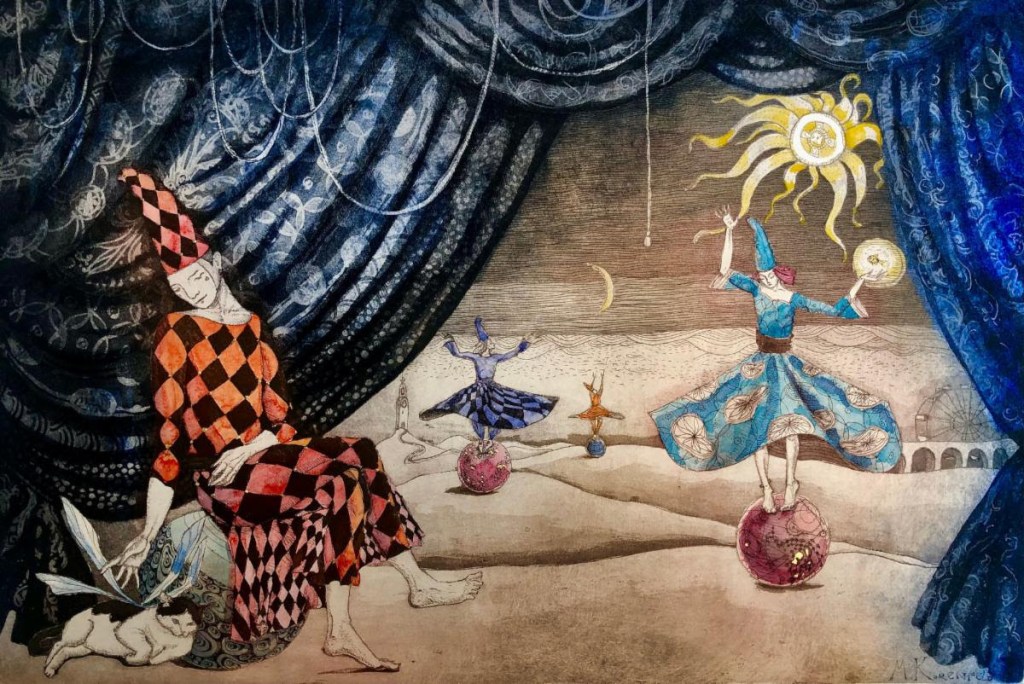
Each morning when you wake to put your armor on, remember this: all the world’s a spinning stage,
all the world’s a carnival— and though it doesn’t have your back or love the cover of your book
all the world’s a turning page. Just when you thought the minstrels, fools and dragon cats had lost their way
inside the inflammation age, they shed the husks of self defense and enter stage, not from the right
or from the left, but from behind. They sneak right up and inch ahead into the distance of your mind.
The sun will melt. The moon will find your part has not yet been assigned. You blink, and take your armor off.
The lights will blaze before they dim. It’s not a sham. It’s not a con. The curtain falls. Show must go on.
*****
The illustration is ‘Not Dancing’ by Marina Korenfeld, and was the subject of Rattle’s Ekphrastic Challenge, February 2026. Wendy Videlock’s response, ‘Before You Put Your Armor On’, was selected as the Rattle Editor’s Choice.
Wendy Videlock lives on the Western Slope of the Colorado Rockies. Her work appears widely and her books are available wherever books are sold. Her upcoming book, Desert Kin, will appear in August, 2026.
The sign. The side door. Come inside. We’re here by nine or ten. She sobbed. Pack extra peas. The dealer robbed His boss. No soups. They need a ride
To get their tags. Some coffee too. He’s had a stroke. It’s just a sprain. She can’t mow lawns for all the rain. She’s starved, but not for food. She’s blue
But cackles. Eggs. A constant cough. No chicken. You apologize: We don’t have diapers in that size. We’ll pay before they cut you off
And let you freeze. Her son’s on pills And so’s the wife. For seven weeks They’ll keep the kids. His engine leaks. She’s out of propane. Bring the bills
But come by five. Her swollen knees Are healing slow. His wife dropped dead On Christmas. Have some frozen bread, A bladder wash, a bag of cheese,
A pack of chocolate shakes, a pound Of venison, a protein bar, A couple sleeping in their car, A case of noodles, barren ground
On farmhands’ faces, cracked and worn. When silence falls, go find a shelf, Collect your neighbors as yourself And stack them up, like cans of corn.
*****
Jeff Sypeck writes: “Usually I write about history, and my poetry tends to focus on the past, but sometimes the here and now come calling, with tough and immediate needs.”
Jeff Sypeck is the author of the pop-history book Becoming Charlemagne and co-author of I Have Started for Canaan, the first full-length history of a Reconstruction-era African American community in Maryland. His latest book is an annotated, peer-reviewed translation of a Carolingian calendar poem. He lives in an agricultural reserve an hour outside Washington, D.C. www.jeffsypeck.com www.quidplura.com
You can almost see Vincent Price, black-robed, hunched above the console of a jumbo organ in the bowels of his creaky haunted manse; or maybe a stadium of damned souls, strobed in lurid red and howling nettle-robed as they plummet into Pandemonium, pore and pith aflame. It’s no troubadour, undoubtedly, this vast atonal gob.
As with the Roach Motel, we’d check in, but never out—us or anything, since it can swallow errant planets whole, and still, however much the mass, can’t eat its fill. Though it’s larger far than Jupiter or Mars, we can barely see it, thank our lucky stars.
*****
William Trowbridge writes in Rattle, where this poem was published: “I’ve spent most of my years as a poet writing free verse, though lately I find myself turning toward form. Unlike those who see formalist verse as dry and effete, I find it can generate power by means of barriers to play against—‘the net’ as Frost put it, by which he also meant boundary lines. If you pour gunpowder in a pile and light it, a mere flash occurs. But pack it tightly into a container, and you can get something more powerful. And, as opposed to the notion that form is restrictive, I agree with Richard Wilbur that it often liberates one from choosing the easy word in order to discover the better, surprising one. I haven’t moved into this part of town yet, but I stop there more and more.”
William Trowbridge’s tenth poetry collection, Father and Son, was published by Wayne State College Press Press in April. His poems have appeared in more than 45 anthologies and textbooks, as well as on The Writer’s Almanac, AnAmerican Life in Poetry, and in such periodicals as Poetry, The Gettysburg Review, The Georgia Review, The Southern Review, Plume, Rattle, The Iowa Review, Prairie Schooner, Epoch, and New Letters. He is a mentor in the University of Nebraska-Omaha Low-residency MFA in Writing Program and was Poet Laureate of Missouri from 2012 to 2016. For more information, see his website, williamtrowbridge.net.
Poems used to rhyme. In time, the couplets were dispensed. Incensed, today’s poet rebels from rhyming schemes, It seems. The writer, newly shedding the shackles of quatrains, Refrains from even a modicum of lilt.
And built now from unpaired diphthongs, His songs have lost a measure of glue. It’s true. No longer does the ear delight In flight of fancy, in teeter-totter, Like water on the endless sand, the to-and-fro, And no, this tide will not abate.
Of late, I find that poems no longer draw me in. They’re thin.
*****
Doc Mehl writes: “For the last two decades I’ve written rhyming western poetry, and I’ve performed both the poetry and my original western-themed music at cowboy poetry events in the western U.S. and Canada. I’ve recorded two spoken-word CDs of my rhyming poetry, and several CDs of my original music. I’m not averse to free verse. (OK, I must pause momentarily to savor the rhyme in that sentence.) Still, the author of a free verse poem ought to be able to convincingly answer this question: “Why do you maintain that this work should be categorized as poetry rather than prose?” In this poem (“Poems Used To Rhyme”), I liked the gamesmanship of sneaking the rhyming word of each “couplet” into the beginning of the second line rather than at the end of the second line. The resulting poem might first appear to be a tongue-in-cheek free verse poem about why rhyme is important. Still, the magic of the closely juxtaposed rhyming words can’t help but rise from the ether.”
Newly transplanted from Colorado to Black Diamond, Alberta, Al “Doc” Mehl traces his family roots to central Kansas, where his grandfather raised six children on the family homestead. His debut music CD is titled “Asphalt Cowboy,” and his second music CD titled “I’d Rather Be…” was released in 2008. Doc Mehl has also published a CD of original poetry titled “Cowboy Pottery,” and a second spoken-word poetry CD titled “The Great Divide,’ named 2013 “Cowboy Poetry CD of the Year” by both the Western Music Association and the Academy of Western Artists. In 2020, Doc published his first collection of poetry, “Good Medicine: Read Two Poems and Call Me in the Morning.” And in 2022, Doc released two new CDs of music, “West of the 22” and “Tried and True. Doc’s poems and musical lyrics have been featured on the website http://www.CowboyPoetry.com, he has been published in the poetry journal “Rattle,” and he was a first-place silver buckle winner at the National Cowboy Poetry Rodeo in Montrose, Colorado in 2009.
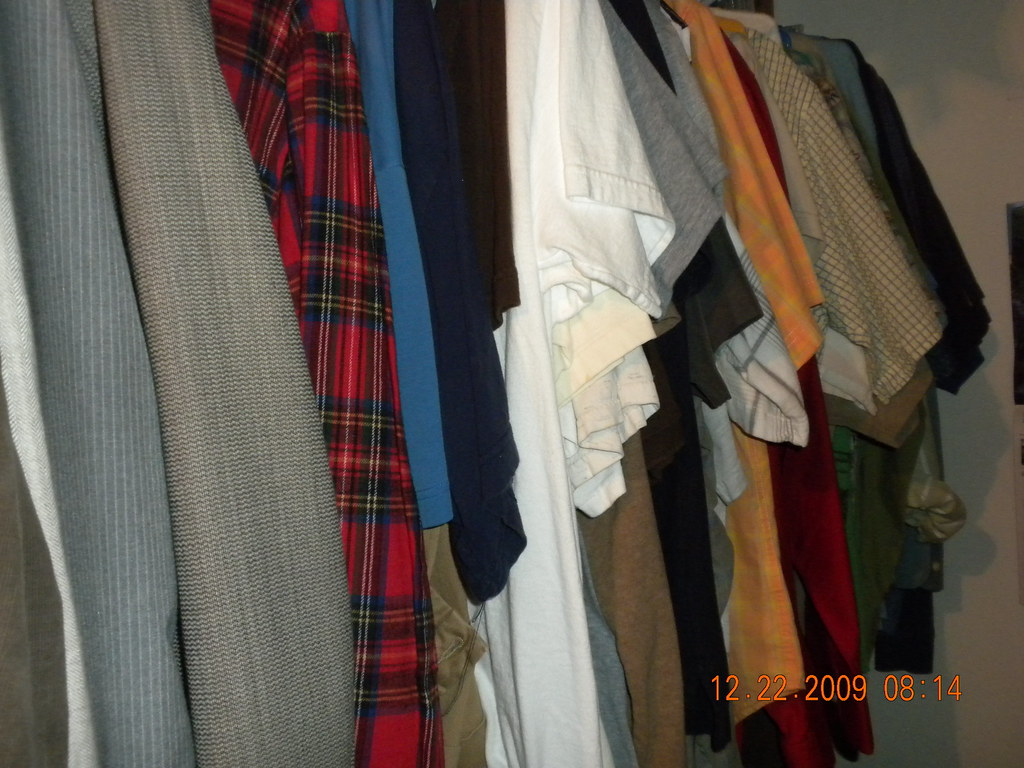
I remember you some mornings in the midst of getting dressed Surprised that I recall exactly when I wore you last
The paisley patterns spilling over sleeves The Nehru collars nobody believes … were popular The turtlenecks no turtle ever wore Those V-neck disco shirts that dance no more … Spectacular!
Are you lurking in the closet among other clothes I own? I gently touch your shoulder—a brief flash, then you’re gone
The concert souvenir shirts we outgrew The obligation gifts we always knew … were wrapped in haste Thick cotton plaids lost lumberjacks would covet That college T tossed out, but how we loved it … still, such a waste
You promised transformation, but what else did you require The full ensemble led us toward transcendence or desire (Attire of another age, accessories all the rage)
Bell-bottom flares that took flight as we walked Embroidered jeans so tight that people talked … of nothing else Those bomber jackets earthbound boomers froze in Those leather wristlets grunge guitar gods posed in … with death’s head belts
You folded in your fabric everyone I used to be Now that you’re gone, I realize I’m left with only me But if I run across you in some thrift shop bargain rack Or rummaging recycling bins, what else would you bring back? Who else will you bring back?
Some nights I see you in my dreams of places far away I’m wearing you as if I haven’t aged a single day Shirts of the distant past, shirts of the distant past
*****
Ned Balbo writes in Rattle #85, Fall 2024 (where you can hear the song performed): “I’ve played guitar since I was 5, keyboards since I was 13, and ukulele since I was 42, but my time as a ‘professional’ musician—someone paid to play—is scattershot and humble. Ice rinks, a Knights of Columbus Hall, a campers’ convention in Yaphank, a crowd of disco-loving retirees at Montauk’s Atlantic Terrace Motel, company picnics, school dances, private parties, and more—these were where I played guitar, sang, and devised versions of the Beatles, Bowie, et al. in two Long Island cover bands. The Crows’ Nest or Tiffany’s Wine-and-Cheese Café hosted noise-filled solo acoustic gigs, with more receptive listeners for original songs and covers of Elvis Costello or Eno at my undergrad college’s coffeehouse. More recently, I’ve written lyrics to Mark Osteen’s preexisting jazz scores (look for the Cold Spring Jazz Quartet on Spotify, Amazon, CDBaby, and elsewhere) and returned to solo songwriting and recording with ‘ned’s demos’ at Bandcamp. As a relic from the age when lyrics were sometimes scrutinized with poetry’s intensity, I listen closely to the sonics of language, whether sung or spoken, and look up to lyricists whose words come alive both aloud and on the page.”
Balbo: Robin, thanks for posting ‘Shirts from the Distant Past’, my little song-poem hybrid. I’ll be happy to answer any questions you have.
Editor: For myself, I see a continuum from womb heartbeat to dance to music to song to formal verse. I would love to have any additional comments on the subject in general, or on the creation of this poem in particular, related to these elements.
Balbo: I love what you’re saying about womb, heartbeat, and dance. A formative text for me is Donald Hall’s essay on poetic form’s psychic origins, ‘Goatfoot, Milktongue, Twinbird‘. You probably know it. Hall proposes three metaphors for poetry’s deepest sources: Goatfoot, the impulse toward dance, rhythm, movement; Milktongue, the pure pleasure of language, the texture of words when spoken; and Twinbird, our desire for form, symmetry, wholeness, which is complicated and energized by the contradictions it contains and reconciles. To me, Hall’s terms just sound like different ways of envisioning exactly what you’re talking about. They apply as much to song as they do to verse. The meter varies by stanza or section: iambic heptameter (seven iambs) in the couplet verses—not so different, after all, from the tetrameter to trimeter shifts we find in many ballads. The “shirts” title refrain, which doesn’t appear in print till the last line, are two trimeter phrases. It was fun to find surprising rhymes to hold the whole song together.
Editor: Regarding ‘Shirts’, quite apart from the charming idea, I like the work that has gone into the metre, rhyme, idiosyncratic structure.
Balbo: Thank you. I wrote and sung ‘Shirts’ as a poetic song lyric—one that could be read and enjoyed but, ideally, would be heard. I view its structure as that of a call-and-response song in traditional format. (In rock, for example, I think of George Harrison’s ‘Taxman’ with John and Paul harmonizing “Taxman, Mr. Wilson, Taxman, Mr. Heath” in answer George’s lead vocal.) In ‘Shirts’, the call-and-response comes from using the title as a refrain: it explains who the “you” is in each verse (when you hear it, anyway—I cut it from the visual text for fear it would seem repetitious without the music). Sometimes the title refrain answers a statement in the verse: “I gently touch your shoulder—a brief flash, then you’re gone” sounds like I might be talking (or singing) about a person, but it turns out to be those long-lost shirts—a playful fake-out.
Then there are the brief call-and-responses of the bridge sections which comment on the previous line or complete an unfinished thought: “Those V-neck disco shirts that dance no more…spectacular!” or “Embroidered jeans so tight that people talked…of nothing else.” They’re in iambic pentameter, with the second and fourth changing to heptameter if we count the two extra beats (set off on their own line) answering them.
The so-called “middle 8” (usually eight bars used to break up the verse-chorus/verse-chorus model) is delayed till just before the end: “You folded in your fabric everyone I used to be, etc.” That’s meant to set up the payoff: it’s not the shirts but our lost selves— along with loved ones, lost ones, everyone—we’re missing or mourning. But writing or singing about shirts—clothing that shapes and defines us—makes the lyric less depressing, leavens it with wit (I hope) so that what’s more poignant comes at the very end where more dramatic music can counterbalance the mood—the contradictions reconciled, as Donald Hall might have put it.
Of course, the very end is quieter – wistful again.
As I mentioned in Rattle (thanks again to Tim Green for giving both words and music a home), I grew up in the era when lyrics were often analyzed as seriously as poetry (and not just by undergraduates in long-ago dorm rooms under black light posters). Whether I’m writing poetry or songs, I listen closely to the different ways words sound—what works when sung doesn’t always work as well when spoken or encountered on the page—so when I do write lyrics, I try to make them both readable and singable.
Poems and song lyrics operate differently, but there’s lots of overlap between them. I wanted ‘Shirts’ to operate on both levels, even if it tilts more toward song lyric than poem.
*****
Ned Balbo’s six books include The Cylburn Touch-Me-Nots (New Criterion Prize), 3 Nights of the Perseids (Richard Wilbur Award), Lives of the Sleepers (Ernest Sandeen Prize), and The Trials of Edgar Poe and Other Poems (Donald Justice Prize and the Poets’ Prize). He’s received grants or fellowships from the National Endowment for the Arts (translation), the Maryland Arts Council, and the Mid Atlantic Arts Foundation. Balbo has taught at Iowa State University’s MFA program in creative writing and environment and, recently, the Frost Farm and West Chester University poetry conferences. His work appears in Contemporary Catholic Poetry (Paraclete Press), with new poems out or forthcoming in Able Muse, The Common, Interim, Notre Dame Review, and elsewhere. He is married to poet and essayist Jane Satterfield.
Ignore your hand and focus on the pen, which writes without your knowledge of the whole. Do not insert the personal. Avoid translation. The changes made are small and gradual.
Commas herd their letters toward a distant goal of rhymes and metaphors but do not specify a conscious “I” or soul, a bold new vision or a school of thought.
Write like a dancer making small mistakes. What is wrong to you fulfills your friend’s desire. Cuttings and shit are what it takes to grow a garden from a funeral pyre.
A poet will die unless she learns to laugh. Do not hit DELETE. Save everything as DRAFT.
*****
Sue Parman writes: “When I was four years old, my father asked me, ‘When is a door not a door?’ His answer, ‘when it’s ajar,’ infuriated and then intrigued me. I began to keep a journal in which I wrote down sentences such as, ‘If the Devil is evil, God is odd.’ Puns were my intro-duction to poetry, a form of verbal play that taught me that words, rather than being a lifeline to truth, could be slippery and contain many truths at the same time. One of my favorite poets is Kay Ryan, the queen of poetic puns (see her ‘Bestiary’). As an anthropologist, I consider them a vital contributor to mental health, since they satisfy the needs of large-brained mammals to avoid epilepsy by indulging in surprise.”
Sue Parman is an anthropologist and award-winning essayist, short story writer, poet, and playwright. She is the author of two poetry books, “The Thin Monster House” and “Carnivorous Gaze,” and her poems have been published in a variety of journals and anthologies, including the above poem in Rattle. She writes in a number of other genres as well, including anthropological travel memoirs and mysteries. Her most recent publications include a short story, “Gannets and Ghouls,” which appeared in the September/October 2024 issues of Ellery Queen Mystery Magazine; and a nonfiction essay, “You Can’t Get There from Here,” that was awarded the Travelers’ Tales Grand Prize for Best Travel Story of 2024. After teaching anthropology in California for thirty-five years, she moved to Oregon in search of water, and travels frequently in hopes of getting lost. https://www.sueparman.com
Those daffodils that I recall While lying on a bed settee Are faded now, their petals fall In nature and in memory.
It’s time to rise, to go outside And head off for a subway ride. I’m in New York’s YMCA Undressing for a midday swim;
A poet could not but be gay With bodies toned up in the gym. But I am getting no cheap thrills From dongs like dangling daffodils.
I twinkled at the twinkies there Tossing their heads in sprightly dance Or heading for the sauna where I might get lucky if, by chance,
One of the bronzed and buffed young men Is eager for my fountain pen. But, sadly, no one needs to hear This exiled poet strut his stuff.
I am an old Romantic queer, Ignored, unloved. I’ve had enough. I join the hustling New York crowd And wander lonely as a cloud.
*****
Conor Kelly writes: “Daffodils was submitted as a prompt poem to Rattle (https://www.rattle.com) and was printed in the Summer 2024 issue of the magazine. The prompt was to continue where another poem left off. So I disturbed Wordsworth on the couch where he lay remembering daffodils and sent him on his gay way to modern New York where he had some dubious adventures. I kept the stanzaic form, the metre, the rhyme scheme and even some of the original lines. I left him where he began, wandering lonely as that singular cloud.”
Conor Kelly was born in Dublin and spent his adult life teaching in a school in the city. He now lives in Western Shore, Nova Scotia from where he runs his twitter (X) site, @poemtoday, dedicated to the short poem. He has had poems printed in Irish, British, American, Canadian and Mexican magazines. He was shortlisted for a Hennessy New Irish Writers award. At the ceremony one of the judges, Fay Weldon, asked him, “Where are you in these poems?” He is still asking himself that same question.