Hogamus, higamus,
Man is polygamous;
Higamus, hogamus,
Woman’s monogamous.
I’m going to go out on a limb here and say this is American anthropologist Margaret Mead‘s creation. I have a clear memory of reading the story many years ago, probably in ‘Male and Female’, of her waking up in the middle of the night with an understanding of the secret of the universe. She grabbed the pencil and paper she kept by her bedside and wrote it down, then went back to the sleep. And in the morning she found she had written the above verse.
I was so certain it was Margaret Mead that I began this blog post about her before trying to check which book the verse came from and if I had the wording correct. (I last read Mead decades ago, and I leave beyond the reach of bookstores and real libraries.) To my frustration, all I can find in Google is attribution to William James, Dorothy Parker, Ogden Nash, Bertrand Russell, Alice Duer Miller… and Mrs. Amos Pinchot, who allegedly denied authorship. According to Quote Investigator, “The first known evidence of this unusual anecdote appeared in the Cleveland Plain Dealer newspaper in November 1939. The article ‘Thanksgiving Nightmare’ by Claire MacMurray (…) presented a supposed episode in the mental life of a person named Mrs. Amos Pinchot”, and tells the tale as I remember it. Mead’s ‘Male and Female’ came out in 1949, so (if the poem was in that book) it may have been referring to the Pinchot story, or it may have been something that had happened more than ten years previously to Mead, and she had shared the story and it had spread by itself.
The poem itself is brief, witty, amusing. It is rhythmic, repetitive, well rhymed, very catchy. Those are all excellent qualities. As for the content, it seems very 20th century: it gives the impression of having broken out of the conventions of society and church, and to be saying that the two sexes have differing needs for propagating themselves successfully. It is also 20th century in being simplistic. Where does the concept of serial monogamy fall? How does the rhyme relate to the LGBTQ+ members of society? The verse is definitely not comprehensive enough for the 21st century. But Margaret Mead was a controversial opener of cans of worms in the early 20th century, and that is where this little poem came from. Her obsession with gender roles and her self-deprecating humour make her a good candidate for its author.
And where the poem came from, apparently, was a communication from the unconscious, a gift to the dreamer. Always respect and preserve what the Muse offers you – who knows, a couple of lines of verse may be treasured and quoted for a hundred years!
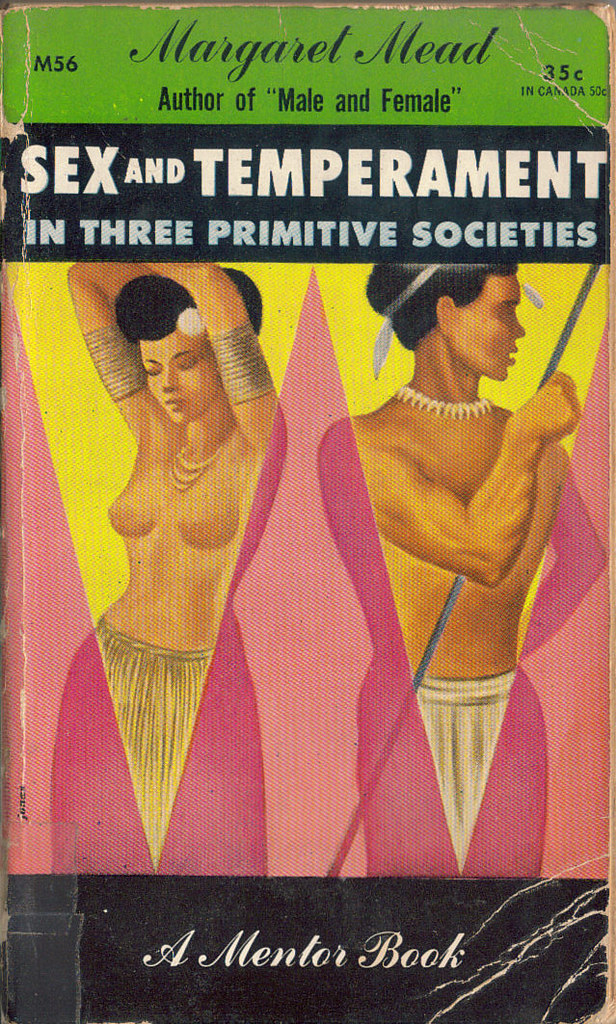
“Sex and Temperament in three primitive societies” by your neighborhood librarian is licensed under CC BY-NC-SA 2.0


I’ve seen it attributed to Gertrude Stein, too, which is too good to be correct either…
LikeLiked by 1 person
I have it in a book of poems by Dorothy Parker, a NY poet & writer known for her sarcastic wit.
LikeLiked by 1 person
I was so sure I’d read the story in Margaret Mead… but I can’t find it and, decades later, who knows. I could have been reading both at the same time and conflated them; but it fits my image of Mead.
LikeLiked by 2 people
Mead would somehow fit. I first heard it attributed to William James, which just seems a wee bit our of character…
LikeLiked by 1 person
I was told it was William James – he took mescalin or similar and had a trip. When he awoke he was sure he had written something profound but was disappointed to see this was the sum of it.
LikeLiked by 1 person
Despite the genuinely funny stories, I’m a strong advocate of making the effort to write down whatever words come to you in the middle of the night. Not necessarily profound, but a touchpoint with your subconscious, and often the start of something larger and more coherent.
LikeLiked by 1 person
john d macdonald used that in one of his travis mcgee series books
LikeLiked by 1 person
My mother told me this story about 70 years ago. I don’t remember to whom she attributed it, but the “poem” popped into my head today for the first time in seven decades. It was absurd, I thought, that I was remembering it correctly or that this bit of doggerel would have survived to have a life on the internet. But I was wrong on both counts, and you made my day.
LikeLiked by 1 person
Verse – meaning rhythm and rhyme – are the best tricks for remembering exactly over the decades!
LikeLiked by 1 person
My understanding is that William James dreamed it, wrote it down, and went back to sleep, confident that he had thought of the ultimate explanation for the human condition. When he awoke in the morning and read it, he was very disappointed.
LikeLiked by 1 person