Monthly Archives: January 2022

Potcake Poet’s Choice: Michael R. Burch, ‘Bible Libel’

If God
is good,
half the Bible
is libel.

Michael R. Burch writes: “This may be the first poem I wrote. I read the Bible from cover to cover at age 11, and it was a traumatic experience. But I can’t remember if I wrote the epigram then, or came up with it later. In any case, it was probably written between age 11 and 13, or thereabouts. It would be kinda cool to be remembered by a poem I wrote at such an early age. Plus, it’s short, so readers would probably finish it!

I have been using Google results to determine which of my poems are the most popular on the Internet. Some of my poems have gone viral, appearing on hundreds or thousands of web pages. That’s a lot of cutting and pasting, and I like to think people must like a poem in order to take the time to replicate it. This epigram, which I wrote around age 11 to 13, at one time returned over 405,000 results for the last two lines, and over 51,000 results for the entire poem. The last time I checked, it still returned over 292,000 results. I was especially pleased to see one of the first poems I wrote, and possibly the first, go viral. If I wrote anything earlier, I don’t remember it.

Michael R. Burch has over 6,000 publications, including poems that have gone viral. His poems have been translated into fourteen languages, incorporated into three plays and two operas, and set to music by seventeen composers. He also edits TheHyperTexts.

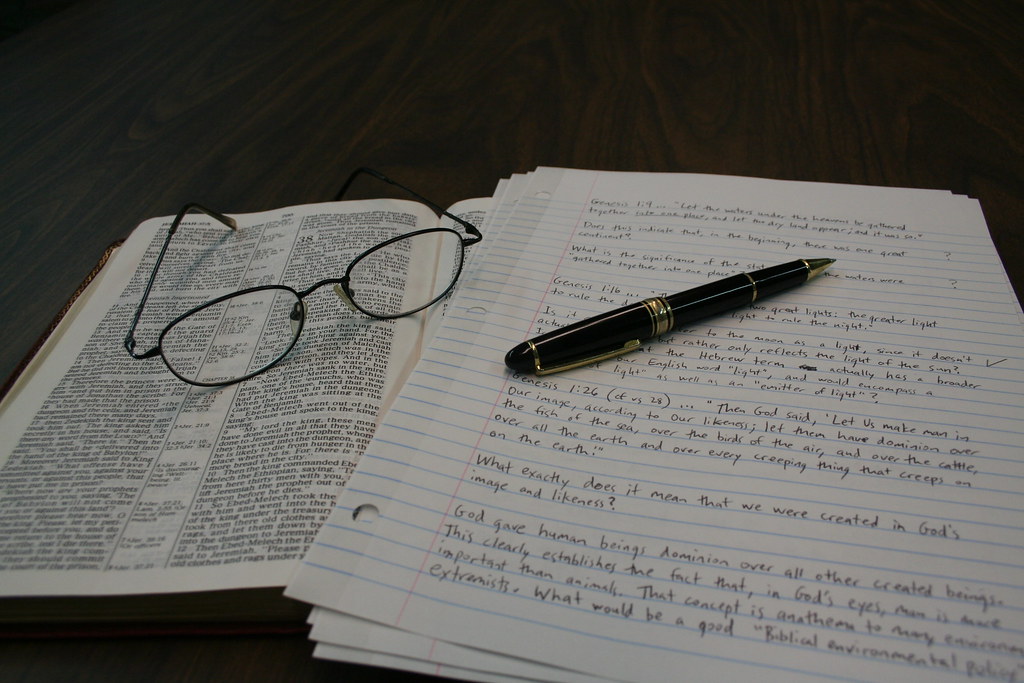
Photo: “Bible, Reading Glasses, Notes and Pen” by paul.orear is licensed under CC BY-SA 2.0

Poem on poetry: ‘Diatribe Against Unversed Poets’

Ignoring clockwork towns and fertile farms
Tied to the sun-swing as the seas to moon,
They searched for verse in deserts without rhyme,
Lifted erratic rocks nonrhythmically
In search of poetry, then through the slough
Of their emotions hunted for a trail:

“The scent is cold. Its Spirit must have fled;
The body of its work, though dead,
Has been translated to some higher plane.
Look how the world’s translated verse
Comes to us plain—why can’t we emulate?
Then if the words themselves are unimportant,
If poetry in essence is idea,
And song is wrong,
Rhyme a superfluous flamboyance
(Like colour in Van Gogh),
Rhythm a distraction to the memoring mind,
Then we determine poetry’s true form is mime!”

While in the air the deafening blare
Confounds their silence everywhere:
Before our hearts began to beat
We were conceived in rhythmic heat;
So, billions strong, we sing along
For all the time, in time, our time, the song
Goes rocking on in rhythmic rhyme. Rock on!

“Unversed” means “not experienced, skilled, or knowledgeable”. Poetry takes different forms in different languages, but the forms all have the same desirable outcome: to make it easier to memorise and recite word-for-word. Alliteration, assonance, rhyme, metre – these are all useful tools for achieving this, along with less tangible tools such as fresh or startling imagery. Metre/beat/rhythm is viscerally important to us, because the mother’s heartbeat is the background to sensory development in the womb, and our own heartbeat and breathing rhythms continue throughout life. As humans we drum, we dance, we sing, just as we walk and run rhythmically, tap our fingers rhythmically when we are bored, teach small children to clap and sing, teach older children clapping and skipping games. Rhythm is built into us from before birth.

Rhythmic poetry didn’t die when it almost stopped being publishable. It just went into folk songs, blues, rock, country-and-western, musicals, rap, hip hop… Popular music let teenagers and adults continue to thrive with what they were not given by schools: rhythm and rhyme. This drive to make words memorable and recitable is part of who we humans are. So schools do best when they leaven “creative self-expression” with getting kids to learn things by heart, and getting them to pay attention to the qualities that make it easy to memorise and recite.

Photo: “Lost in desert” by Rojs Rozentāls is licensed under CC BY-SA 2.0