Monthly Archives: November 2022

Odd poem: ‘The Naughty Preposition’ by Morris Bishop

I lately lost a preposition:
It hid, I thought, beneath my chair.
And angrily I cried: “Perdition!
Up from out of in under there!”

Correctness is my vade mecum,
And straggling phrases I abhor;
And yet I wondered: “What should he come
Up from out of in under for?”

*****

Morris Bishop had a high regard for light verse: “The aim of poetry, or Heavy Verse, is to seek understanding in forms of beauty. The aim of light verse is to promote misunderstanding in beauty’s cast-off clothes. But even misunderstanding is a kind of understanding; it is an analysis, an observation of truth, which sneaks around truth from the rear, which uncovers the lath and plaster of beauty’s hinder parts.”

Bishop was an acknowledged master of rhyme and meter, but that doesn’t imply that he would be limited by the grammatical restrictions of the apparently well-educated. He employed and enjoyed common speech.

Now this may sound strange coming from me, someone who writes a blog dedicated to the expansion of formal verse, but many “rules of grammar” are garbage. To me, correct speech is whatever unambiguously communicates what the speaker intended. This is naturally aided by the use of predictable patterns of word usage, because we are a pattern-recognition species, and this in turn leads to “rules”; but these rules are really only “commonly used patterns”.

Similarly the forms of traditional verse are there because they are useful: rhythm guides and builds emotion; rhyme, rhythm and wordplay all create engagement and help memorisation. The forms are neither arbitrary nor sacrosanct. The formality is purely useful (and part of its use is creating fun). Grammatical rules and formal verse have that in common.

Winston Churchill is often cited as the author of a scribbled comment on someone “correcting” his grammar: “This is the sort of nonsense up with which I will not put.” But that joke appears to predate his involvement with the issue: there is a lengthy discussion of it here in the Quote Investigator.

English has particularly confusing and contradictory rules because of the blending of several waves of Germanic speakers (Anglo-Saxons, followed by Danish invaders and later Dutch merchants) overrunning the British (i.e. Celtic speakers with their complicated auxiliary verbs: “How did you do that?”), in turn being overrun by French-speaking conquerors supported by Latin-speaking priests. (I recommend John McWhorter’s ‘Our Magnificent Bastard Tongue‘.) It was this latest ruling class that was averse to (among other things) ending a sentence with a preposition. But that’s a natural and correct part of speech for a Dane to end with.

And I’m an Anglo-Dane.

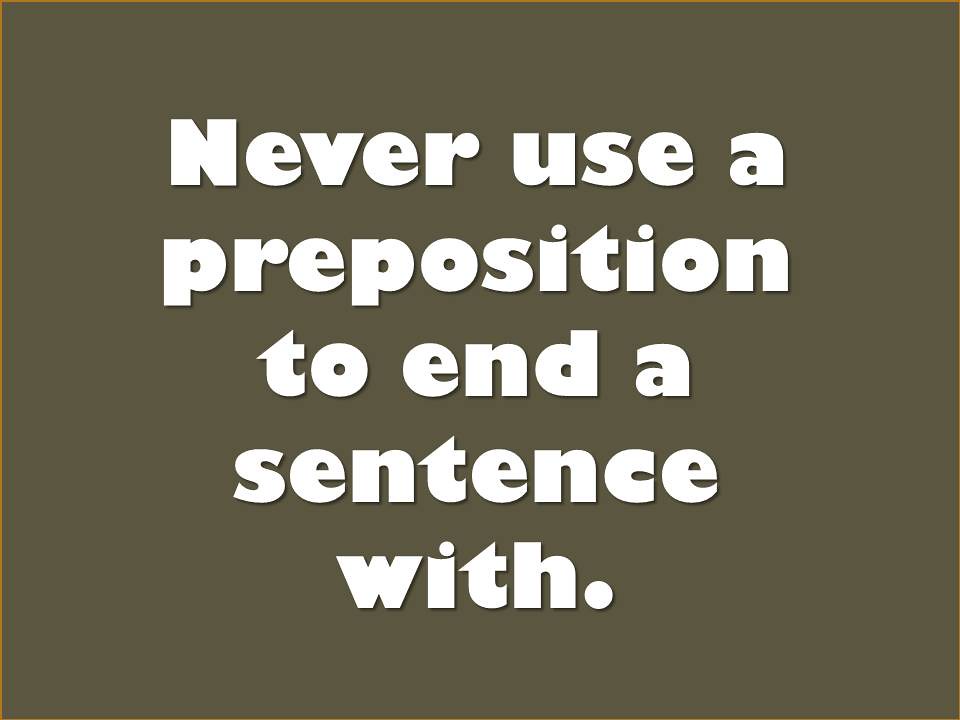
T-shirt Slogan: ‘Never use a preposition to end a sentence with.’” by Ken Whytock is licensed under CC BY-NC 2.0.

Political poem: Nina Parmenter, ‘Led by Donkeys’

Donkey, show me your big boy teeth,
show me expensive dentistry.
Mine are NHS wonky,
but you’re a donkey.

Donkey, show me your pearly hooves,
stomp them down on my two-bit shoes.
Mine are M&S clonky,
but you’re a donkey.

Donkey, show me your government car
driving to where the dollars are.
Mine is a wee bit shonky.
You’re still a donkey.

Donkey, show me your public school,
show me your passport to ruin us all.
You think it’s your right, but you’re wrong, see,
cos you’re a donkey.

*****

Nina Parmenter writes: “As the world looks on, bewildered, the political stupidity in the UK continues to know no bounds. The title of this poem is borrowed from a group of political activists – they, in turn, borrowed it from a First World War phrase describing British soldiers as ‘Lions led by donkeys’.

Today we have different threats – hunger, a declining health service, fuel poverty – but our leading class of donkeys remain seemingly blinkered to ordinary people’s welfare. Money, after all, is their master.

All this is build up to a rather silly poem in which donkey is proudly rhymed with wonky, clonky and shonky. A quick terminology guide for non-Brits: NHS = National Health Service, M&S = Marks and Spencer (a Very Ordinary Store), and ‘public school’ in the UK means a private school – no, don’t ask, I don’t understand why either. 😉”

Nina Parmenter has no time to write poetry, but does it anyway. Her work has appeared in Lighten Up Online, Snakeskin, Light, The New Verse News, Ink, Sweat & Tears, and the Potcake Chapbook ‘Houses and Homes Forever’. Her home, work and family are in Wiltshire.
https://ninaparmenter.com/

Photo: “Charming” by Another Seb is licensed under CC BY-NC-ND 2.0.

Julia Griffin: ‘Arachne’s Double’

We had a lot in common:
Grey eyes to stop and summon;
A taste for shifts and shuttles,
For instigating battles;
An aptitude for order,
A talent to embroider.
We kept ourselves in stitches;
We were each other’s matches.

As deity and woman,
We shared a kind of famine;
Vicarious in action,
Our work confined to fiction,
To woven elegiacs,
We craved our own heroics:
To beat our favourite heroes;
To share their blazing sorrows.

What have we now in common,
Besides not being human?
Only the understanding
Of what is past amending:
That all this endless weaving
Is just suspended living.
That loving is devouring.
That starving is enduring.

*****

Julia Griffin writes: “That appeared in Mezzo Cammin 14.2 (Winter, 2019). I’m pleased with it because I feel the form works with the subject-matter. It was inspired by a dear friend of mine, Candy Schille, who died tragically in November 2017: she was so quick and charismatic, and we had a sort of sparring relationship before we became friends.”

Julia Griffin lives in south-east Georgia/ south-east England. She has published in Light, LUPO, Mezzo Cammin, and some other places, though Poetry and The New Yorker indicate that they would rather publish Marcus Bales than her. Her poem ‘Wasp Waste’ was reprinted in the Potcake Chapbook ‘Robots and Rockets‘, and much more of her poetry can be found in Light, at https://lightpoetrymagazine.com/?s=julia+g&submit=Search

Photo: “Arachne” by J. Star is licensed under CC BY-NC-SA 2.0.