Monthly Archives: December 2023

Using form: Semi-formal: RHL, ‘Hunting’

The Osprey splashes, misses, and flies by
skimming the waves, rising, five yards away.
What’s its success rate? Does it care?
The Stingray searches, gliding, mouth to sand
five yards beyond the shallows where I stand.
Its Roomba-work’s its own affair.
The water splishes, burbles random rhythms.
The sun confuses, over-hot, then hidden.
The Oystercatcher calls. The Osprey rocks
on its branch in a casuarina,
flaps down-beach to another.
Along the margins of the shore, alone, each stalks.
They hunt for food
and I hunt them for what they mean, or could.

*****

There are elements of the sonnet about this semi-formal poem: it’s in iambics (though with uneven lengths of line); it has rhyme (though some only slant rhyme, and not patterned); it has 14 lines and a final couplet (though not with a clear volta where you would hope, after the 8th line). But I think the disjointed nature of the poem, its stop-and-go lines of different length, is suitable for the nature of the hunt: the searching, the sudden swoop, the pause, the restarting. In that sense the form is appropriate for the subject matter, and therefore good. It may be that I was too lazy to beat the whole thing into pentameters with a regular rhyme scheme… but it may also be that this was the right place to stop for this particular poem.

‘Hunting’ was originally published in Obsessed With Pipework, and has just been reprinted in Green Ink Poetry (motto: “We Welcome Chaos, Calamity, And The Natural World. Hope Punks & Witches” in their current collection with the theme of ‘Forage’.

Photo: “Osprey” by Mick Thompson1 is licensed under CC BY-NC 2.0.

Amit Majmudar, ‘To the Hyphenated Poets’

Richer than mother’s milk
is half-and-half.
Friends of two minds,
redouble your craft.

Our shelves our hives, our selves
a royal jelly,
may we at Benares and Boston,
Philly and Delhi

collect our birthright nectar.
No swarm our own,
we must be industrious, both
queen and drone.

Being two beings requires
a rage for rigor,
rewritable memory,
hybrid vigor.

English herself is a crossbred
mother mutt,
primly promiscuous
and hot to rut.

Oneness? Pure chimera.
Splendor is spliced.
Make your halves into something
twice your size,

your tongue a hyphen joining
nation to nation.
Recombine, become a thing
of your own creation,

a many-minded mongrel,
the line’s renewal,
self-made and twofold,
soul and dual.

*****

Editor’s comments: Being Anglo-Danish from birth and with the subsequent acquisition of other passports, I am naturally biased in favour of multiculturalism. It was interesting a couple of months ago to hear Britain’s Home Secretary Suella Braverman say “Multiculturalism has failed.” As one commentator noted, “She’s descended from Goan Indians from Mauritius and Kenya, married to a Jewish husband, and is in a senior cabinet position in a government headed by Britain’s first Hindu PM, himself the son of immigrants… Hello???” Suella Braverman left the cabinet shortly after.

Indians in particular, having been invaded and occupied by the Portuguese, French and British in the past couple of centuries, have used those connections to move out into the world – not just as entrepreneurs, but also in the arts, sciences… and politics. In mid-2023 the Prime Ministers of Ireland, Mauritius, Portugal and the UK, and the Presidents of Guyana, Mauritius, Seychelles, Singapore, Suriname and Trinidad & Tobago, all had Indian origins.

Amit Majmudar is a poet, novelist, essayist, translator, and the former first Poet Laureate of Ohio. He works as a diagnostic and nuclear radiologist and lives in Westerville, Ohio, with his wife and three children. He is the author of twenty books so far in a variety of categories, with different bodies of work published in the United States and in India.
His poetry collections include 0’, 0’ (Northwestern, 2009), shortlisted for the Norma Faber First Book Award, and Heaven and Earth (2011, Storyline Press), which won the Donald Justice Prize. These volumes were followed by Dothead (Knopf, 2016) and What He Did in Solitary (Knopf, 2020). His poems have won the Pushcart Prize and have appeared in the Norton Introduction to LiteratureThe New Yorker, and numerous Best American Poetry anthologies as well as journals and magazines across the United States, UK, India, and Australia. Majmudar also edited, at Knopf’s invitation, a political poetry anthology entitled Resistance, Rebellion, Life: 50 Poems Now.
One of Majmudar’s forthcoming volumes is a hybrid of prose, drama, and poetry, entitled Three Metamorphoses (Orison Books, 2024). A new poetry collection is forthcoming from Knopf in 2026.

For links to Majmudar’s Nonfiction, Fiction, Mythology and Translations, please see his website.

Photo by Ami Buch Majmudar.

Using form: Rondeau: Gail White, ‘Opera Rondeau’

And then she dies—since men are no damn good—
Mimi, consumptive and misunderstood,
or Desdemona, most defamed of brides—
the woman is abandoned on all sides—
she so believes in love (as women should)
and in the end she burns like firewood.

Here Tosca on the tower a moment stands,
first throwing back her hood and then her hands
and then one step—invisibly she flies—
and then she dies.

Poor Butterfly, who meant to be so good.
Tough Carmen, using all the wiles she could
to get her man. So many suicides,
so many murders. Violetta hides
but can’t escape—she’s found, she’s understood—
and then she dies.

*****

Gail White writes: “One of my favorites in my new book Paper Cuts is ‘Opera Rondeau’.  It was written after a friend pointed out to me that most summaries of opera plots could end with the words “then she dies.” Although the poem doesn’t conform perfectly to the rondeau rhyme scheme, it does provide the perfect refrain. And gives me a chance to mention a few of the many opera heroines who win, lose, or miss love altogether – and die.”

Gail White is the resident poet and cat lady of Breaux Bridge, Louisiana. Her books ASPERITY STREET and CATECHISM are available on Amazon. She is a contributing editor to Light Poetry Magazine. “Tourist in India” won the Howard Nemerov Sonnet Award for 2013. Her poems have appeared in the Potcake Chapbooks ‘Tourists and Cannibals’, ‘Rogues and Roses’, ‘Families and Other Fiascoes’, ‘Strip Down’ and ‘Lost Love’. ‘Opera Rondeau’ was first published in Mezzo Cammin and is collected in her new light verse chapbook, ‘Paper Cuts‘, also available on Amazon.

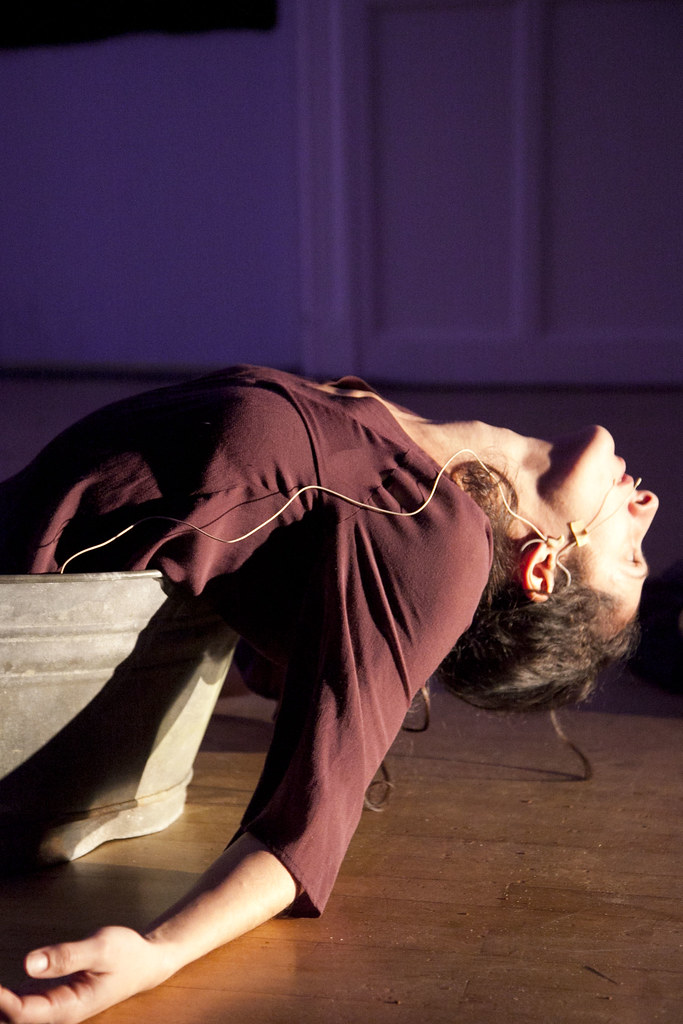
Photo: “Heroine – a female lament” by Yo! Opera is licensed under CC BY-NC-SA 2.0.