“One thing you must accept,” Said the butcher—”and I don’t intend this meanly: To live is to get divided up And to live well is to divide up cleanly.”
“One thought that made sense of things,” Said the baker—“perhaps even solved life’s riddle: To live is to harden in the heat And to live well is to stay soft in the middle.”
“One principle strikes me as ultimate,” Said the candlestick-maker—“if not downright holy: To live is to burn down And to live well is to burn down slowly.”
*****
Fergus Cullen writes: “These stanzas are about that state in which work comes to occupy one’s mind so utterly that one begins to see the rest of life through it. They do not make any statement on the subject: we just hear from some personalities living in this condition.I wanted contrast. On the one hand, the form is so light as to be barely there (speech rhythms in long lines, stanzas only pulled together by trite rhymes); and the characters originate in the world of nursery rhyme. On the other, these characters take on the biggest subject; and what they say may sound rueful, even bitter. It was certainly written that way; though, returning to it after some time, I see that it need not be read that way. This is one of two versions of the poem and was published in The Borough. I hope the other, rather different, shall appear soonish.”
Fergus Cullen is a postgraduate researcher in history at Queen Mary, University of London, and an occasional writer and translator of prose and verse.
The management has gauged how much you’ll take before you buckle or walk out. They care about your health—at least until you break, use up your sick leave, or require repair.
The management endorses your retiring early. They will help you out the door, so that they can economize by hiring fresh blood for half of what they paid before.
The management can’t monetize your gain in knowledge or experience. They doubt that anything you’d do if you remain could beat their savings if you’re shunted out.
They needn’t lay you off, just raise your stress through higher workloads and adverse conditions, until exhaustion, strain, and hopelessness force you to leave, fulfilling their ambitions.
*****
Susan McLean writes: “In my lifetime, I’ve worked in private businesses, government agencies, and academia; most of them abused or exploited workers at some level, which is not surprising when power relations are one-sided. However, I was most shocked by what happened when the business model was applied to education. Education suffers when students are treated as products to be turned out as cheaply as possible, and when teachers are treated as easily replaceable cogs in a machine. But the mistreatment of workers to increase profitability is widespread across many forms of employment, so I did not want to limit the poem’s relevance to the academic world.
“Over the thirty years that I taught at a state university, states reduced the amount they paid for public higher education, shifting the economic burden more and more to the students, and creating budget crises for the universities. In response, university administrators reduced their hiring of professors, often increasing class sizes dramatically, shifting teaching of many classes to ridiculously underpaid grad students or adjunct instructors with no job security, and shutting down departments in order to lay off tenured professors. Students were paying more and getting less; professors were overworked and fearful of losing their jobs at ages at which no one else would be likely to hire them; recent PhDs were unable to find teaching jobs with a livable wage or any prospect of long-term employment. Meanwhile, administrative jobs were burgeoning, adding more deans and assistant deans to bolster the status and shoulder the duties of those in charge.
“The stress and overwork that many professors experienced under the business model of higher education took a physical toll on many, with some disciplines suffering more than others. Those who had to spend endless hours at computers or grading papers tended to develop back pain and a host of other ailments common to sedentary jobs. When administrators offered incentives for them to accept early retirement, so that the university could save money by replacing them with lower-paid workers, many retired. I was one of them.
“This poem got its start when I noticed that “pain management” (usually associated with using analgesics or other methods to reduce pain) could also mean “management by means of pain.” It was published in New Verse Review.”
Susan McLean has two books of poetry, The Best Disguise and The Whetstone Misses the Knife, and one book of translations of Martial, Selected Epigrams. Her poems have appeared in Light, Lighten Up Online, Measure, Able Muse, and elsewhere. She lives in Iowa City, Iowa. https://www.pw.org/content/susan_mclean
She was the one who went off on her own. She was the one who filed for the divorce. You gave her what she wanted in due course. Still she will never leave your life alone.
Available through email more than phone, You have remained a favorite resource. She contacts you supposedly perforce, Less for herself than for a son long grown.
She seeks a certain something left behind, A sterling ladle or an antique chest, A recipe or record you must find. Your common past has yet to enter rest Since fire so often burns within her mind. For smoke fly’s sake, you try to do your best.
A native Virginian, Jane Blanchard lives and writes in Georgia. Her collections with Kelsay Books include Metes and Bounds (2023) and Furthermore (forthcoming, 2025).
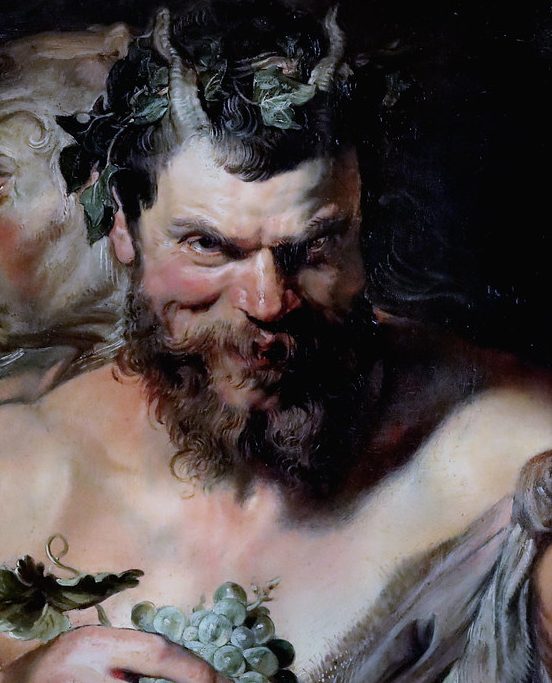
He looked at me as if I ought to know just who he was but I did not. I looked away, then so did he. Alas I didn’t recognize the Great God Pan in human form. I simply thought he was another man. I felt a warm gaze inviting me once more. I turned to see him changed. A God again, hooves and furry legs, horns grew. He gestured “Hey?” I was too dumbstruck to do more than stare. He shook his curls and sprinted off somewhere.
*****
Juleigh Howard-Hobson writes: “I wrote this when I lived off-grid on ten acres up in rural Washington State.The forest that made up half my property was dark and creepy. The Great God Pan was no more out of place than BigFoot or werewolves. All of which I imagined I saw/heard from time to time (I use italics as I am not absolutely convinced it was all imagination). Nothing out there ever hurt me, so all’s well that ends well–I’ve since moved back to civilization, which is far more frightening in many ways. As for the form–well, that just was how the poem decided to be.”
Juleigh Howard-Hobson’s work can be found in Think Journal, Able Muse, New Verse Review (including this poem), The Deadlands, Autumn Sky Poetry and other venues. She has been nominated for “The Best of the Net”, Pushcart, Elgin & Rhysling Awards. Her latest book is Curses, Black Spells & Hexes (Alien Buddha). A member of the HWA and the SFPA, she lives on the coast of the Pacific Northwest. In a poetically haunted house. X: poetforest
now we, the people, willingly obtuse and largely satisfied with self-abuse
elect a narcissistic psychopath who rules with lies, incompetence, and wrath;
accept a healthcare system that’s a mess and limp from life to death with less and less;
continue to dismiss without a care the shit we dump in water, land, and air;
allow the filthy rich to have their way, to run the world, to bleed us day by day;
abandon logic, reason, vital news and swallow whole all sorts of crackpot views —
we piss away our brains, our soul, our nerve and get the fucked up country we deserve
*****
Richard Meyer writes: “Current cultural and political circumstances have me feeling ornery, so I hammered out this verse about the great American democratic experiment. My caustic verse was partly inspired by the comments of various prominent writers throughout history, including Thomas Jefferson who said, “The government you elect is the government you deserve”.”
Richard Meyer, a former English and humanities teacher, lives in Mankato, MN. A book of his collected poems,Orbital Paths, was a silver medalist winner in the 2016 IBPA Benjamin Franklin Awards. He was awarded the 2012 Robert Frost Farm Prize for his poem “Fieldstone” and was the recipient of the 2014 String Poet Prize for his poem “The Autumn Way.” His poetry has appeared in a variety of print and online journals and has also received top honors several times in the Great River Shakespeare Festival sonnet contest. His most recent book, Wise Heart, is a memoir of his mother Gert who was born in poverty, came of age during the Great Depression, enlisted in the army during World War II, served overseas, and was awarded the Bronze Star for meritorious service performed during the Battle of the Bulge. His books are available through Amazon.
What, you haven’t heard of me, despite my art and stormy life? There’s much to tell of pride and bitterness, of bliss and hell— but not regret. I’ll fill my pen and write.
I was born a bastard. Maman worked, a laundress, while I’d roam Montmartre, spying through café and whorehouse doorways, trying to snitch some fruit or francs. I laughed and lurked. With lumps of coal I loved to draw on streets. Ditching convent school at puberty, I learned to earn my way. I felt free in circus work, curvaceous and petite and daring on the high trapeze, strong until I hurt my back—I fell headlong.
That set me back, but new work came along— also daring, deemed risqué—being painted, a model for men. Few were sainted . . . nor was I. I didn’t think it wrong to give a man some pleasure and to claim my own. For one artiste I posed unclad and soon became his favorite lover. I had his child, and kept my word: I didn’t name that man on papers with a ‘Father’ line and kept on working. Maman tended him, my son, Maurice Utrillo—a pseudonym so he would not be stigmatized by mine, that of the saucy urchin shedding clothes— and budding painter, watching men compose.
I watched the colors bloom as men composed. Toulouse-Lautrec’s hues, both somber and bright, would join or jar to make a mood just right. He’d talk of wealthy clients and gallery shows while I could study his techniques with paint. He studied me and loved my breasts, my hair, my thighs, my openness to him. I dared to love that rich midget with no restraint. When he refused to marry me, my feigned suicide didn’t change his mind. But what I learned while posing, I combined with my good eye, instinctive and untrained. I’d use my wits (and likely my libido) to paint in oils, with honesty my credo.
I painted nude women by my credo. When I showed Degas my work, he praised me with, “Madame, you’re one of us!” That raised my nerve; like those Montmartre men, I’d show my art—although I’d wish my name need not be printed next to ‘woman artist,’ a tag suggesting Other like a warning flag. I’m already Other in my lot as Bastard-with-a-Bastard history. Will I be known for art or just my life of scandal? I never stayed a bougeois wife, as two would always tangle into three; our pacts permitting infidelity could not prevent one partner’s jealousy.
His cryptic music vented jealousy; Eric Satie was moody, odd, hysteric— and amusing, in and out of bed. Eric and Paul Mousis loved me zealously and it was bound to chafe, our double link. Mousis was rich; Satie holed up in one squalid room. He slowly came undone without me to himself—he took to drink till drink took him. Maurice, by then eighteen, also drank. Since he was prone to rage and smashing things since an early age, Maman would feed him wine to calm such scenes. When briefly sober, it was to me he came— I treasured hearing Maman as my name.
Of course Maurice Utrillo made his name with me his mother-teacher and his Papa (I tell you now) Pierre-Auguste Renoir! Maurice was barely sane, but all the same, prolific and successful in his art. His painter colleague André, with brains and flair, had tireless desire in our affair; our turbulent trio could not live apart. With André as our agent, income flowed— I once took fifty children to the circus . . . Montmartre beggars crowded round to work us . . . we’d help out any artist friend who owed. The stream of money later dried to drought, but while it flowed I bloomed by giving out.
Too soon I knew my bloom was giving out— I missed men’s wide-eyed stares, their swiveled heads. André, still youthful, strayed to other beds; Maurice would drink or sit around and pout. We three unraveled into separate ways. Instead of painting nudes I painted flowers; they didn’t sell but brightened up the hours of living alone, inviting in malaise, till I found Gazi. This young, exotic man takes care of me and listens to my stories, roughly true—my slights, successes, glories. I’m seventy-two. I’ll end where I began, a bastard bitch whose art was bold and right. My pride and grit leave little room for spite.
*****
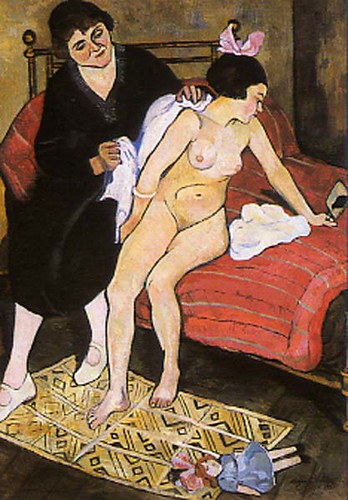
Here is what the judge for the 2024 Kim Bridgford Memorial Sonnet Contest wrote: Praise for the winning sonnet crown: Among a strong group of finalists, “Roughly True” distinguished itself across the board—in form, in voice, in message, in grace. After reading these seven sonnets in the voice of French painter Suzanne Valadon, I felt as if I had just taken short courses in poetic form, meter, rhyme, and art history, all expertly and candidly delivered by the fully realized persona of an accomplished, but overshadowed figure, one exquisitely resurrected here in verse. ~Dan Albergotti, Judge
Barbara Lydecker Crane writes: “I was surprised and thrilled to win this contest, and further pleased that the judge seemed to recognize the same strength of character in Suzanne Valadon that I did. The more I researched her life and work, the more I felt I actually knew this gritty woman a bit, despite our wildly different lives. As I get older I find I am more interested in writing about others than myself. My latest book, You Will Remember Me (Able Muse), is a collection of persona poems about portrait artists and their works. I am currently writing a new series of persona poems, this time about landscape artists and their works. This time, rather than writing all sonnets, each poem takes a different form; but all (so far) are in rhyme and meter. That seems fitting both for older times and for the craft and musicality I strive for, to befit the art that I hope to see with these poems one day, perhaps in a new book. And there is something about writing in form that, to me, is exactly like framing a picture. What a difference that makes; it says “completed,” and adds its own panache to the art.”


 Form in Formless Times