Tag Archives: wisdom

RHL, ‘Fifty Year Argument: Old Fool, Young Twit’

1. To Myself in Fifty Years Time

Old fool!  You really think yourself the same
As I who write to you, aged 22?
Ha!  All we’ve got in common is my name:
I’ll wear it out, throw it away,
You’ll pick it up some other day….
        But who are you?

My life’s before me; can you say the same?
I choose its how and why and when and who.
I’ll choose the rules by which we play the game;
I may choose wrong, it’s not denied,
But by my choice you must abide….
        What choice have you?

If, bored, I think one day to see the world
I pack that day and fly out on the next.
My choice to wander, or to sit home-curled;
Each place has friends, good fun, good food,
But you sit toothless, silent, rude….
        And undersexed!

Cares and regrets of loss can go to hell:
You sort them out with Reason’s time-worn tool.
Today’s superb; tomorrow looks as well:
The word “tomorrow” is a thrill,
I’ll make of mine just what I will….
        What’s yours, old fool?

2. Reply to Myself – Fifty Years Later

Young twit! You really think we’re not the same?
That means you’re too young to extrapolate.
You’re the mere seed of what I since became:
    a husband, father, game creator,
    global skills facilitator…
        well paid; thought great!

You claimed to thrive, renting some garbage heap;
you travelled: hitchhiked, froze, thought life’s a bitch,
and ate whatever you could find that’s cheap;
    I travel too, and I eat well,
    and choose to sleep in a hotel…
        not in a ditch!

Your search for happiness was excellent;
you lived with several countries, faiths and girls,
though little lasted from those years you spent;
    for when you can’t tell love from lust
    and never work out who to trust…
        of course life whirls!

Your limited perspective proved a sham.
Your rude invective, though a load of shit,
helped fertilise my growth to what I am.
        My resumé –kids raised, loves gained,
        a business built –shows much attained…
            what’s yours, young twit?

*****

I was proud of the form I created when I wrote the first bratty poem, with both the rhyme scheme (abaccb) and the lines getting shorter (3 pentameter, 2 tetrameter, and a dimeter) contributing to the effect of each stanza ending with a punchline. But after I wrote that first poem to my future self at age 22, I was nagged by the need to respond as I got older; and I was never able to produce anything I liked. Finally, a full 50 years later, I produced the 72-year-old’s point by point rebuttal in the same form as the original. The original took a couple of hours over two days to write; the response was done in a couple of hours in one day.

The argument was first published in Snakeskin.

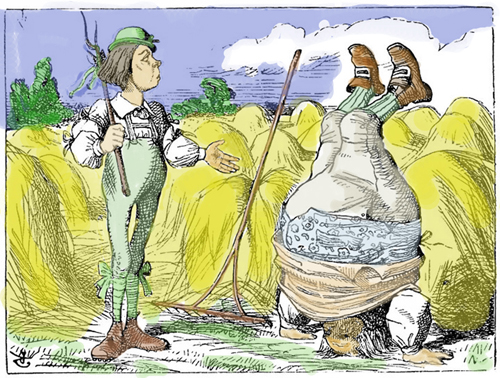
The illustration is one of Tenniel’s for Lewis Carroll’s “You are old, Father William“. And, yes, I still do headstands.
Richard Meyer, ‘Sapiens’

By evolution born and bred
with something extra in the head
(and maybe also in the heart)
that sets us markedly apart

from all the teeming life on Earth,
we sapiens, for what it’s worth,
create and feel and comprehend,
but to what purpose, to what end?

Wisely foolish, cruelly kind,
with jumbled passions, muddled mind,
we’re oxymorons through and through.
In what we do or fail to do

a pestilential gifted ape
with a history we can’t escape.
Our future tenuous and stark,
we stumble onward in the dark.

*****

Richard Meyer writes: “I’ve always been amused that our species defines itself as Homo sapiens, meaning “wise man” or “wise human.” The history of humanity contains much that is wonderful, beautiful, and commendable, but it also records much that is horrible, dreadful, and appalling. The verdict as to which tendency will prevail remains uncertain. It’s difficult to be optimistic when the Doomsday Clock was recently set at 85 seconds to midnight. In addition, the political situation in the United States is grim. So, we stumble onward.”

‘Sapiens’ was originally published in the Alabama Literary Review (2023, Vol. 32)

Richard Meyer, a former English and humanities teacher, lives in Mankato, MN. His book of poems Orbital Paths was a silver medalist winner in the 2016 IBPA Benjamin Franklin Awards. He was awarded the 2012 Robert Frost Farm Prize for his poem “Fieldstone.” His poetry has appeared in a variety of print and online journals and has also received top honors several times in the Great River Shakespeare Festival sonnet contest. He is also the author of Wise Heart, a memoir of his mother Gert who was born in poverty, came of age during the Great Depression, enlisted in the army during World War II, served overseas, achieved the rank of first sergeant, and was awarded the Bronze Star for meritorious service performed during the Battle of the Bulge. Richard’s most recent book is Stumbling Onward, a collection of new and selected poems. His books are available on Amazon. 

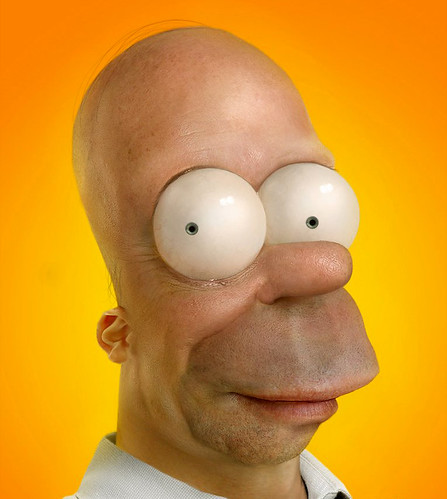
Photo: “Homer Sapiens” by Brett Jordan is licensed under CC BY 2.0.

Quatrains: Fergus Cullen, ‘Wisdom of Working Men’

“One thing you must accept,”
Said the butcher—”and I don’t intend this meanly:
To live is to get divided up
And to live well is to divide up cleanly.”

“One thought that made sense of things,”
Said the baker—“perhaps even solved life’s riddle:
To live is to harden in the heat
And to live well is to stay soft in the middle.”

“One principle strikes me as ultimate,”
Said the candlestick-maker—“if not downright holy:
To live is to burn down
And to live well is to burn down slowly.”

*****

Fergus Cullen writes: “These stanzas are about that state in which work comes to occupy one’s mind so utterly that one begins to see the rest of life through it. They do not make any statement on the subject: we just hear from some personalities living in this condition.I wanted contrast. On the one hand, the form is so light as to be barely there (speech rhythms in long lines, stanzas only pulled together by trite rhymes); and the characters originate in the world of nursery rhyme. On the other, these characters take on the biggest subject; and what they say may sound rueful, even bitter. It was certainly written that way; though, returning to it after some time, I see that it need not be read that way. This is one of two versions of the poem and was published in The Borough. I hope the other, rather different, shall appear soonish.”

Fergus Cullen is a postgraduate researcher in history at Queen Mary, University of London, and an occasional writer and translator of prose and verse.

https://x.com/FairGoose
https://ferguscullen.blogspot.com/p/about.html

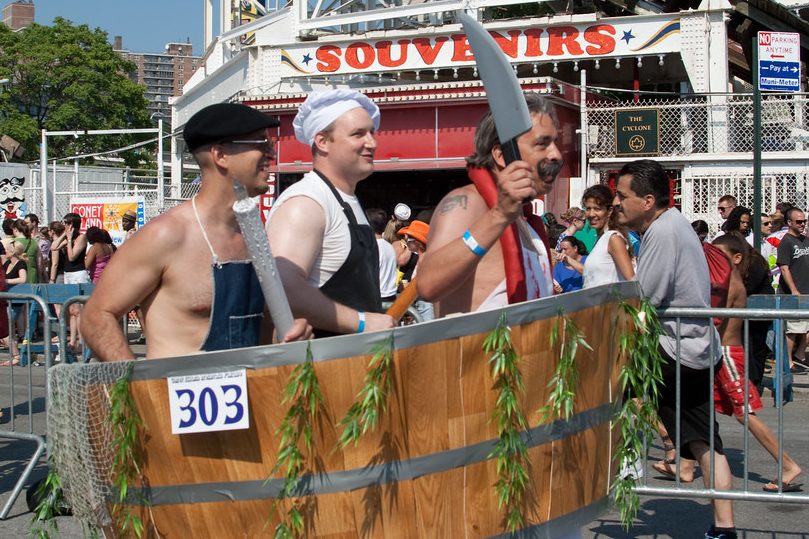
Photo: “Rub-a-dub-dub Three Men in a Tub” by DJOtaku is licensed under CC BY-NC-SA 2.0.

Non-traditional sonnet: RHL, ‘The Range of Change’

In times of no change, the advantage lies
with those who are receptive to being taught.
Parents and teachers may seem truly wise,
avoiding dangers with which life is fraught;
the stories of the old none would despise
when they hold all the answers that are sought.

In times of constant change, advantage shifts
to those who, hating school, go and explore.
Old answers fail. Fresh questions cause great rifts
with parents who are seen as wise no more;
questions now turn up unexpected gifts
in crossing unknown seas to virgin shores.

Remain alert that there’s a range of change
from none, to gradual, to fast, to strange.

*****

A sonnet, or not? 14 lines of iambic pentameter, rhyming regularly and with a final couplet. Though not in either of the standard English forms, it has the organised, compressed, reflective sense of the sonnet. Recently published in Shot Glass Journal, Online Journal of Short Poetry. Thanks, Mary-Jane Grandinetti!

Climate change icon” by Tommaso.sansone91 is marked with CC0 1.0.

Epigram: ‘Many Why’s’

Many “Why?”s
Make one wise.

*****

This epigram was recently published in The Asses of Parnassus. Thanks, Brooke Clark, for hosting “lots of poems for people with short attention spans.”

Photo: “WHY?” by annnna_ is licensed under CC BY-ND 2.0.